

New Daily Persistent Headache


New daily persistent headache: why it never seems to stop
New daily persistent headache, or NDPH, is a headache that starts on a specific day and then does not let up. Most people with NDPH can name the exact date it began.¹ The pain becomes daily and constant within 24 hours of that first headache, and it stays that way for at least three months.¹ It is rare and often confusing to live with, but it is a real, recognized headache disorder, and there are ways to manage it.
Key takeaways
- NDPH starts suddenly, on a day you can usually remember, and becomes constant within 24 hours.
- It affects about 0.03% to 0.1% of people, and it is more common in children and teens than adults.²
- About half of people with NDPH have migraine-like features such as light sensitivity or nausea. The other half have pain more like tension-type headache.³
- There is no single proven treatment, but many people improve with a plan built around migraine or tension-type headache care.
- A self-limiting form often eases on its own within months. A second, more stubborn form can last years and needs ongoing specialist care.⁴
What is new daily persistent headache?
NDPH is a primary headache disorder, which means it is not caused by another illness.³ The pain itself does not have one set pattern. It can feel like migraine, with throbbing pain, light sensitivity, or nausea. It can feel like tension-type headache, with a dull, pressing ache on both sides of the head. Some people have a mix of both.¹
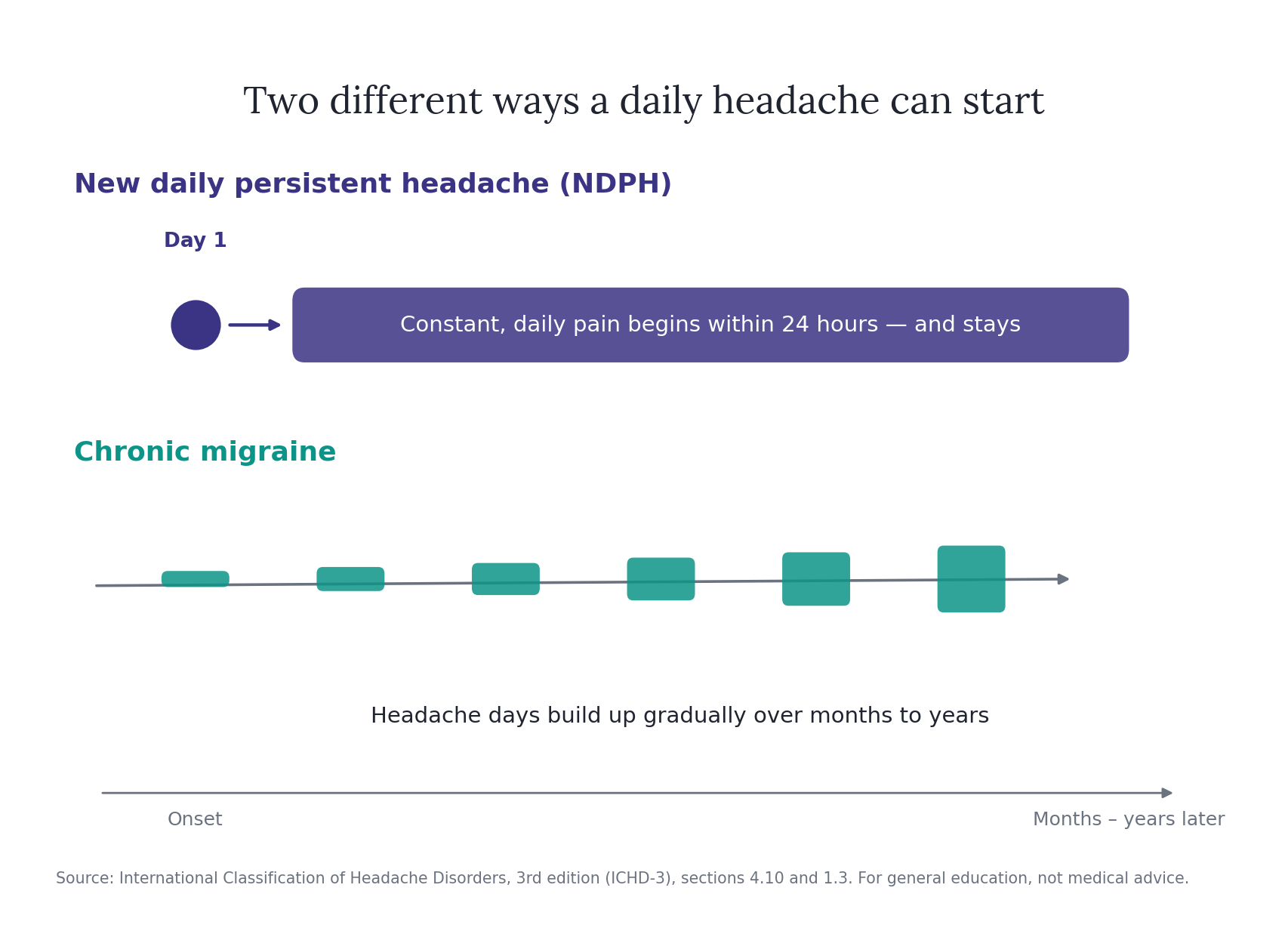
What sets NDPH apart is the way it starts. Most other chronic headache patterns build up slowly, with headaches becoming more frequent over months or years. NDPH does the opposite. The headache shows up, often without warning, and is daily and unremitting almost from day one.⁵ Many people remember exactly what they were doing when it started, even if it was something as ordinary as watching television or reading.
NDPH can affect anyone, from childhood into someone's seventies, though it most often begins around age 35.³ It is two to three times more common in women than men, a smaller gap than seen in migraine.³
How is NDPH diagnosed?
A provider diagnoses NDPH using criteria from the International Classification of Headache Disorders, 3rd edition (ICHD-3), the reference guide headache specialists use worldwide.¹ To meet the criteria, your headache needs to:
- Have a clear, clearly remembered starting point.
- Become continuous and constant within 24 hours of that start.
- Last for more than 3 months.
- Not be better explained by another headache disorder or a different medical condition.¹
There is also a "probable NDPH" diagnosis for headaches that fit this pattern but have lasted less than 3 months so far.¹
Before settling on NDPH, your doctor needs to rule out other causes of a sudden, ongoing headache. This usually means blood work. It often means brain imaging too, like an MRI, to check for infection or changes in brain fluid pressure.⁶ This step matters. A few rare but serious conditions can also cause a headache that starts suddenly and does not stop. These include a cerebrospinal fluid leak or a clot in one of the brain's veins.⁶ If your headache came on like a thunderclap, reaching full intensity in seconds to minutes, tell your doctor right away. That pattern needs urgent care.
Your doctor will also check that you are not dealing with medication overuse headache instead, which is a constant headache caused by using pain medicine too often.⁷ If your daily headache pattern started before you were using extra medication, both NDPH and medication overuse headache can be diagnosed at the same time.¹
What causes NDPH?
The honest answer is that doctors do not fully know. NDPH does not have one identified cause, and researchers increasingly think it may be a syndrome with several different triggers rather than a single disease.⁸ Some patterns researchers have noticed:
- About 30% of people recall a cold, flu, or other infection-like illness right before their headache started. Epstein-Barr virus and, more recently, COVID-19 have both been linked to NDPH onset.³
- About 10% recall a stressful life event just before onset.³
- A smaller group develops NDPH after a minor head injury or a surgery.
- Close to half of people with NDPH have a family member with frequent headaches, suggesting some people may have a genetic tendency toward headache disorders.³
- At least half of people cannot identify any trigger at all.³
Researchers have also looked at inflammation in the brain and spinal fluid as a possible piece of the puzzle, and at problems in the upper neck that may feed into headache pathways.⁹ None of this points to one clear mechanism yet. What it does suggest is that NDPH in one person may not work the same way as NDPH in another, which is part of why treatment can take some trial and error.
How long does NDPH last?
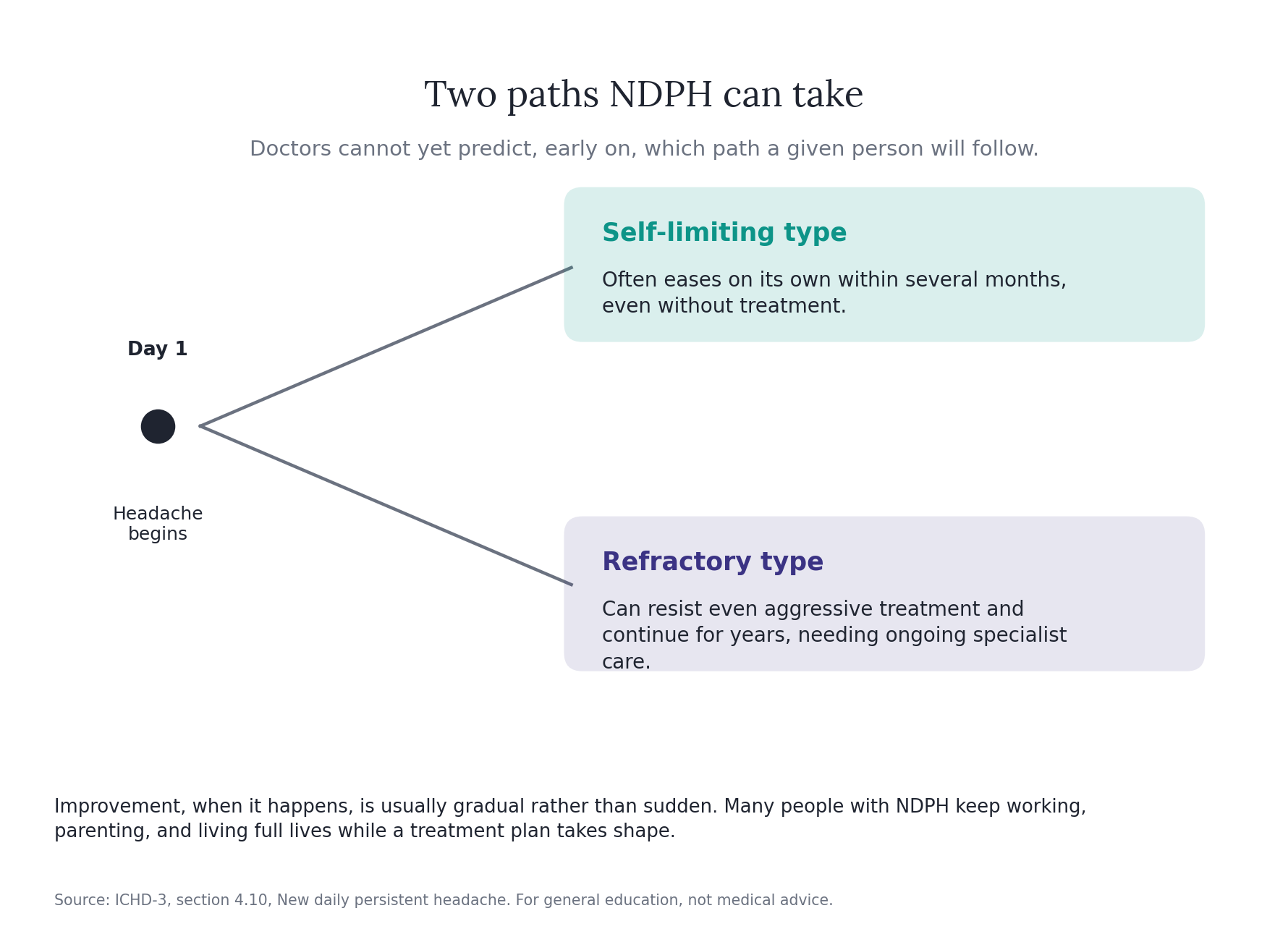
NDPH tends to follow one of two paths. A self-limiting type often fades on its own within several months, even without treatment.⁴ A more stubborn, refractory type can resist even aggressive treatment and continue for years.⁴ Doctors cannot yet predict, early on, which path a given person's headache will take. Improvement, when it happens, is usually gradual rather than sudden.⁵
This uncertainty is one of the hardest parts of NDPH. You are not given a clear timeline, and that can wear on you. Many people with NDPH are still able to work, parent, and build a full life while they manage the daily pain. Treatment is about lowering the pain and its grip on your days, even before it fully resolves.
How is NDPH treated?
There is no single approved treatment built specifically for NDPH. Instead, doctors generally treat it like the headache disorder it most resembles, usually chronic migraine or chronic tension-type headache.⁶ That means your specialist will look closely at your symptoms and history, then borrow from the deep, well-studied toolkit for those conditions.
A word of caution on acute, as-needed medicines: using them too often can cause a second problem, medication overuse headache, layered on top of NDPH.⁶ Your specialist will likely ask you to limit how many days a week you reach for pain relievers, even on hard days. Haven's clinicians do not prescribe opioids or barbiturate-based medicines for this reason, and instead build a plan around safer, evidence-based options.
CGRP medicines deserve a closer look, since they are some of the newest tools available. They work by blocking a protein, CGRP, that plays a part in setting off migraine pain. Learn more about how CGRP medicines work for migraine.
Is NDPH the same as chronic migraine?
No, though the two can look alike. Chronic migraine builds up slowly. You typically have a history of migraine that grows more frequent over time. Eventually it reaches 15 or more headache days a month.¹¹ NDPH works differently. It starts suddenly and is daily almost from day one, often in someone with little or no earlier headache history.¹ If your doctor cannot pin down a clear, sudden starting point, chronic migraine becomes the more accurate diagnosis instead.¹¹
That said, many people with NDPH do have migraine-like symptoms layered on top, including light sensitivity, sound sensitivity, and nausea.³ This is part of why NDPH can take time, and a careful history, to diagnose correctly.
When should you see a doctor?
See a doctor promptly if you develop a new, constant headache, especially if:
- It does not improve with over-the-counter medicine, or keeps getting worse.
- It is on one side only, or feels like throbbing or pounding pain.
- You also have fever, vision changes, weakness, trouble speaking, or confusion.
- It came on like a thunderclap, reaching its worst point within seconds to minutes.
Any of those signs call for prompt medical evaluation to rule out a more urgent cause. If your evaluation comes back clear and your headache fits the NDPH pattern, a headache specialist can help you build a plan from there. Find out what kind of doctor treats persistent headaches.
Frequently asked questions
Can new daily persistent headache go away on its own?
Yes, for some people. The self-limiting type of NDPH often eases within several months without treatment.⁴ Other people have a more treatment-resistant type that lasts much longer and needs active management.
Is NDPH dangerous?
NDPH itself is a primary headache disorder, not a sign of a dangerous underlying problem.³ That said, a sudden, constant headache always needs a medical workup first, since a small number of serious conditions can look similar at the start.
What triggers NDPH?
Many people cannot identify a trigger at all.³ When a trigger is identified, it is often a recent infection, a stressful event, or sometimes a minor head injury or surgery.
Can children get NDPH?
Yes. NDPH is actually more common in children and teens than in adults.² A pediatric headache specialist can help confirm the diagnosis and guide treatment.
Will pain relievers fix NDPH?
Over-the-counter or prescription pain relievers used too often can make things worse by causing medication overuse headache on top of NDPH.⁶ Most effective NDPH care relies on preventive treatment, not daily rescue medicine.
How is NDPH different from a migraine that just won't quit?
Migraine attacks usually come and go, even when frequent. NDPH is unremitting from a specific, rememberable starting day.¹ Learn more about how long a typical migraine attack lasts.
You do not have to face this alone
A headache that never stops can wear down even the most resilient person. NDPH is rare, often misunderstood, and slow to diagnose, but it is a real, recognized condition, and your pain is real too. Many people with NDPH find a combination of treatments that brings real relief, even if it takes some patience to get there.
If you have a headache that started on a specific day and has not let up since, a headache specialist can help confirm what you are dealing with and build a plan suited to your symptoms. Schedule a visit with Haven Headache & Migraine Center to take the next step.
Medically reviewed by: Karissa Secora, DMSc, PA-C, AQH, Haven Headache & Migraine Center and peer-reviewed by Alicia Chang, MSN, APRN, FNP-BC, FNP-C, CEN, PHN
References
- International Headache Society. 4.10 New daily persistent headache (NDPH). ICHD-3. https://ichd-3.org/other-primary-headache-disorders/4-10-new-daily-persistent-headache-ndph/
- Cleveland Clinic. New Daily Persistent Headache (NDPH). 2022. https://my.clevelandclinic.org/health/diseases/24098-new-daily-persistent-headache-ndph
- American Migraine Foundation. Daily Persistent Headache. 2022. https://americanmigrainefoundation.org/resource-library/new-daily-persistent-headache-2/
- International Headache Society. 4.10 New daily persistent headache (NDPH), subtypes. ICHD-3. https://ichd-3.org/other-primary-headache-disorders/4-10-new-daily-persistent-headache-ndph/
- Rozen TD. New Daily Persistent Headache. Practical Neurology. 2022. https://practicalneurology.com/diseases-diagnoses/headache-pain/new-daily-persistent-headache/31897/
- American Migraine Foundation. New Daily Persistent Headache. https://americanmigrainefoundation.org/live-copy/resource-library/new-daily-persistent-headache/
- Haven Headache & Migraine Center. Breaking the Migraine Cycle: Medication Overuse Headache. 2025. https://www.havenheadache.com/post/breaking-the-migraine-cycle-dr-nada-hindiyeh-featured-in-new-educational-video-on-medication-overuse-headache
- Peng KP, Rozen TD. Update in the understanding of new daily persistent headache. Cephalalgia. 2023;43(2). https://journals.sagepub.com/doi/full/10.1177/03331024221146314
- Sadeghpour M, et al. New Daily Persistent Headache (NDPH): Unraveling the Complexities of Diagnosis, Pathophysiology, and Treatment. Curr Pain Headache Rep. 2023;27(10):551-559. https://link.springer.com/article/10.1007/s11916-023-01161-y
- Case report on CGRP monoclonal antibody treatment for a daily, unremitting headache with migraine-like features. Cureus. 2025. https://pmc.ncbi.nlm.nih.gov/articles/PMC12178447/
- International Headache Society. 1.3 Chronic migraine. ICHD-3. https://ichd-3.org/1-migraine/1-3-chronic-migraine/
This article is for general education and is not medical advice. It is not a substitute for care from a qualified health professional. Always talk with your clinician before starting, stopping, or changing any treatment. If you have a sudden, severe headache, the worst headache of your life, or a headache with new symptoms like weakness, trouble speaking, or vision loss, seek emergency care right away.