

Trigeminal Neuralgia: Causes, Symptoms & Treatment

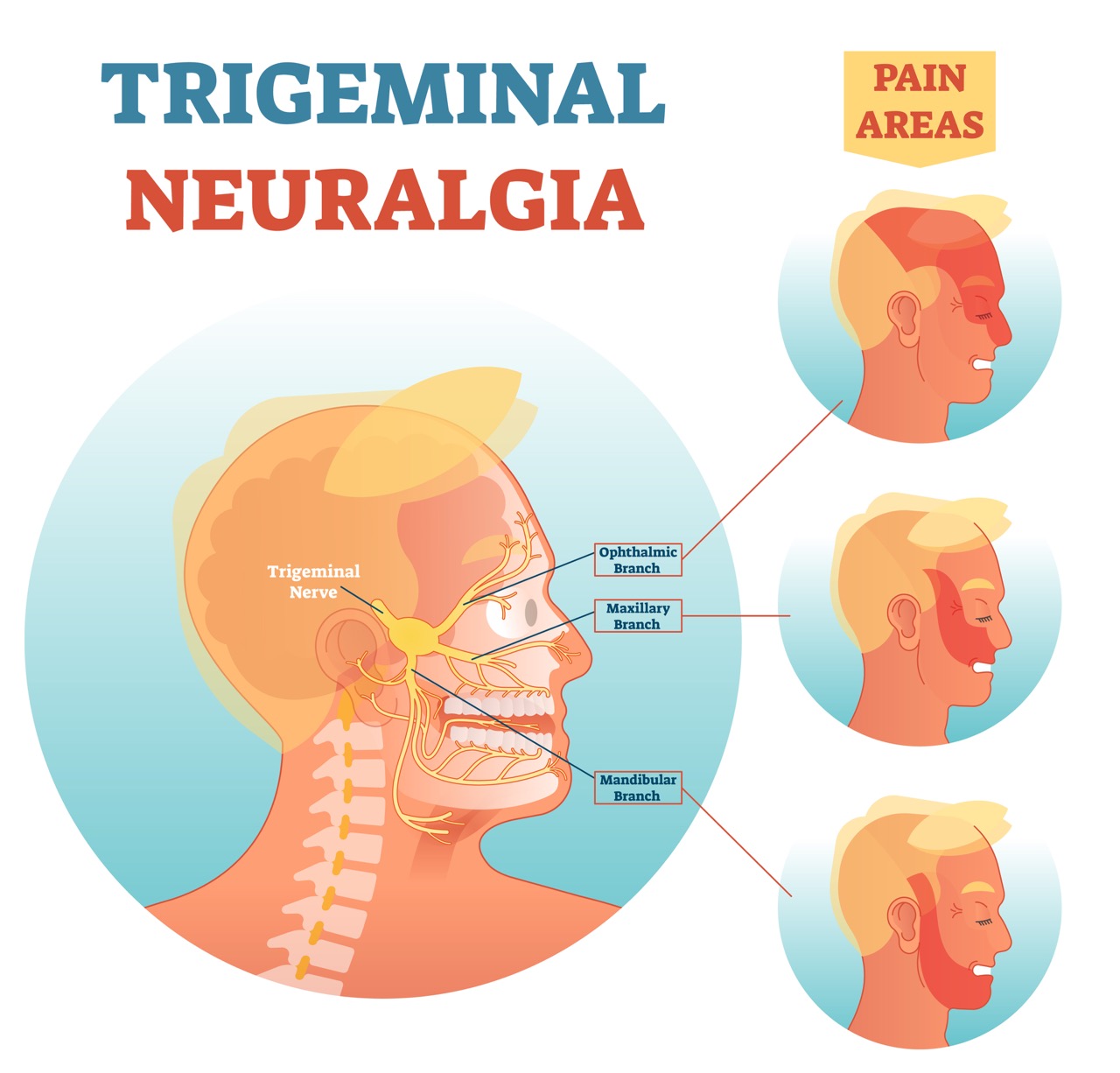
Trigeminal neuralgia: Symptoms, Causes, and Treatment
Trigeminal neuralgia is a nerve condition that causes sudden, electric shock-like pain in the face. The pain comes in short bursts, often set off by something as light as a touch, a breeze, or brushing your teeth. It is rare, but it is a real, treatable condition. It is not the same as migraine or a typical headache.
If you are having attacks like this, you deserve a clear answer and a path forward. This article explores the characteristics of trigeminal neuralgia, what causes it, and what can help you feel better.
Key takeaways
- Trigeminal neuralgia causes brief, severe, shock-like facial pain on one side of the face, usually lasting under two minutes per attack.¹
- It affects about 4 to 13 people per 100,000 each year, and it is roughly twice as common in women as in men.²
- Most cases come from a blood vessel pressing on the trigeminal nerve near the brainstem, which wears away the nerve's protective coating.²
- Light touch to the face, talking, chewing, or brushing teeth can trigger an attack — a pattern that is nearly unique to this condition.²
- Carbamazepine is the best-studied first treatment and helps most people get control of their pain.²
- For people whose pain does not respond to medicine, surgery to relieve pressure on the nerve has a strong long-term success rate.³
What is trigeminal neuralgia?
Trigeminal neuralgia is a chronic pain condition. It affects the trigeminal nerve — the nerve that carries feeling from your face to your brain. The trigeminal nerve has three branches, covering your forehead, your cheek, and your jaw. Trigeminal neuralgia almost always affects only one of these branches, usually in the cheek or the jaw. It almost always affects just one side of the face.³
The pain is distinctive. People describe it as an electric shock, a stabbing jolt, or a sudden burning zap. Each attack is brief, lasting anywhere from a fraction of a second to about two minutes. Attacks may happen once per day or more than 50 times per day.³ Between attacks, most people feel completely normal, though some have a milder, constant ache in the background.
What causes trigeminal neuralgia?
In most cases, a blood vessel — usually a small artery near the brainstem — presses against the trigeminal nerve. Over time, that pressure wears away myelin, the fatty coating that insulates nerve fibers. Without it, the nerve can misfire — sending pain signals from a light touch as if it were a big injury.²
Clinicians sort trigeminal neuralgia into three types based on the cause:
- Classical trigeminal neuralgia. Caused by a blood vessel pressing on the nerve, confirmed on MRI or during surgery.⁴
- Secondary trigeminal neuralgia. Caused by another condition that damages the nerve — most often multiple sclerosis, but also tumors or other structural problems. This accounts for roughly 15 percent of cases.⁵
- Idiopathic trigeminal neuralgia. No clear cause is found on imaging or testing, even though the pain pattern is the same.⁶
Trigeminal neuralgia is also linked to multiple sclerosis. About 2 to 5 percent of people with MS develop it — far higher than in the general population. MS causes its own damage to the nerve's protective coating along its path through the brainstem. When trigeminal neuralgia shows up in someone under 50, clinicians will often check for MS as a cause.⁷
What does a trigeminal neuralgia attack feel like?
Attacks share a few telltale features:
- One-sided. Pain almost always stays on one side of the face. The right side is affected somewhat more often than the left.²
- Electric and brief. Each jolt is sharp, shock-like, and over within seconds to about two minutes.¹
- Triggered by light touch. Many people have a specific trigger zone — often near the nose or mouth — where the gentlest touch sets off an attack.²
- Set off by daily activities. Brushing teeth, shaving, eating, talking, putting on makeup, or even a gust of wind can trigger pain.²
- Comes and goes in cycles. Periods of frequent attacks often give way to weeks, months, or even years of remission.³
Because trigger zones often sit near the teeth or jaw, many people first see a dentist — believing they have a dental problem — before getting the right diagnosis.
How is trigeminal neuralgia different from migraine or cluster headache?
All three conditions can cause severe, one-sided face or head pain. The differences matter, since the treatments are not interchangeable.
If touching your face sets off the pain, that points strongly toward trigeminal neuralgia rather than migraine or cluster headache. If you are unsure which pattern fits you, that is exactly the kind of question a headache specialist can help sort out.
How is trigeminal neuralgia diagnosed?
There is no blood test for trigeminal neuralgia. Diagnosis rests mainly on your history and how the pain acts.¹ A clinician will ask in detail about where the pain happens, how long each jolt lasts, and what sets it off.
Most people get an MRI — mainly to look for a structural cause like a tumor or multiple sclerosis, and to see the blood vessel near the nerve.³ Even when imaging looks normal, the diagnosis can still be made from the pattern of the pain alone.
How is trigeminal neuralgia treated?
Most people start with medicine. A smaller group will eventually undergo a procedure.
Medicines
- Carbamazepine. The best-studied option and the first choice for most people. Strong evidence supports its ability to control pain.²
- Oxcarbazepine. A close relative of carbamazepine, it is sometimes better tolerated. Often used as an alternative first choice.²
- Lamotrigine and baclofen. Second-line options, usually added on or tried when the first medicines do not fully work.²
These medicines work differently from typical pain relievers. NSAIDs and acetaminophen generally do not help trigeminal neuralgia — the pain comes from misfiring nerve signals rather than inflammation.
Procedures, for pain that does not respond to medicine
When medicine stops working or causes side effects that are hard to live with, a few procedures can help:
- Microvascular decompression. A surgeon places a small cushion between the nerve and the blood vessel pressing on it. This is the only procedure that addresses the underlying cause, and it has the strongest long-term results. Studies of over 5,000 patients show that most people are pain-free for years after surgery, and the chance of pain coming back stays low over time.³
- Percutaneous procedures (radiofrequency, glycerol injection, balloon compression). Less invasive options that create a controlled injury to calm the overactive nerve. These tend to carry a higher chance of facial numbness afterward and may need to be repeated.³
- Stereotactic radiosurgery (Gamma Knife). A non-invasive option that focuses radiation precisely on the nerve. Relief can take weeks to develop, since it works gradually rather than right away.³
If need, a specialized surgeon will weigh your age, overall health, and how well you have done on medicine when discussing whether a procedure makes sense for you. Microvascular decompression generally offers the longest pain-free stretch. Less invasive procedures can be a reasonable choice for people who are not good candidates for a bigger operation.¹⁴
When should you see a specialist for facial pain?
See a headache or facial pain specialist if:
- You are having sudden, electric, one-sided face pain — especially if light touch sets it off
- Pain is interfering with eating, talking, or daily hygiene because you are trying not to trigger it
- A medicine that used to work is wearing off, or side effects are becoming hard to manage
- You are under 50 and developing this kind of facial pain for the first time — this can be an early sign of multiple sclerosis and deserves prompt evaluation⁷
Trigeminal neuralgia can be exhausting to live with. Getting the right diagnosis early opens the door to treatments that can help you regain control over your pain.
At Haven Headache & Migraine Center, our specialists evaluate facial pain conditions including trigeminal neuralgia, alongside migraine and other headache disorders. Virtual-first visits can start in days, not months. Book a virtual consultation with Haven.
Frequently asked questions
What does trigeminal neuralgia feel like?
It feels like a sudden electric shock or stabbing jolt on one side of the face, usually lasting from a fraction of a second to about two minutes. Attacks can repeat many times in a row and are often set off by light touch, talking, or chewing.¹
What triggers trigeminal neuralgia attacks?
Light touch to a specific spot on the face — often near the nose or mouth — is the most common trigger. Brushing teeth, shaving, eating, talking, and cold wind can also set off an attack.²
How is trigeminal neuralgia different from a migraine attack?
Trigeminal neuralgia causes brief, electric, shock-like jolts triggered by touch. Migraine causes longer, throbbing pain often paired with nausea and light sensitivity.
Is trigeminal neuralgia linked to multiple sclerosis?
Yes, it can be. About 2 to 5 percent of people with MS develop trigeminal neuralgia — a much higher rate than in the general population. It sometimes appears before MS is diagnosed.⁷ This is why clinicians often order an MRI, especially in younger patients.
What is the first treatment tried for trigeminal neuralgia?
Carbamazepine is usually the first medicine tried, with strong evidence supporting its ability to control pain. Oxcarbazepine is a common alternative with somewhat better tolerability.²
Does surgery cure trigeminal neuralgia?
Surgery cannot promise a permanent cure, but microvascular decompression offers the best long-term results of any surgical treatment. Studies of over 5,000 patients show that most people are pain-free for years after surgery, and the chance of pain coming back stays low over time.³
Medically reviewed by: Samantha Clem, PA-C, Haven Headache & Migraine Center
Peer reviewed by: Karly Kozlowski PA-C, BHS, MPA, Haven Headache & Migraine Center
References
- Headache Classification Committee of the International Headache Society. ICHD-3: 13.1.1 Trigeminal neuralgia. https://ichd-3.org/13-painful-cranial-neuropathies-and-other-facial-pains/13-1-trigeminal-neuralgia/13-1-1-classical-trigeminal-neuralgia/
- Shankar Kikkeri N, Nagalli S. Trigeminal Neuralgia. StatPearls. NCBI Bookshelf. Updated March 3, 2024. https://www.ncbi.nlm.nih.gov/books/NBK554486/
- Lambru G, Zakrzewska J, Matharu M. Trigeminal neuralgia: a practical guide. Pract Neurol. 2021;21(5):392–402. https://pn.bmj.com/content/practneurol/21/5/392.full.pdf
- Headache Classification Committee of the International Headache Society. ICHD-3: 13.1.1.1 Classical trigeminal neuralgia. https://ichd-3.org/13-painful-cranial-neuropathies-and-other-facial-pains/13-1-trigeminal-neuralgia/13-1-1-classical-trigeminal-neuralgia/13-1-1-1-classical-trigeminal-neuralgia-purely-paroxysmal/
- Headache Classification Committee of the International Headache Society. ICHD-3: 13.1.1.2 Secondary trigeminal neuralgia. https://ichd-3.org/13-painful-cranial-neuropathies-and-other-facial-pains/13-1-trigeminal-neuralgia/13-1-1-classical-trigeminal-neuralgia/13-1-1-2-classical-trigeminal-neuralgia-with-concomitant-persistent-facial-pain/
- Headache Classification Committee of the International Headache Society. ICHD-3: 13.1.1.3 Idiopathic trigeminal neuralgia. https://ichd-3.org/13-painful-cranial-neuropathies-and-other-facial-pains/13-1-trigeminal-neuralgia/13-1-1-classical-trigeminal-neuralgia/13-1-1-3-idiopathic-trigeminal-neuralgia/
- Di Stefano G, Maarbjerg S, Truini A. Trigeminal neuralgia secondary to multiple sclerosis: from the clinical picture to the treatment options. J Headache Pain. 2019;20:20. https://link.springer.com/article/10.1186/s10194-019-0969-0
- Headache Classification Committee of the International Headache Society. ICHD-3: Migraine. https://ichd-3.org/1-migraine/
- Bahra A, May A, Goadsby PJ. Cluster headache: a prospective clinical study with diagnostic implications. Neurology. 2002;58(3):354–361. https://www.neurology.org/doi/10.1212/WNL.58.3.354
- Kandel SA, Mandiga P. Cluster Headache. StatPearls. NCBI Bookshelf. Updated July 4, 2023. https://www.ncbi.nlm.nih.gov/books/NBK544241/
- Headache Classification Committee of the International Headache Society. ICHD-3: Cluster headache. https://ichd-3.org/3-trigeminal-autonomic-cephalalgias-tac/3-1-cluster-headache/
- Sebastianelli G, Atalar AÇ, Cetta I, et al. Insights from triggers and prodromal symptoms on how migraine attacks start: The threshold hypothesis. Cephalalgia. 2024;44(10):03331024241287224. https://journals.sagepub.com/doi/10.1177/03331024241287224
- Togha M, Jafari E, Moosavian A, et al. Cranial autonomic symptoms in episodic and chronic migraine: a cross sectional study in Iran. BMC Neurol. 2021;21:493. https://link.springer.com/article/10.1186/s12883-021-02513-0
- Snel BJ, Cohen SP, Erdine S, et al. Treatment algorithm for trigeminal neuralgia. Pain Pract. 2025;25(5):e70051. https://pmc.ncbi.nlm.nih.gov/articles/PMC12086744/pdf/PAPR-25-0.pdf
This article is for general education and is not medical advice. It is not a substitute for care from a qualified health professional. Always talk with your clinician before starting, stopping, or changing any treatment. If you have a sudden, severe headache, the worst headache of your life, or a headache with new symptoms like weakness, trouble speaking, or vision loss, seek emergency care right away.