

Storms and Migraine: Rain, Humidity Triggers

.jpeg)
If a migraine attack rolls in with the clouds, you are not imagining it. A storm brings several changes at once. Humidity climbs. Pressure drops. Sometimes lightning flashes across the sky. For many people with migraine, that mix is enough to set off an attack.
Here is what the research shows about rain, humidity, and storms. You will also find steps to try the next time a storm rolls in.
Key takeaways
- Weather change is one of the most commonly reported migraine triggers. Some research says 30 to 50% of people with migraine name it as a factor.¹
- A large 2025 study looked at temperature and pressure changes. Both were linked to migraine attacks. Humidity alone showed a weaker link.²
- A large 2023 study used a smartphone headache diary and AI. It found that higher humidity, lower pressure, and rainfall were all tied to more headache days.³
- Lightning itself, apart from the rest of the storm, has been linked to a higher chance of headache and migraine.⁴
- Rain rarely acts alone. Humidity, pressure, mold, pollen, and sometimes lightning tend to arrive together. This is likely why storms feel like such a strong trigger.
- You cannot control the forecast. But you can lower your overall threshold on storm days. Then it takes more to set off an attack.
Do rainstorms really trigger migraine attacks?
For many people with migraine, yes. But the science is more nuanced than "rain causes migraine." Weather change as a whole is one of the most reported migraine triggers. Some research puts the number as high as half of all people with migraine.¹
A 2025 review pooled data across 31 studies. It found that both temperature change and pressure shifts were linked to migraine attacks. Humidity, on its own, showed a weaker link. That link did not reach statistical significance across the pooled studies.² This does not mean humidity is irrelevant. It means humidity rarely works alone. A storm brings humidity, pressure change, temperature swings, and sometimes lightning, all at once. It is likely this whole mix, not humidity by itself, that many people react to.
What is it about rain and humidity that affects migraine?
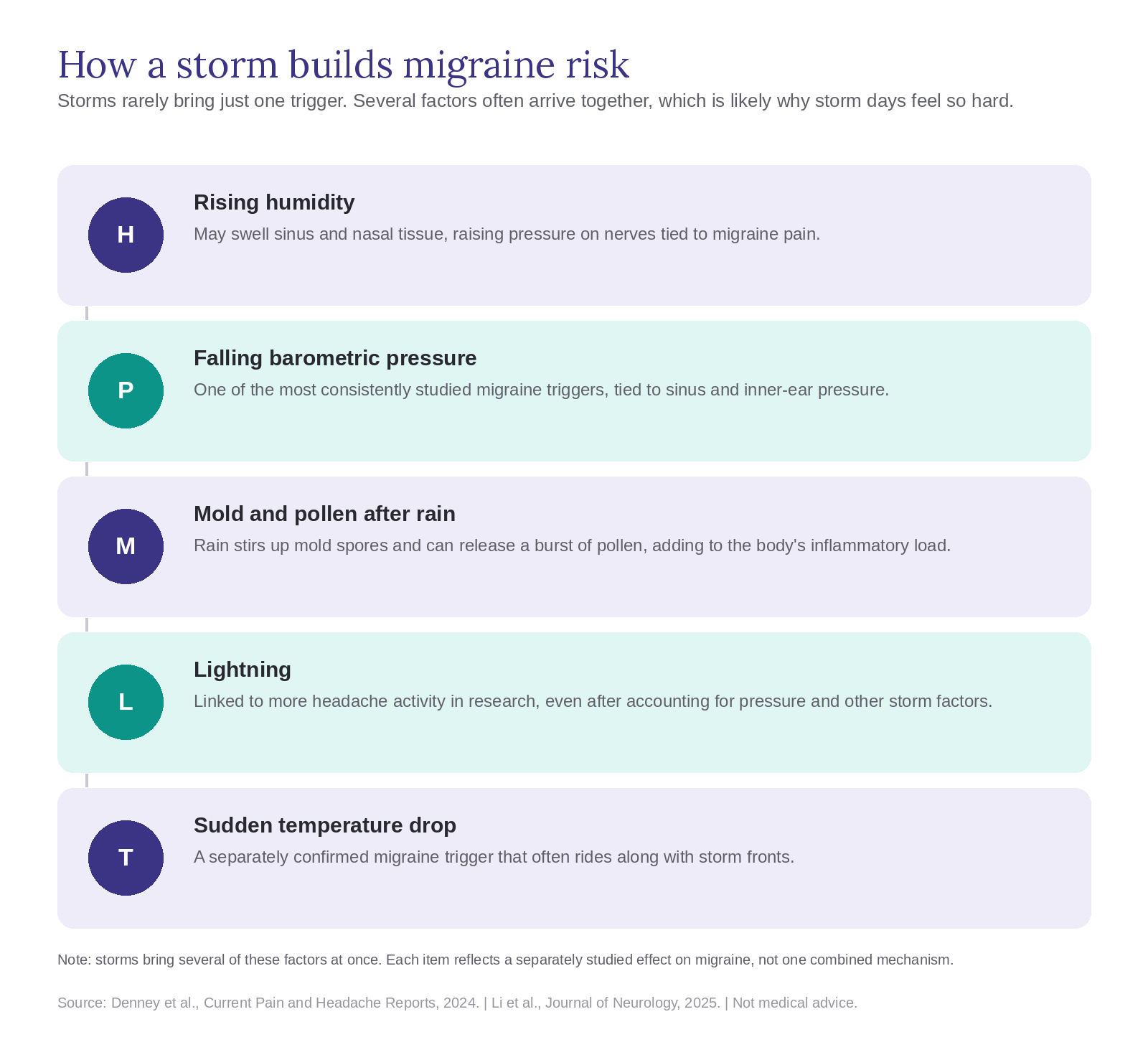
Humidity and sinus pressure. Your sinuses and nasal tissue react to changes in moisture in the air. High humidity can make this tissue swell a little. That raises pressure in a way that can feed into nerve pathways tied to migraine pain. A large 2023 study looked at data from over 4,000 people. It used a headache diary app paired with weather data and machine learning. Higher humidity, lower barometric pressure, and more rainfall were all tied to more headache days.³
Barometric pressure change. Rain rarely arrives without a pressure shift. Storm systems form around areas of low pressure. The pressure drop before a storm is one of the most studied migraine triggers. Haven covers this mechanism in our guide to barometric pressure and migraine, since it deserves its own explanation. The short version: falling pressure changes the pressure balance across your sinuses. It may affect your inner ear too. That shift can be enough to nudge a sensitive brain toward an attack.
Mold and pollen after rain. Rain does not just add moisture to the air. It also stirs up mold spores from wet ground and leaf litter. It can trigger a burst of pollen once the rain clears. For people with migraine and seasonal allergies, this adds to the body's inflammatory load. That can lower the threshold for an attack, on top of the pressure and humidity changes.
A brain already primed for change. Migraine is a disease of a nervous system that is more sensitive to change than most. A 2024 review of weather-migraine research put it plainly. No single weather factor reliably predicts attacks for everyone. But strong or combined weather changes have a bigger effect. And how much weather matters varies a lot from person to person.⁴
Does lightning make things worse?
It might, apart from the rest of the storm. A 2024 research review looked back at a study that tracked migraine diaries against real lightning-strike data. That study found more headaches on lightning days than on non-lightning days. Migraine frequency rose by 31% on lightning days. Researchers even adjusted for other storm factors, like pressure and wind. Lightning still showed its own added effect on headache risk.⁴
Researchers cannot say exactly why yet. Some possible reasons include electromagnetic waves from lightning, a rise in ozone from electrical activity, and fungal spores stirred up by storm downdrafts, which can act as allergens.⁴ None of these ideas are confirmed. But the research does show one clear thing. Lightning was tied to more headaches even when pressure and other storm factors were counted separately. That suggests lightning is not just riding along with the rest of the storm.
What is happening, at a glance
How can I protect myself during storm season?
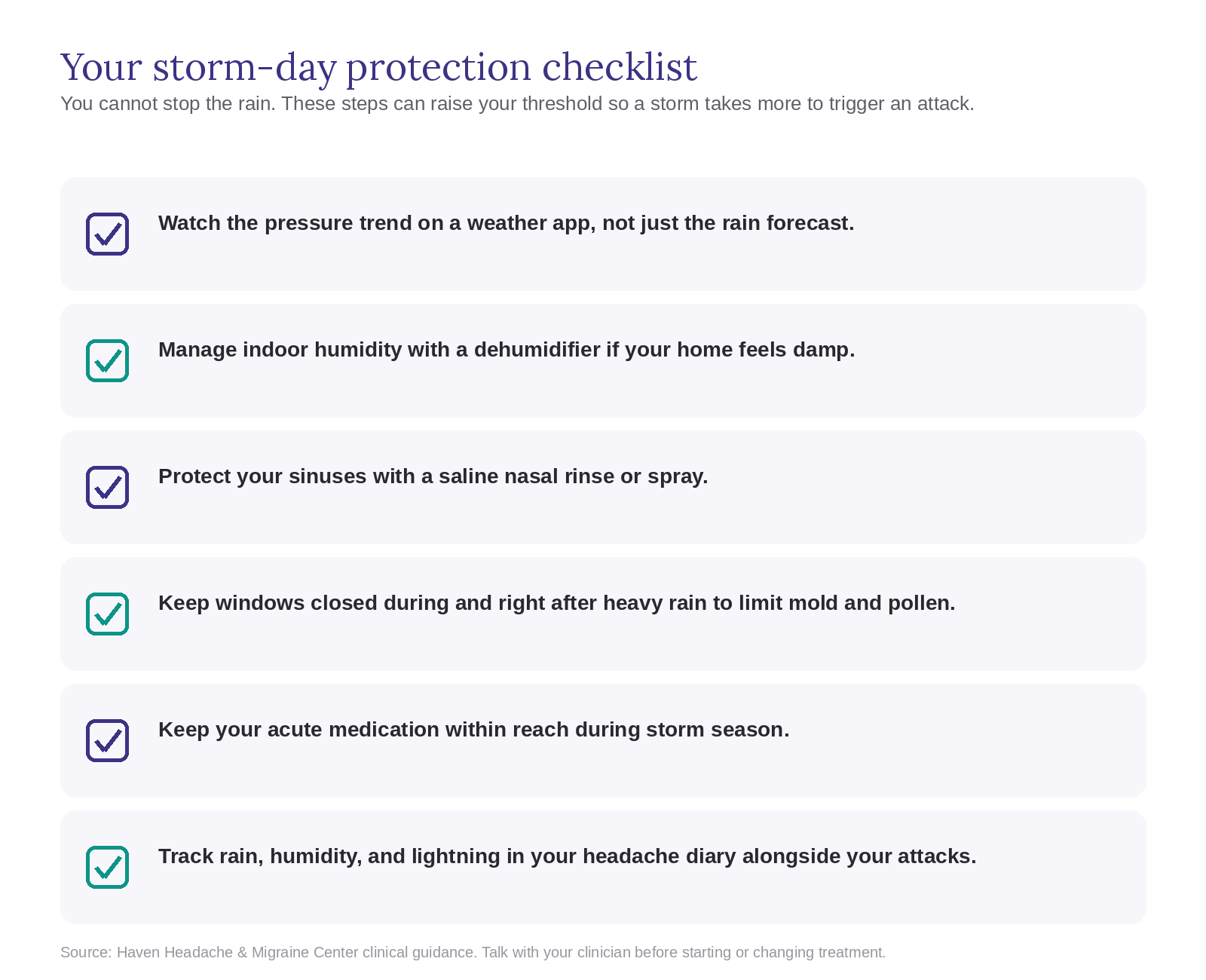
You cannot stop the rain. But you can lower your overall threshold. Then a storm takes more to tip you into an attack.
Watch the pressure trend, not just the forecast. Many weather apps show hourly barometric pressure next to the rain forecast. Watch for a steep drop in the hours before a storm arrives. This gives you useful advance notice. Some people feel the effects before the rain starts.
Manage indoor humidity. Does your home feel damp during rainy stretches? A dehumidifier in your bedroom or main living space can help. It keeps indoor humidity in a more comfortable range.
Protect your sinuses. A saline nasal rinse or spray can ease pressure and congestion. These build up as humidity rises. This is a small step. But it targets one of the more likely mechanisms directly.
Reduce mold and pollen exposure. Keep windows closed during and right after heavy rain. That is when mold spores and pollen are most likely to spike. Do you have known allergies? Staying on top of your allergy treatment during rainy stretches can help too.
Have your acute medication ready. Are storms a known trigger for you? Keep your acute treatment within reach during storm season. Use it early in an attack, rather than waiting to see if it passes.
Track the pattern. Log rainy days, humidity, and any thunderstorms in your headache diary. Note them alongside your attacks. Over a season or two, this can show you what matters most for you. It might be the rain itself, the humidity, the pressure drop, or the lightning. That knowledge changes what is worth managing first.
When should I see a headache specialist?
Does storm season reliably bring on attacks that disrupt your work, sleep, or daily life? That pattern is worth discussing with a headache specialist. A clinician can help you sort out which part of a storm is really driving your attacks. They can build a plan for high-risk weather days. They can also help you decide if you need a preventive treatment, one you take regularly to make attacks happen less often, and not just a plan for acute days.
At Haven Headache & Migraine Center, we take weather-related triggers seriously as part of your full migraine picture.
Book a virtual consultation with Haven
Frequently asked questions
Do rainstorms really trigger migraine attacks?
For many people, yes. Weather change is one of the most commonly reported migraine triggers. Pressure and temperature shifts during storms have a stronger, more consistent link to migraine than humidity alone. But storms usually combine several of these factors at once.
Is it the rain, the humidity, or the pressure drop that causes migraine?
It is likely a mix, and this differs from person to person. Falling barometric pressure has the most consistent research support. Humidity has a weaker link on its own. But it showed up as significant in at least one large 2023 study. A headache diary matched against a weather app can help you learn which factor matters most for you.
Can lightning trigger a migraine attack?
Research suggests it might. A study tracked migraine diaries against real lightning data. A 2024 research review looked back at this study. It found more headaches on lightning days, even after accounting for pressure and other storm factors. The exact reason is not confirmed. Possibilities include electromagnetic effects, more ozone, and mold spores stirred up by the storm.
Does mold from rain make migraine worse?
It can contribute. Rain stirs up mold spores and can trigger a burst of pollen once it clears. For people with migraine and seasonal allergies, this adds to the body's inflammatory load. That can lower the threshold for an attack on top of the storm's other effects.
Can I predict a migraine attack from the weather forecast?
Not with certainty. But tracking barometric pressure trends can give you useful advance notice. Some people feel the effects of a pressure drop before rain starts. A headache diary that includes weather notes can help you see your own pattern over time.
What can I do to prevent a storm-triggered migraine attack?
Keep your acute medication within reach. Manage indoor humidity with a dehumidifier if your home feels damp. Use a saline nasal spray for sinus pressure. Keep windows closed during and after heavy rain to limit mold and pollen.
Medically reviewed by: Stephanie Messina, MHS, PA-C, Haven Headache & Migraine Center
References
- Cleveland Clinic. How Weather Plays a Role with Migraines. Cleveland Clinic Newsroom. 2025. https://newsroom.clevelandclinic.org/2025/06/30/how-weather-plays-a-role-with-migraines
- Li S, Liu Q, Ma M, Fang J, He L. Association between weather conditions and migraine: a systematic review and meta-analysis. Journal of Neurology. 2025;272(5):346. PMID: 40246758. https://doi.org/10.1007/s00415-025-13078-0
- Katsuki M, Tatsumoto M, Kimoto K, Iiyama T, Tajima M, Munakata T, Miyamoto T, Shimazu T. Investigating the effects of weather on headache occurrence using a smartphone application and artificial intelligence: a retrospective observational cross-sectional study. Headache. 2023;63(5):585-600. PMID: 36853848. https://doi.org/10.1111/head.14482
- Denney DE, Lee J, Joshi S. Whether Weather Matters with Migraine. Current Pain and Headache Reports. 2024;28(4):181-187. PMID: 38358443. https://doi.org/10.1007/s11916-024-01216-8
Medically reviewed by Alicia Chang, MSN, APRN, FNP-Bc, FNP-C, CEN, PHN, Haven Headache & Migraine Center
This article is for general education and is not medical advice. It is not a substitute for care from a qualified health professional. Always talk with your clinician before starting, stopping, or changing any treatment. If you have a sudden, severe headache, the worst headache of your life, or a headache with new symptoms like weakness, trouble speaking, or vision loss, seek emergency care right away.
Living with headache or migraine? The specialists at Haven Headache & Migraine Center are here to help. Book a virtual consultation.