

Status Migrainosus


Status migrainosus: when a migraine attack won't stop
Status migrainosus is a migraine attack that lasts more than 72 hours. It is so severe it gets in the way of daily life.¹ It feels like your usual migraine attack. It just will not quit. You do not have to wait three days to ask for help, and many headache specialists do not.²³ There are treatments that may help end a long attack. A plan can also lower the odds of another one.
Key takeaways
- Status migrainosus is a debilitating migraine attack that lasts more than 72 hours. A break of up to 12 hours from sleep or medicine does not reset the clock.¹
- Most headache specialists in one survey treated a severe, stubborn attack before the 72-hour mark.²
- It happens to people with episodic migraine and to people with chronic migraine.⁴⁵
- Some signs point to something other than migraine. A sudden, explosive headache, fever with a stiff neck, or new weakness needs emergency care.⁶⁷
- Care often combines medicines. IV medicines and nerve blocks are two tools used in the emergency room.⁸
- Poor sleep is linked to repeat episodes. Using rescue medicine too often can cause its own headache problem.⁴⁹
</aside>
What is status migrainosus?
Status migrainosus is a debilitating migraine attack that lasts more than 72 hours.¹ You may also hear it called a prolonged or intractable migraine attack.
The International Classification of Headache Disorders (ICHD-3) sets the rules. To count as status migrainosus:¹
- You already have a migraine diagnosis.
- The attack feels like your usual attacks, only longer and more severe.
- Pain or other symptoms do not let up for more than 72 hours.
- The attack is debilitating, which means it stops you from doing your normal day.
- Breaks of up to 12 hours from sleep or medicine are allowed.
Infographic 1: Status Migrainosus - 72 hour Timeline
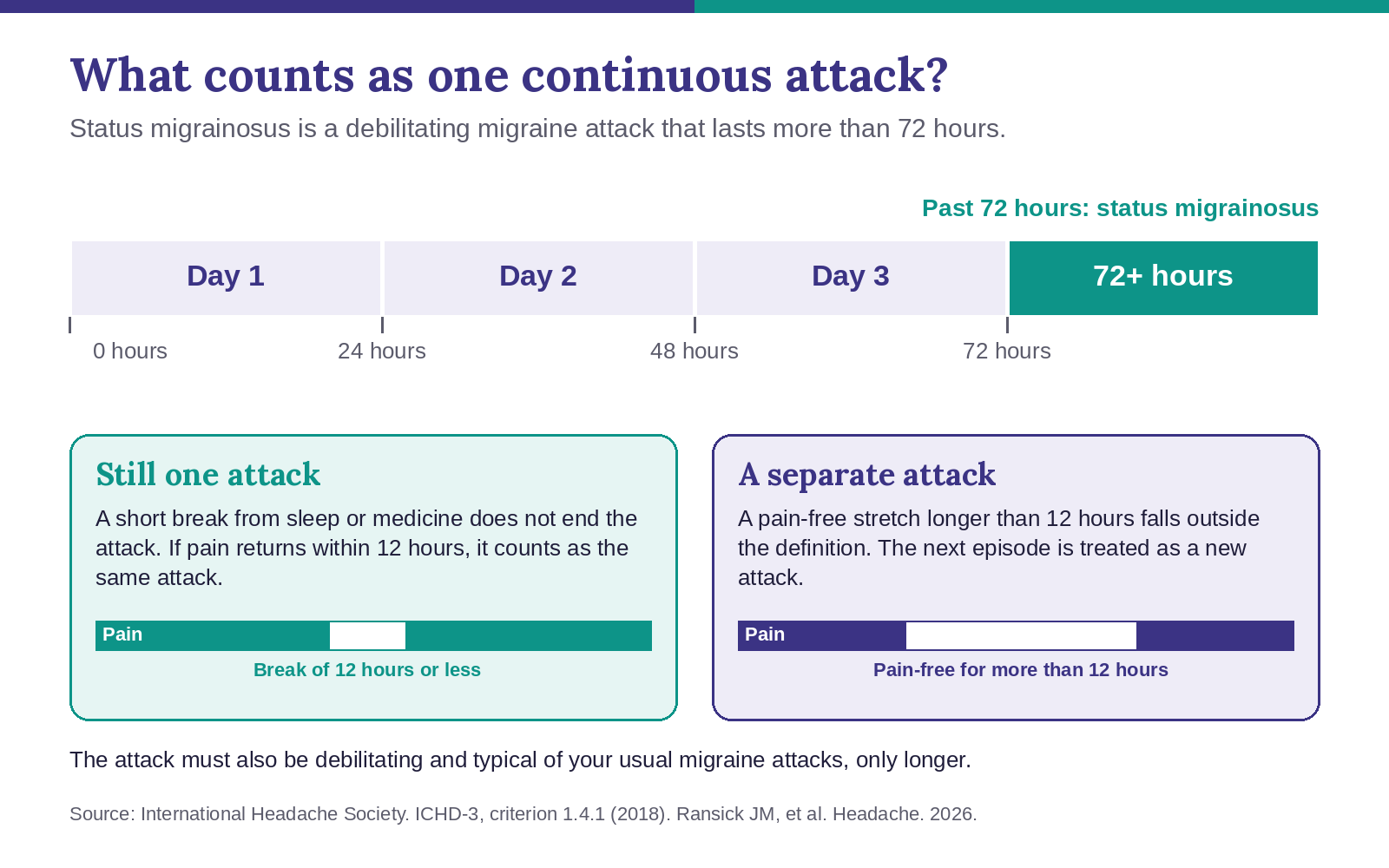
The symptoms match a regular migraine attack. You may have throbbing head pain, often on one side. You may have nausea or vomiting. Light and sound may bother you a lot.¹⁰ What sets status migrainosus apart is how long it lasts.
A note on the 72-hour line
Experts say the 72-hour mark came from history, not from tests.³ Studies also define status migrainosus in different ways, which makes it hard to compare them.¹¹ In real life, doctors do not wait for day three to treat a severe attack.²³
One more rule matters. Rescue medicine can cause headache when you take it too often. If you meet the rules for that problem, doctors code it as medication-overuse headache instead.¹
How common is status migrainosus?
Researchers have counted it in two very different groups.
In Olmsted County, Minnesota, doctors found 26.6 new cases per 100,000 people each year among people who sought care. The typical attack lasted 5 days. Most cases were in women (88.6%), and the peak ages were 40 to 49.⁴
At a specialty headache clinic in Arizona, the numbers were higher. About 44% of clinic patients with migraine had at least one episode in their lifetime. About 24% had one during 2022. The typical attack lasted 10 days. About 18% visited the ER, and about 6% were admitted to the hospital.⁵
Infographic 2: Status migrainosus by the numbers
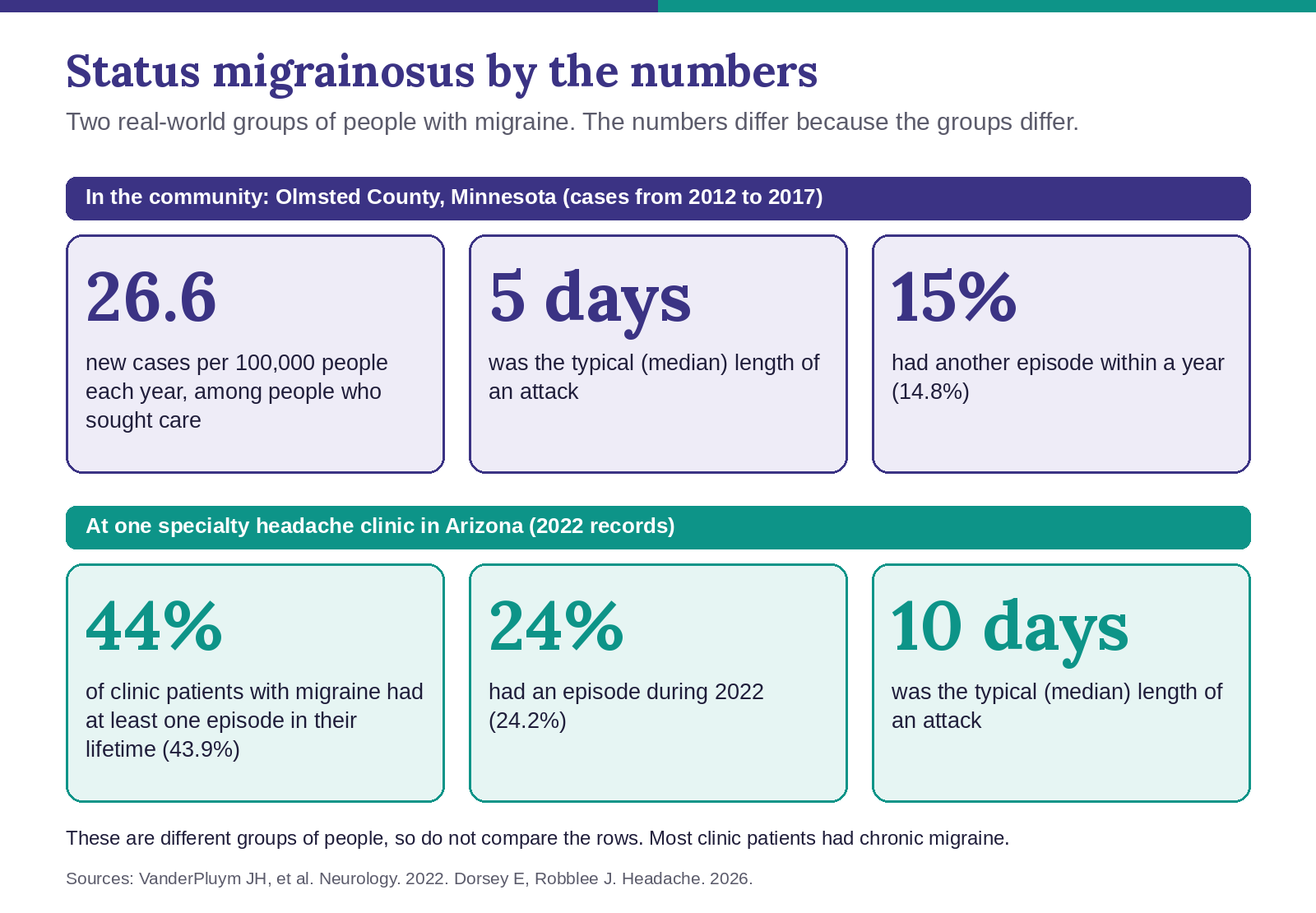
Do not compare the two groups. They are different kinds of people, and most people in the clinic study had chronic migraine.⁵
Who is at risk?
Anyone with migraine can have a long attack. In the Minnesota study, only about 1 in 3 people had a history of chronic migraine.⁴ Chronic migraine means headache on 15 or more days a month for more than three months. On at least 8 of those days, the headache has migraine features.¹²
In the specialty clinic, most people with an episode had chronic migraine.⁵ Women made up most cases in both studies, and men had episodes too.⁴⁵
What triggers status migrainosus?
Doctors do not fully know why some attacks turn into long ones.¹³ Studies do point to a few clues.
The China study was small. It looked at 21 people. Triggers are clues, not blame. Ask a headache specialist to help you sort out what applies to you.
When should you go to the emergency room?
Go to the ER or call 911 if your headache is sudden and explosive. Go too if it comes with a fever, a stiff neck, or new signs like weakness, trouble speaking, vision loss, or confusion.⁶⁷ These can point to a serious cause other than migraine, such as bleeding in the brain.
Infographic 3: Emergency room or headache specialist?
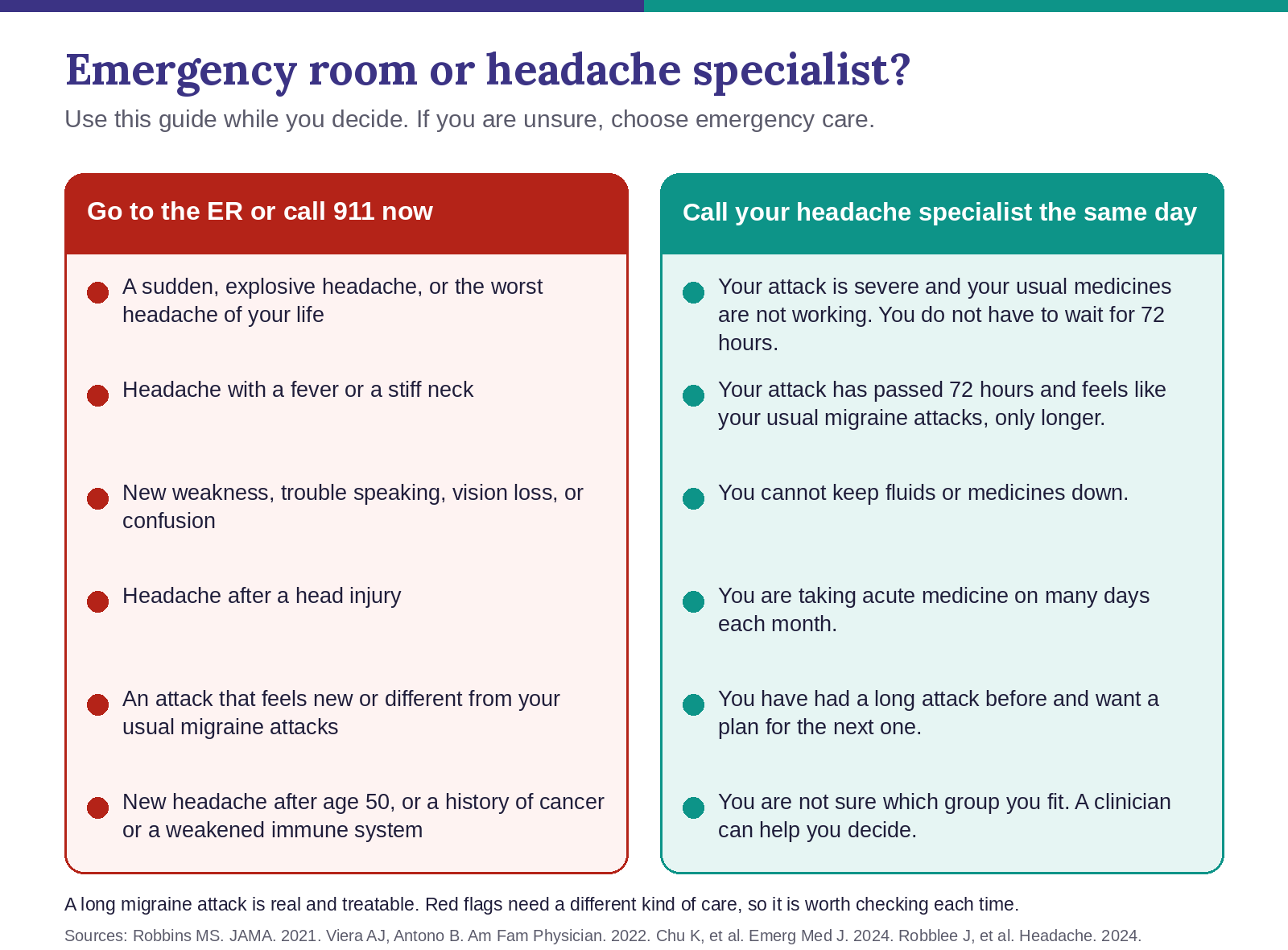
Also get urgent care if:
- You hit your head recently.⁷
- The headache feels new or different from your usual attacks.¹⁵
- You are over 50 and the headache is new, or you have had cancer or a weak immune system.¹⁶
Most people who go to the ER with a headache do not have a serious cause. In one large study of 5,293 people, 6.1% did.⁷ Red flags help doctors find the people who do.
If none of these fit, call your headache specialist. Do this if your attack has passed 72 hours or your rescue plan is not working. Tell them right away if vomiting keeps you from drinking or taking medicine.
How is status migrainosus treated?
Treatment is usually a mix of medicines. The plan depends on where you are in the attack. There is no single standard of care, and high-quality research is limited.²¹³
Start early
In one survey, about 7 in 10 headache specialists said they treat a severe, stubborn attack as status migrainosus before 72 hours pass.² Early treatment and a plan for future attacks are key parts of care.¹⁷
At home first
Most specialists in the survey (76%) start with medicine you take at home.² Their top five choices are below. Doctors sometimes use "bridge" plans to ease a stubborn attack and avoid an ER trip.¹⁷
Infographic 4: What headache specialists reach for at home
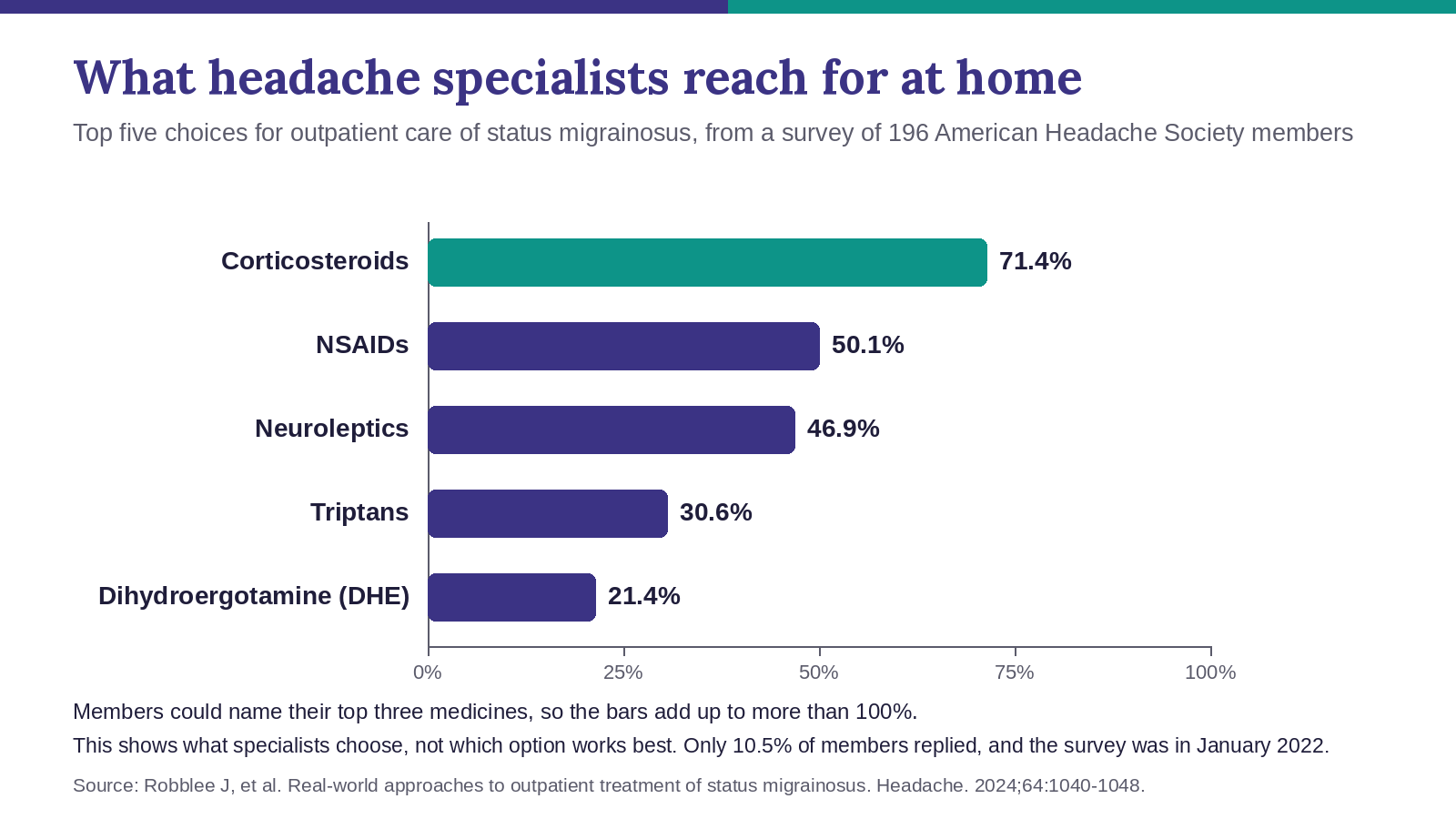
The survey shows what specialists choose, not which medicine works best. Only 10.5% of members replied.²
In a clinic or the emergency room
If home care does not work, you may need medicine through a vein, called an IV. A few specialists send people to an infusion center. Others use procedures, such as nerve blocks.²
One expert review describes a staged plan. It starts with a sumatriptan injection plus IV or injected medicines. These include dopamine blockers, NSAIDs, and acetaminophen. Magnesium sulfate, dihydroergotamine, seizure medicines, steroids, and anesthetics can be added.¹³
Infographic 5: How care steps up when an attack will not stop
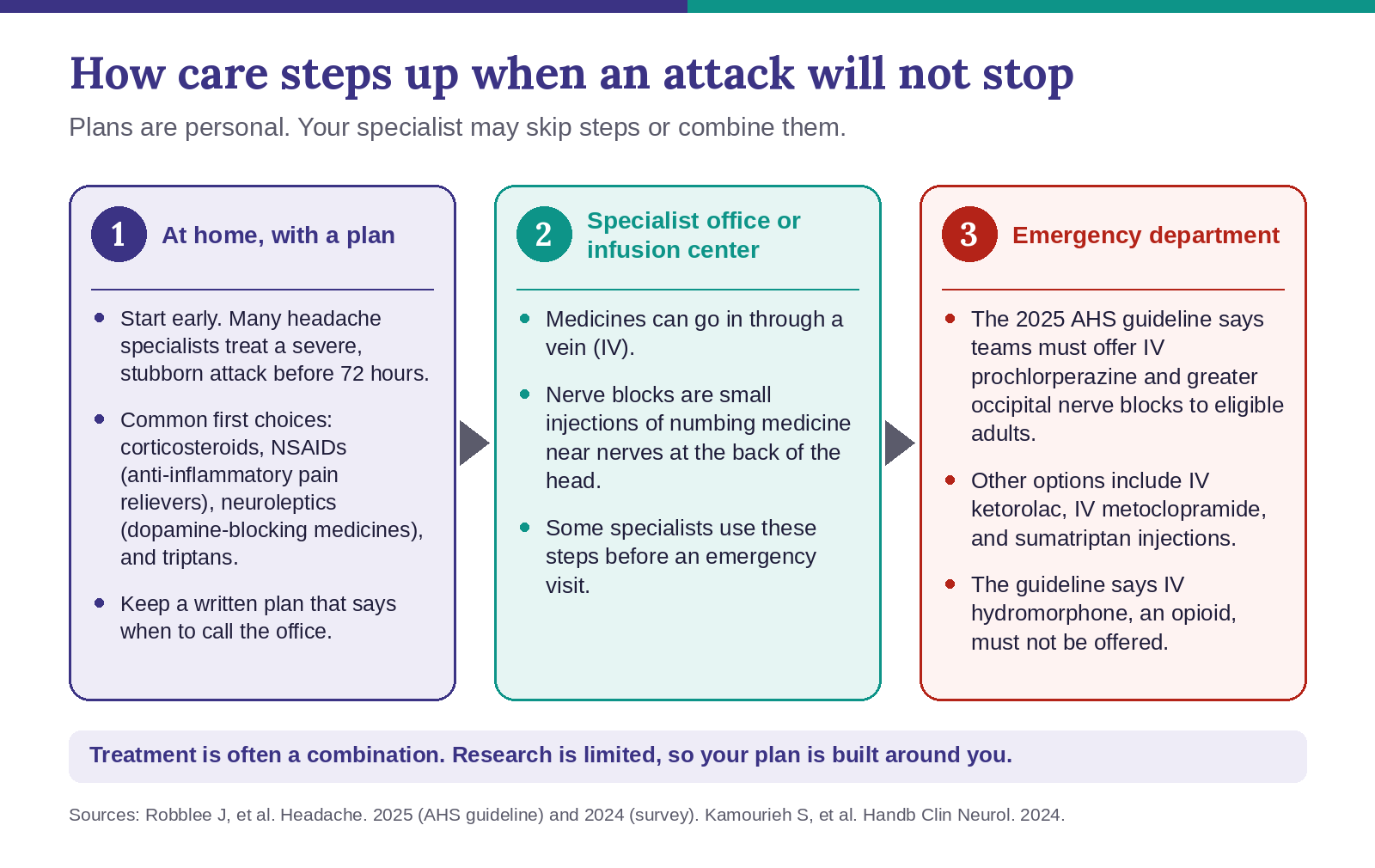
In 2025, the American Headache Society updated its guideline for injected treatment of migraine attacks in adult ER patients. It covers migraine attacks in general, not only status migrainosus. Here is how it rates each option:⁸
These ratings come from separate studies. They are not a head-to-head race. Some options, such as eptinezumab, have too little ER-specific evidence for a rating. Your clinician will choose based on your history and any reasons to avoid a medicine.
Nerve blocks
A nerve block is a small injection of numbing medicine near nerves at the back of the head. The guideline says emergency teams must offer a greater occipital nerve block to eligible adults who need injected treatment.⁸ In the Arizona clinic, about 19% of people with an episode had a nerve block.⁵
Newer medicines
Gepants and ditans are newer acute medicines. Researchers are studying where they fit in ER care.¹⁸ Ask your specialist if they make sense for you.
Can status migrainosus lead to chronic migraine?
Studies link the two, but they cannot prove that one causes the other. One review found that people with status migrainosus have higher rates of ER visits, hospital stays, and chronic migraine.¹⁷ In Minnesota, 15% had another episode within a year.⁴ Recovery is a good time to revisit your prevention plan.
How can you lower the chance of another long attack?
Prevention has a few parts. You do not have to do them all at once.
- Treat attacks early. Treating sooner is a key part of care.¹⁷
- Watch your rescue medicine. Using acute medicine too often can cause medication-overuse headache.⁹ A specialist can help you find a safe balance.
- Protect your sleep. In Minnesota, too much or too little sleep was linked to higher odds of another episode.⁴ Steady sleep times are a good goal.
- Ask about a preventive medicine. This is a medicine you take on a schedule so attacks happen less often. Options include blood pressure medicines, seizure medicines, antidepressants, CGRP antibodies, and onabotulinumtoxinA. On average, these cut migraine by 1 to 3 days a month compared with placebo.¹⁶ That can mean fewer attacks, though it is not a cure.
- Keep a written rescue plan. Write down what to take, when to call the office, and when to go to an infusion center or the ER.¹⁷
Frequently asked questions
What does status migrainosus feel like?
It feels like your usual migraine attack, but it does not stop. You may have throbbing head pain, nausea, and sensitivity to light and sound for more than 72 hours.¹¹⁰
Is status migrainosus dangerous?
It can be disabling, and some people need urgent care. In the Arizona clinic study, about 18% visited the ER and about 6% were admitted to the hospital.⁵ Other serious problems can look like a bad headache, so sudden or new symptoms need emergency care right away.⁶
How is status migrainosus different from chronic migraine?
Chronic migraine is a pattern. It means headache on 15 or more days a month for more than three months, with migraine features on at least 8 of those days.¹² Status migrainosus is one attack that lasts more than 72 hours.¹ The two are linked, and status migrainosus goes along with a higher chance of chronic migraine.¹⁷
Should I wait 72 hours before I call my doctor?
No. In one survey, about 7 in 10 headache specialists treated a severe, stubborn attack before 72 hours passed. Call early and use your rescue plan.²
Why is a long attack harder to treat?
Experts do not fully know why some attacks turn into long ones.¹³ Your usual plan was built for shorter attacks. A long attack often needs a mix of medicines, and some are given by injection or IV.⁸¹³
Are opioids a good choice for status migrainosus?
Opioids are not a first choice. The 2025 American Headache Society guideline says IV hydromorphone, an opioid, must not be offered to adults in the ER with a migraine attack.⁸ Ask your specialist about other options.
What should I bring to the ER?
Bring a list of your medicines and allergies. Note what has and has not worked for you before. If you have a headache specialist, ask them to call ahead.
You deserve care that takes long attacks seriously
A migraine attack that will not stop is exhausting, and it is real. It is not a sign of weakness. It is a recognized complication of migraine, and treatment may help.
Have you had a long attack? Do you worry about the next one? A headache specialist can help you build a plan. At Haven Headache & Migraine Center, we offer virtual and in-person care, so you can get answers faster. When you are ready, book a consultation with a Haven headache specialist.
Medically reviewed by: Karissa Secora, DMSc, PA-C, AQH, Haven Headache & Migraine Center
Peer reviewed by: Samantha Clem, PA-C, AQH, Haven Headache & Migraine Center
References
- Headache Classification Committee of the International Headache Society. The International Classification of Headache Disorders, 3rd edition. Cephalalgia. 2018;38(1):1-211. Section 1.4.1, Status migrainosus. https://ichd-3.org/1-migraine/1-4-complications-of-migraine/1-4-1-status-migrainosus/
- Robblee J, Orlova YY, Ahn AH, et al. Real-world approaches to outpatient treatment of status migrainosus: a survey study. Headache. 2024;64(8):1040-1048. https://doi.org/10.1111/head.14769
- Robblee J, Smith JH, Ahmad S, et al. Redefining status migrainosus: a narrative review. Headache. 2026;66(5):1117-1127. https://doi.org/10.1111/head.70075
- VanderPluym JH, Mangipudi K, Mbonde AA, et al. Incidence of status migrainosus in Olmsted County, Minnesota, United States: characterization and predictors of recurrence. Neurology. 2022;100(3):e255-e263. https://doi.org/10.1212/WNL.0000000000201382
- Dorsey E, Robblee J. Epidemiology and characteristics of status migrainosus in a tertiary headache clinic: a retrospective cohort study. Headache. 2026;66(6):1294-1304. https://doi.org/10.1111/head.70067
- Viera AJ, Antono B. Acute headache in adults: a diagnostic approach. Am Fam Physician. 2022;106(3):260-268. https://pubmed.ncbi.nlm.nih.gov/36126007/
- Chu K, Kelly AM, Kuan WS, et al. Predictive performance of the common red flags in emergency department headache patients: a HEAD and HEAD-Colombia study. Emerg Med J. 2024;41(6):368-375. https://doi.org/10.1136/emermed-2023-213461
- Robblee J, Minen MT, Friedman BW, et al. 2025 guideline update to acute treatment of migraine for adults in the emergency department: the American Headache Society evidence assessment of parenteral pharmacotherapies. Headache. 2026;66(1):53-76. https://doi.org/10.1111/head.70016
- Kebede YT, Mohammed BD, Tamene BA, et al. Medication overuse headache: a review of current evidence and management strategies. Front Pain Res. 2023;4:1194134. https://doi.org/10.3389/fpain.2023.1194134
- Khan J, Al Asoom LI, Al Sunni A, et al. Genetics, pathophysiology, diagnosis, treatment, management, and prevention of migraine. Biomed Pharmacother. 2021;139:111557. https://doi.org/10.1016/j.biopha.2021.111557
- Ransick JM, Pejic J, Marks L, VanderPluym JH. Evaluating the study design and criteria used for status migrainosus research: a systematic review. Headache. Epub 2026 Sep 5. https://doi.org/10.1111/head.70201
- Headache Classification Committee of the International Headache Society. The International Classification of Headache Disorders, 3rd edition. Cephalalgia. 2018;38(1):1-211. Section 1.3, Chronic migraine. https://ichd-3.org/1-migraine/1-3-chronic-migraine/
- Kamourieh S, Rozen T, Anderson JM. Status migrainosus. Handb Clin Neurol. 2024;199:413-439. https://doi.org/10.1016/B978-0-12-823357-3.00017-3
- Wang X, Zhang L, Lai Y, et al. Clinical characteristics and treatment of patients hospitalized with status migrainosus: a retrospective analysis. Acta Neurol Belg. 2025;125(4):1007-1014. https://doi.org/10.1007/s13760-025-02785-0
- García-Azorín D, Abelaira-Freire J, González-García N, et al. Sensitivity of the SNNOOP10 list in the high-risk secondary headache detection. Cephalalgia. 2022;42(14):1521-1531. https://doi.org/10.1177/03331024221120249
- Robbins MS. Diagnosis and management of headache: a review. JAMA. 2021;325(18):1874-1885. https://doi.org/10.1001/jama.2021.1640
- Mayers M, Wogayehu J, Ailani J. Status migrainosus: a narrative review. Curr Neurol Neurosci Rep. 2025;25(1):53. https://doi.org/10.1007/s11910-025-01437-3
- Cortel-LeBlanc MA, Orr SL, Dunn M, James D, Cortel-LeBlanc A. Managing and preventing migraine in the emergency department: a review. Ann Emerg Med. 2023;82(6):732-751. https://doi.org/10.1016/j.annemergmed.2023.05.024
This article is for general education and is not medical advice. It is not a substitute for care from a qualified health professional. Always talk with your clinician before starting, stopping, or changing any treatment. If you have a sudden, severe headache, the worst headache of your life, or a headache with new symptoms like weakness, trouble speaking, or vision loss, seek emergency care right away.