

Sinus Headache vs Migraine: How to Tell the Difference


Sinus headache vs migraine: how to tell the difference
If you have a stuffy nose, pressure behind your cheeks, and a throbbing head, you might assume you have a sinus headache.
Studies show that around 88 to 90% of people who believe they have a sinus headache actually have migraine.¹² That mix-up matters, because the treatments are completely different. Getting the right diagnosis is the first step toward real relief.
Key takeaways
- About 9 in 10 self-diagnosed "sinus headaches" turn out to be migraine attacks.¹
- Migraine can cause a runny nose, congestion, and facial pressure — which is why the two feel so similar.³,¹²
- True sinus headaches only occur alongside a confirmed sinus infection (rhinosinusitis) with thick, discolored nasal discharge.⁴
- Weather changes, hormonal shifts, and stress trigger migraine — not sinus problems.¹
- If sinus medications are not helping, migraine-specific treatment may be what you need.

What is a true sinus headache?
A real sinus headache — the medical term is headache attributed to rhinosinusitis — only happens when the sinuses are actively infected or inflamed.⁴ The sinuses are air-filled spaces behind your forehead, cheeks, and nose. When bacteria or viruses invade those spaces, pressure builds, and that pressure can cause pain.
The International Classification of Headache Disorders, 3rd edition (ICHD-3) — the global diagnostic standard — requires clinical or imaging evidence of rhinosinusitis before a headache can be called a sinus headache.⁴ Without that, the ICHD-3 notes that "sinus headache" is an outdated term that has often been misapplied to primary headache disorders like migraine.⁵ A 2021 review in Cephalalgia confirms that headache genuinely caused by sinus disease is uncommon in clinical practice and is seen mainly during acute sinusitis or acute flares — making it far rarer than most patients and clinicians assume.⁶
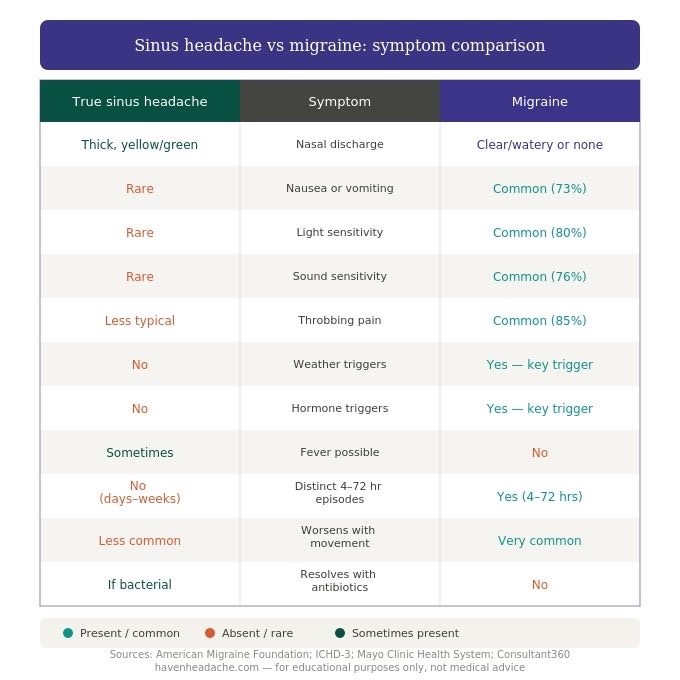
Signs that point to a true sinus headache rather than migraine:⁵⁶
- Thick, yellow or green nasal discharge
- Recent cold, flu, or upper respiratory infection
- Reduced sense of smell
- Pain in one cheek or upper teeth
- Pain that lasts more than a week and does not come in distinct episodes
- No nausea, light sensitivity, or sound sensitivity
- No relief with standard migraine treatment, but relief when the infection clears
Why migraine is so often mistaken for a sinus headache
The overlap is real — and it comes down to anatomy.
During a migraine attack, the trigeminal nerve (the large nerve that supplies your face and sinuses) becomes activated.¹ This nerve connects to the same structures that control your sinuses. When it fires, it can trigger what are called cranial autonomic symptoms — which include nasal congestion, a runny nose, and watery eyes.³,¹² Research shows that up to 45% of people with migraine have at least one of these sinus-like symptoms during an attack.¹
This means your runny nose during a "sinus headache" may not be coming from your sinuses at all. It may be migraine activating the nerves that happen to supply those structures.
Here is the important distinction: in migraine, the nasal symptoms resolve when the attack ends (and often when migraine-specific treatment is taken). In true rhinosinusitis, the congestion and discharge persist for days or more, tied to the infection.
Why does weather change trigger what I thought was a sinus headache?
Weather change is one of the most common reasons it may appear to be a “sinus headache”. However, it is one of the clearest clues that migraine is the real cause.
People often notice headaches when barometric pressure drops before a storm. The common assumption is that low pressure changes the pressure inside the sinuses. But research shows that weather changes — drops in barometric pressure, shifts in temperature, high winds — are well-documented migraine triggers.¹ Sinus disease, by contrast, is not set off by weather patterns. It is triggered by infections.
If your "sinus headaches" happen when rain is coming, or when the season changes, migraine is the far more likely explanation.
Other common migraine triggers include:
- Hormonal fluctuations (especially around menstruation)
- Missed meals or dehydration
- Sleep changes — too much or too little
- Stress and stress let-down ("weekend headache")
- Bright lights, strong odors, or loud sounds
- Alcohol, especially red wine
How can I tell if I have migraine? The ID Migraine questionnaire
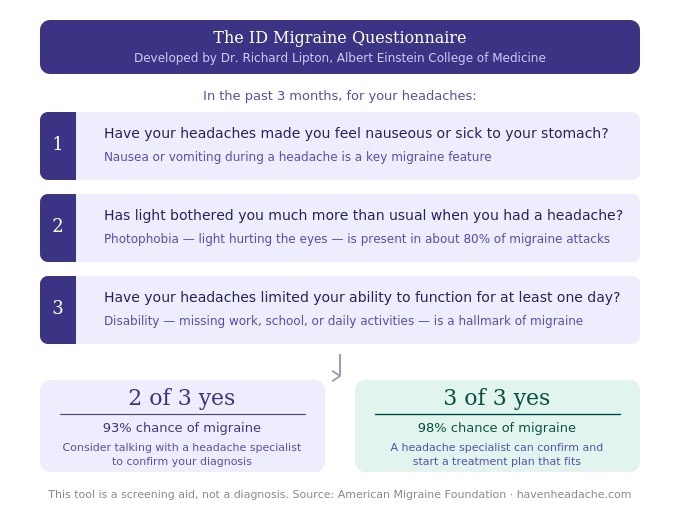
Dr. Richard Lipton of Albert Einstein College of Medicine developed a three-question screening tool called the ID Migraine Questionnaire. You can use it right now.¹
In the past three months:
- Have your headaches made you feel nauseous or sick to your stomach?
- Has light bothered you when you had a headache (much more than when you don't have one)?
- Have your headaches limited your ability to work, study, or do what you needed to do for at least one day?
If you answer yes to two of the three questions, there is a 93% chance you have migraine. If you answer yes to all three, a migraine diagnosis is 98% likely.¹
People with headaches from true sinus disease are far less likely to answer yes to these questions.
What about over-the-counter sinus medications?
Many people take decongestants, antihistamines, or combination sinus products and notice some improvement. This can feel like proof that the problem is the sinuses.
But there is a reason those products sometimes help migraine too: they often contain pain relievers like acetaminophen or ibuprofen that can take the edge off any headache, regardless of cause.⁷ The underlying migraine is still there, untreated.
Taking pain relievers too frequently — more than 10 to 15 days per month — can actually lead to medication overuse headache, which makes attacks more frequent.⁷ If you find yourself reaching for sinus medications regularly, that pattern is itself a reason to talk with a headache specialist.
What is the risk of staying misdiagnosed?
Missing a migraine diagnosis has real consequences.
Research shows that people who are misdiagnosed with sinus headache wait an average of nearly eight years before receiving the correct diagnosis.⁸ During that time, many undergo unnecessary imaging, antibiotic courses, and — in some cases — sinus surgery that does nothing to reduce attack frequency.⁸ Migraine can also worsen over time without proper management, sometimes progressing from episodic (fewer than 15 headache days per month) to chronic (15 or more headache days per month).
The sooner the right diagnosis is made, the sooner treatment that actually works can begin.

How is migraine treated differently from a sinus headache?
A true sinus headache caused by bacterial sinusitis may need antibiotics, saline irrigation, or decongestants — treatments aimed at clearing the infection.
Migraine is a neurological disease of the brain, and it is treated as one.⁹
Acute treatments (taken at the start of an attack to stop or shorten it) include:
- Triptans — a class of medicines that target serotonin receptors in the brain and reduce pain and associated symptoms¹⁰
- Gepants — a newer class that blocks a protein called CGRP, which is released during a migraine attack and contributes to pain¹¹
- NSAIDs (ibuprofen, naproxen) for mild to moderate attacks
- Anti-nausea medications when needed
Preventive treatments (taken regularly to reduce how often attacks happen) include:
- CGRP monoclonal antibodies (monthly or quarterly injections)
- Beta-blockers, antiseizure medicines like topiramate, or tricyclic antidepressants
- Gepants used daily as a preventive option
- OnabotulinumtoxinA (Botox) for chronic migraine — 15 or more headache days per month
None of these are appropriate for sinus disease. And no sinus treatment — antibiotics, decongestants, or surgery — addresses migraine.
Frequently asked questions
Can migraine cause nasal congestion and a runny nose?
Yes. During a migraine attack, the trigeminal nerve activates structures that supply the sinuses and nasal passages, producing congestion, a clear runny nose, or watery eyes in roughly 45% of people.¹ These symptoms resolve as the attack ends, which distinguishes them from the ongoing discharge seen in a true sinus infection.
What does a true sinus headache feel like compared to migraine?
A true sinus headache appears alongside a confirmed sinus infection and typically causes dull, constant pressure — not throbbing — in the forehead or cheeks, often following a cold. It does not usually cause nausea, light sensitivity, or sound sensitivity. Migraine tends to produce throbbing, one-sided pain that worsens with movement and is accompanied by those neurological symptoms.⁶
Why do antibiotics sometimes seem to help my "sinus headache"?
Some relief after antibiotics may reflect the placebo effect, or the fact that the anti-inflammatory effect of medication generally eases discomfort for a short time. Antibiotics do not treat migraine, and if they appear to help, it is not because the headache was caused by a bacterial infection.¹²
Is "sinus headache" an official medical diagnosis?
Not in the way most people use it. The ICHD-3 — the global standard for headache classification — notes that the term "sinus headache" has been applied so broadly and inaccurately that it is now considered outdated.⁵ The clinically recognized diagnosis is "headache attributed to rhinosinusitis," which requires objective evidence of sinus disease.
How long do migraine attacks last compared to sinus headaches?
Migraine attacks typically last four to 72 hours.⁶ A true sinus headache tied to infection tends to persist for days to weeks, closely tracking the course of the infection — it does not come in distinct episodes the way migraine does.
What triggers migraine but not sinus headaches?
Migraine can be set off by changes in barometric pressure (weather shifts), hormonal fluctuations (especially around menstruation), stress, missed meals, sleep changes, bright lights, strong odors, and certain foods or drinks. These are not triggers for sinus disease, which is driven by infection and inflammation of the sinus lining.¹
Should I see a specialist if I keep getting "sinus headaches"?
A headache specialist can review your history, apply the ICHD-3 criteria, and determine whether migraine or sinus disease is the real cause. If prior sinus treatments have not helped, or if your headaches recur in patterns tied to triggers like weather or hormones, a headache and migraine specialist is the right next step.
You deserve the right diagnosis
If you have been treating your headaches as sinus problems for months or years without real relief, you are not alone — and you are not at a dead end.
Migraine is a well-understood neurological disease with a range of proven treatments. Once you have the right diagnosis, your care team can build a plan that actually matches what your brain is doing. Many people with migraine go from frequent, disabling attacks to far fewer headache days with the right treatment.
If sinus remedies have not been working, it may be time to talk with a headache and migraine specialist. Book a consultation at Haven Headache & Migraine Center and take the first step toward care that fits.
Medically reviewed by Karissa Secora, DMSc, PA-C, Haven Headache & Migraine Center.
Peer reviewed by: Samantha Clem, PA-C, Haven Headache & Migraine Center.
References
- American Migraine Foundation. Sinus Headache. https://americanmigrainefoundation.org/resource-library/sinus-headache/
- Mayo Clinic Health System. Sinus headache: Not what you think. 2024. https://www.mayoclinichealthsystem.org/hometown-health/speaking-of-health/your-sinus-headache-may-not-be-what-you-think
- Vicente BN, Oliveira R, Martins IP, Gil-Gouveia R. Cranial Autonomic Symptoms and Neck Pain in Differential Diagnosis of Migraine. Diagnostics. 2023;13(4):590. https://pmc.ncbi.nlm.nih.gov/articles/PMC9955923/
- International Headache Society. ICHD-3: 11.5.1 Headache attributed to acute rhinosinusitis. https://ichd-3.org/11-headache-or-facial-pain-attributed-to-disorder-of-the-cranium-neck-eyes-ears-nose-sinuses-teeth-mouth-or-other-facial-or-cervical-structure/11-5-headache-attributed-to-disorder-of-the-nose-or-paranasal-sinuses/11-5-1-headache-attributed-to-acute-rhinosinusitis/
- International Headache Society. ICHD-3: 11.5 Headache attributed to disorder of the nose or paranasal sinuses. https://ichd-3.org/11-headache-or-facial-pain-attributed-to-disorder-of-the-cranium-neck-eyes-ears-nose-sinuses-teeth-mouth-or-other-facial-or-cervical-structure/11-5-headache-attributed-to-disorder-of-the-nose-or-paranasal-sinuses/
- Ceriani CEJ, Silberstein SD. Headache and rhinosinusitis: A review. Cephalalgia. 2021;41(4):453–463. https://journals.sagepub.com/doi/10.1177/0333102420959790
- Rizzoli P. Medication-overuse headache. Continuum (Minneap Minn). 2024;30(2):379–390. https://doi.org/10.1212/CON.0000000000001403
- Al-Hashel JY, Ahmed SF, Alroughani R, Goadsby PJ. Migraine misdiagnosis as a sinusitis, a delay that can last for many years. J Headache Pain. 2013;14(1):97. https://pmc.ncbi.nlm.nih.gov/articles/PMC4028747/
- Cleveland Clinic. Migraine: What It Is, Types, Causes, Symptoms & Treatments. https://my.clevelandclinic.org/health/diseases/5005-migraine-headaches
- The Migraine Trust. Triptans. https://migrainetrust.org/live-with-migraine/healthcare/treatments/triptans/
- The Migraine Trust. Gepants. https://migrainetrust.org/live-with-migraine/healthcare/treatments/gepants/
- Robblee J, Secora KA. Debunking Myths: Sinus Headache. Curr Neurol Neurosci Rep. 2021;21(8):42. https://doi.org/10.1007/s11910-021-01127-w
This article is for general education and is not medical advice. It is not a substitute for care from a qualified health professional. Always talk with your clinician before starting, stopping, or changing any treatment. If you have a sudden, severe headache, the worst headache of your life, or a headache with new symptoms like weakness, trouble speaking, or vision loss, seek emergency care right away.