

Silent Migraine: Aura Without Headache Explained


Silent migraine: what it means to have migraine aura without headache
A silent migraine happens when you get the aura part of a migraine attack. This can mean flashing lights, numbness, or trouble speaking. But no headache follows. Doctors call this migraine aura without headache.¹ It can feel confusing or even scary, especially the first time. You're not imagining it, and there's a clear path to figuring out what's happening.
Key takeaways
- Silent migraine means aura symptoms with no headache within 60 minutes.¹
- It's uncommon. Migraine with aura makes up only about a third of migraine cases overall, and aura without any headache at all is a much smaller slice within that group.⁷
- For some people, migraine with aura evolves with age, so the headache fades while the aura symptoms continue.¹⁰
- "Silent" doesn't mean harmless. Research links aura without headache to a higher risk of stroke, so a first episode, especially after age 40, needs a medical evaluation to rule out other causes.¹ ⁸
- The preferred clinical term is "migraine aura without headache." Older terms like "acephalgic migraine" are still used in medical literature but are fading from everyday practice.³ ¹¹
What is silent migraine?
Silent migraine, or migraine aura without headache, is a migraine attack where the aura shows up but the headache doesn't. Aura is a set of temporary nervous system symptoms. It usually acts as a warning sign right before migraine pain starts.¹
Doctors used to call this "acephalgic migraine." That term is fading from use. Most headache specialists now prefer "migraine aura without headache," since it describes exactly what's happening.³ You may also hear the informal term "ocular migraine." That phrase is imprecise. It can refer to a few different conditions.
What does a silent migraine feel like?
Symptoms build gradually, usually over 5 minutes or more, and last between 5 and 60 minutes.¹
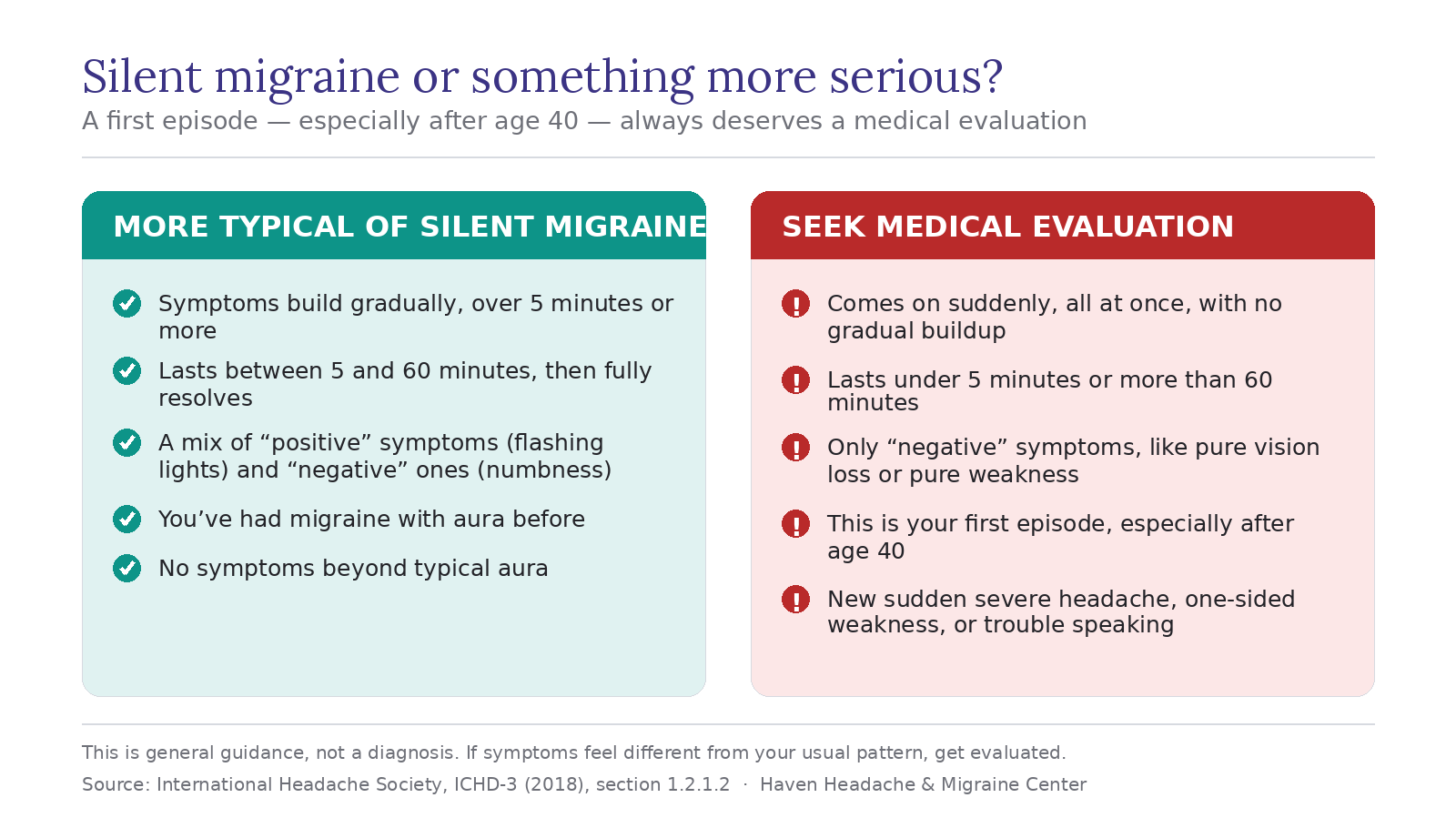
The most common type is visual. You might see:
- Flashing or shimmering lights
- Zigzag lines or a jagged, expanding pattern
- A blind spot or blurry patch in part of your vision
Other symptoms can include:
- Numbness or tingling, often on one side of the body
- Trouble finding words or speaking clearly
- Dizziness, ringing in the ears, or unsteady balance, in a less common form called brainstem aura
You may also notice light sensitivity, sound sensitivity, or mild nausea, even without a headache. About a third of people with migraine experience aura of any kind, with or without pain.⁶⁷
How common is silent migraine, and who gets it?
Silent migraine is uncommon. Migraine with aura makes up roughly a third of all migraine cases, and aura without any headache at all is a much smaller group within that.⁷ It tends to show up in two groups: young adults in their 20s and 30s, and adults in midlife.²
For some people, it develops later in life after years of migraine with aura and headache. Research on how aura patterns change over time shows the headache phase can fade with age while the aura symptoms continue on their own.¹⁰
Is silent migraine dangerous?
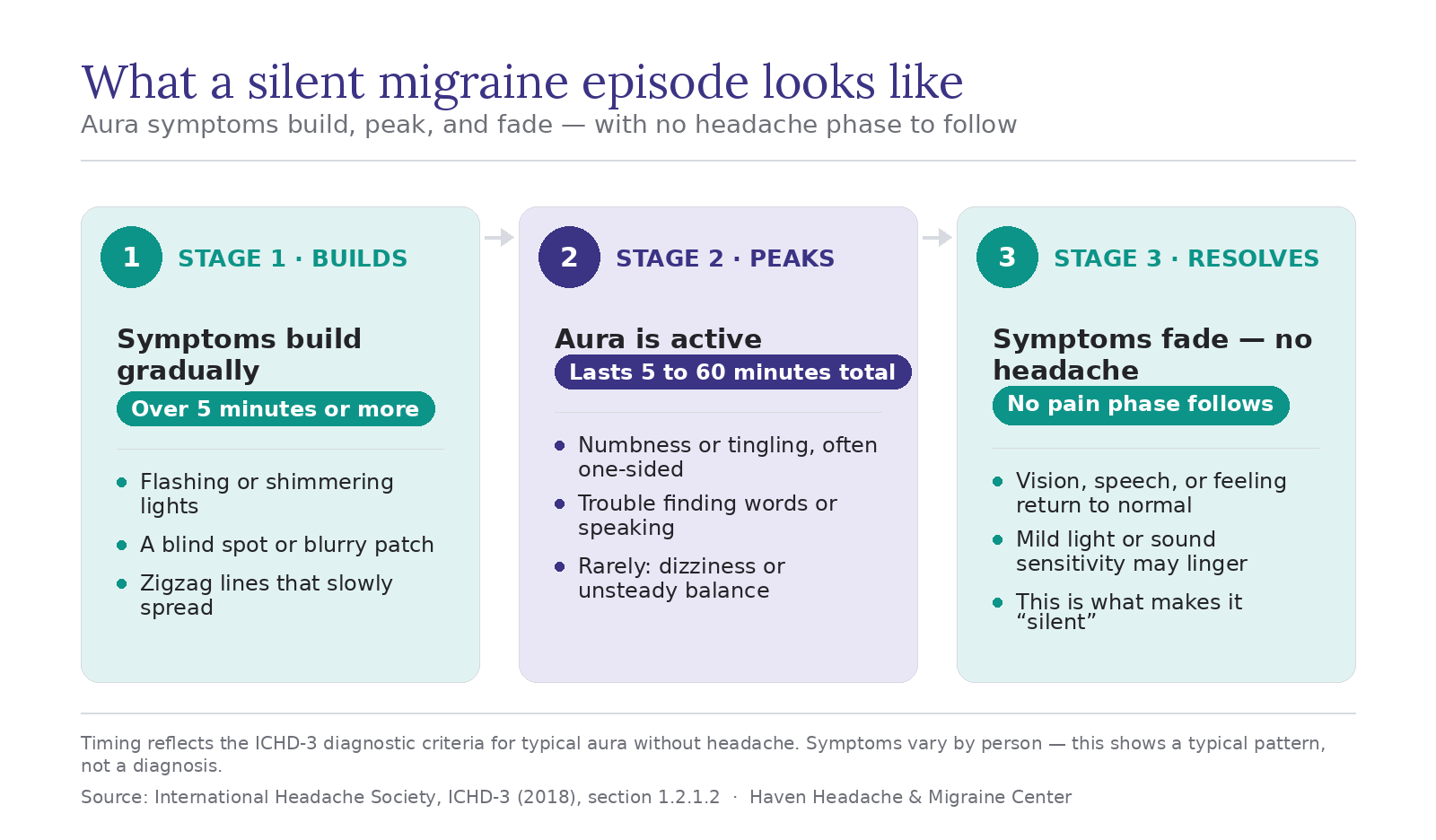
Most of the time, no. But because there's no headache to confirm the pattern, silent migraine can look like other, more serious conditions, including stroke.⁹ This is especially true for a first episode.¹
A transient ischemic attack, sometimes called a mini-stroke, can cause similar symptoms. So can other neurological conditions. Certain patterns raise more concern than others.
It's also worth knowing something else. A large study that followed thousands of people in Denmark for over a decade found that aura without headache was linked to more than double the risk of stroke, plus a higher risk of atrial fibrillation, an irregular heartbeat.⁸ The overall risk still stays low for most people, but this is one more reason a first-time evaluation matters. It's also a good time for an honest talk with your doctor about other stroke risk factors, including estrogen-containing birth control.³
How is silent migraine diagnosed?
There's no single test that confirms silent migraine. Your doctor builds the diagnosis from your history and by ruling out other causes, especially the first time symptoms appear.¹ Because there's no headache to confirm the pattern, silent migraine is sometimes mistaken for anxiety, a sleep problem, or another neurological condition, especially when symptoms are unusual, like fatigue or nausea on their own.¹¹
A clear, distinct start and finish to your symptoms supports a migraine diagnosis. If your symptoms are vague, that's a clue too. When you can't say clearly when they began and ended, your doctor may look more closely at other explanations.⁴ Your evaluation may include a neurological exam and a review of your personal and family migraine history. Sometimes imaging is needed to rule out other causes.
How is silent migraine treated?
Treatment options are limited, mainly because the aura itself is short. Medicines like triptans often take too long to work to stop an aura before it ends on its own.
Still, there are ways to manage silent migraine:
- Track your patterns. A headache diary can help you and your doctor spot triggers and confirm the diagnosis over time.
- Manage common triggers. Stress, poor sleep, and known personal triggers can bring on silent migraine the same way they trigger other migraine attacks.
- Treat related symptoms. If nausea, light sensitivity, or dizziness show up alongside the aura, your doctor can suggest options for those.
- Consider preventive medicine for frequent episodes. If silent migraine happens often and disrupts your life, your doctor may discuss daily preventive options used for migraine more broadly.
Frequently asked questions
Is silent migraine the same as acephalgic migraine?
Yes. "Acephalgic migraine" is an older term for the same condition. Most headache specialists now use "migraine aura without headache."³
Can silent migraine turn into a stroke?
Silent migraine itself doesn't cause a stroke. But research shows aura without headache is linked to a higher risk of stroke over time, so ongoing care with a doctor matters.⁸
Why do I get aura but no headache anymore?
This is common as people with migraine get older. Research on evolving aura patterns shows the headache phase can fade while the aura symptoms continue.¹⁰
How long does a silent migraine episode last?
Most episodes last between 5 and 60 minutes, with symptoms building gradually rather than starting all at once.¹
Should I go to the emergency room for a silent migraine?
Go right away if it's your first episode, especially after age 40, if symptoms come on suddenly with no buildup, or if you have only negative symptoms like pure vision loss or weakness.¹
Is silent migraine the same as ocular migraine?
Not exactly. "Ocular migraine" is an informal term that people use loosely for migraine aura or for retinal migraine, a rarer condition that affects only one eye. Ask your doctor which one applies to you.
You deserve an answer, not just reassurance
Living through vision changes, numbness, or speech trouble with no headache to explain it can feel unsettling. That reaction makes sense. A headache specialist can confirm what's happening, rule out other causes, and help you feel confident the next time it happens. You don't have to sort this out alone.
Medically reviewed by: Karissa Secora, DMSc, PA-C, AQH, Haven Headache & Migraine Center and peer-reviewed by Alicia Chang, MSN, APRN, FNP-BC, FNP-C, CEN, PHN
References
- International Headache Society. ICHD-3: 1.2.1.2 Typical aura without headache. https://ichd-3.org/1-migraine/1-2-migraine-with-aura/1-2-1-migraine-with-typical-aura/1-2-1-2-typical-aura-without-headache/
- American Migraine Foundation. Migraine Aura without Headache. https://americanmigrainefoundation.org/resource-library/migraine-aura-without-headache/
- American Migraine Foundation. Aura Without Headache or "Silent Migraine": A Guide. https://americanmigrainefoundation.org/resource-library/silent-migraine/
- American Migraine Foundation. Demystifying Migraine with Aura. https://americanmigrainefoundation.org/resource-library/demystifying-migraine-with-aura/
- Mayo Clinic. Ocular migraine: When to seek help. https://www.mayoclinic.org/diseases-conditions/migraine-headache/expert-answers/ocular-migraine/faq-20058113
- American Headache Society. Migraine with Aura. https://americanheadachesociety.org/resources/primary-care/migraine-with-aura
- Grodzka O, Dzagoevi K, Rees T, et al. Migraine with and without aura—two distinct entities? A narrative review. The Journal of Headache and Pain. 2025;26(1):77. https://doi.org/10.1186/s10194-025-01998-1
- Dudukina E, Nagy D, Fuglsang CH, et al. Risk of stroke, myocardial infarction, coronary intervention, and atrial fibrillation or flutter in individuals experiencing typical migraine aura without headache: a Danish registry-based cohort study. International Journal of Epidemiology. 2025;54(4). https://doi.org/10.1093/ije/dyaf079
- Borończyk M, Zduńska A, Węgrzynek-Gallina J, et al. Migraine and stroke: correlation, coexistence, dependence - a modern perspective. The Journal of Headache and Pain. 2025;26(1):39. https://doi.org/10.1186/s10194-025-01973-w
- Robertson CE, Digre KB. Persistent aura, visual snow, and other visual symptoms. Handbook of Clinical Neurology. 2024;199:441-464. https://doi.org/10.1016/B978-0-12-823357-3.00018-5
- Oliveira DG. Acephalgic Migraine Presenting as Episodic Fatigue and Nausea: A Case Report. Clinical Medicine & Research. 2025;23(4):165-171. https://doi.org/10.3121/cmr.2025.2030
This article is for general education and is not medical advice. It is not a substitute for care from a qualified health professional. Always talk with your clinician before starting, stopping, or changing any treatment. If you have a sudden, severe headache, the worst headache of your life, or a headache with new symptoms like weakness, trouble speaking, or vision loss, seek emergency care right away.