

Post Concussion Headache

.jpeg)
Post-concussion headache: causes, symptoms, and treatment
A headache after a concussion is common. It usually starts within a week of the injury. It often feels like a migraine attack or a tension-type headache. For most people, it fades within three months.
For some people, it lasts longer. If your headache from a head injury never really left, you are not imagining it. You are not stuck with it either.
Key takeaways
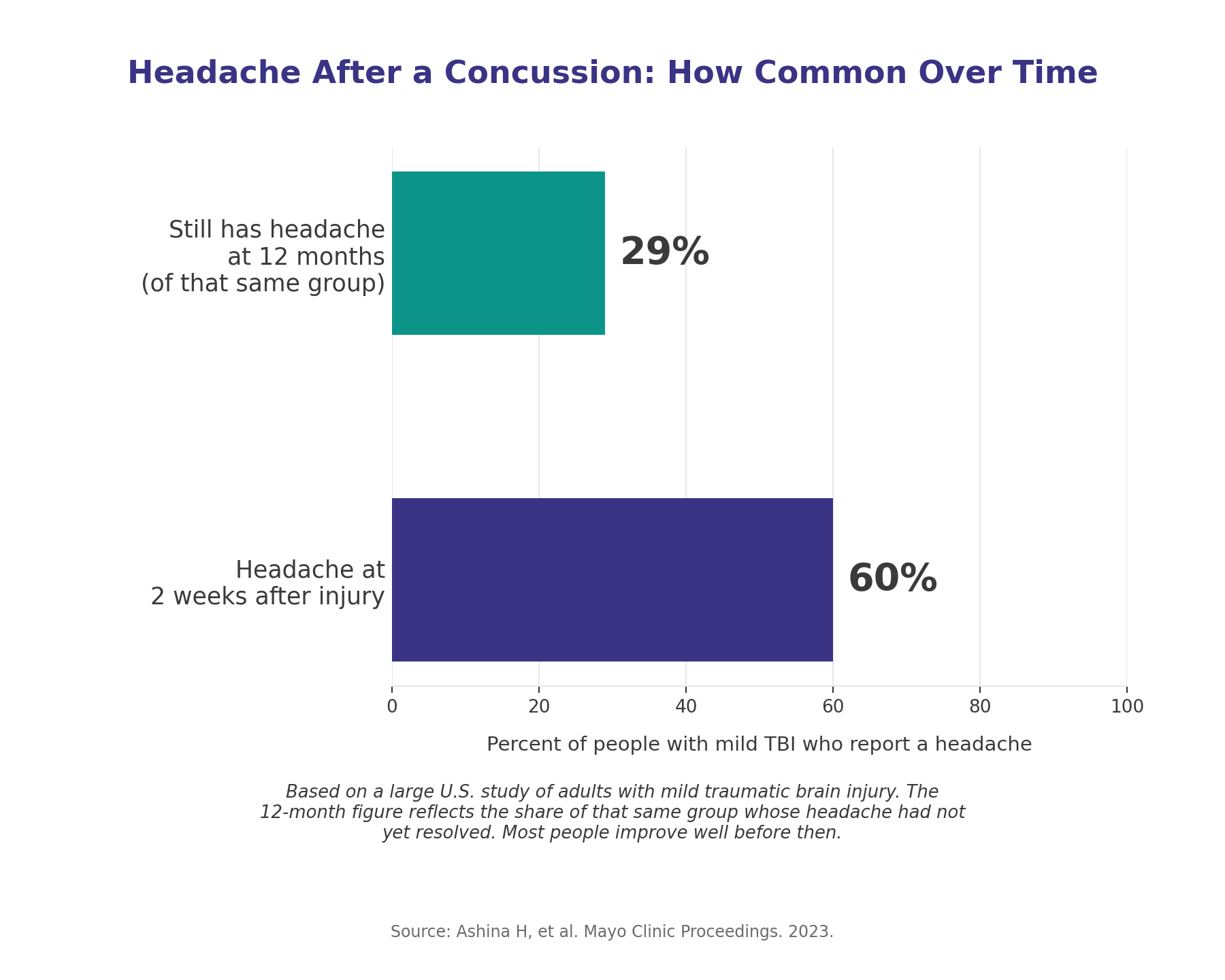
- Headache is the most common symptom after a concussion. In one large study, 60% of people had a headache two weeks after mild traumatic brain injury.¹
- Doctors call this headache "acute" if it clears within 3 months. They call it "persistent" if it lasts longer.²³
- Most post-concussion headaches look like migraine, not like a generic ache.⁴
- A history of migraine, being female, and a more severe injury all raise the odds the headache sticks around.⁴
- Treatment works best when it starts early. The best plans mix careful medication use with therapies like graded activity and cognitive behavioral therapy.⁵
What is a post-concussion headache?
A post-concussion headache is also called a post-traumatic headache. It is a headache that starts after a blow to the head. It can also start after a jolt that shakes the brain inside the skull. Doctors diagnose it when the pain begins within 7 days of the injury. It can also start within 7 days of waking up or being able to feel pain again.²
This headache has two stages. Acute post-traumatic headache lasts less than 3 months. Past that point, it is called persistent post-traumatic headache.³ Reaching the 3-month mark does not mean the pain is permanent. It means the headache needs its own treatment plan, often modeled on migraine care.
What causes a headache after a concussion?
A concussion disrupts how brain cells use energy and talk to each other. This short-term "energy crisis" can irritate the pain-sensing nerves around your brain and blood vessels.
Researchers point to a few likely drivers:
- CGRP release. Calcitonin gene-related peptide, or CGRP, is a protein that helps set off migraine. Head trauma seems to trigger extra CGRP release. This can cause migraine-like pain, even in people who never had migraine before.⁶
- Nerve sensitization. The injury can make pain-sensing nerves in the head and neck fire more easily. Normal signals start to feel like pain.
- Neck involvement. The same forces that jar the brain also strain the neck. Neck-related pain, called cervicogenic pain, often overlaps with post-concussion headache.
- A prior tendency toward migraine. People with a personal or family history of migraine may have a nervous system that reacts more strongly to injury.⁴
Sleep loss, stress, and dehydration are not the root cause. But they can all make the pain worse during recovery.
What does a post-concussion headache feel like?
Post-concussion headache does not follow one fixed pattern. It usually takes on the features of a headache type you may already know.
Migraine-like pain is the most common pattern after concussion. Because of this, migraine treatments often work well, even in people who never had migraine before their injury.
How long does a post-concussion headache last?
Most people improve within weeks. In a large U.S. study of adults with mild traumatic brain injury, 60% reported a headache at the two-week mark.¹ Of that group, about 29% still had a headache a full year later.¹
Most people do get better. But a meaningful number need ongoing care, not just patience. If your headache is still here at 3 months, that is your signal to get evaluated by a specialist.
Who is more likely to get a headache that does not go away?
A few factors raise the risk that a post-concussion headache becomes persistent:⁴
- A personal or family history of migraine or frequent headache
- Being female
- Younger age
- A more severe head injury
- Anxiety, depression, or high stress around the time of injury
Having one of these factors does not guarantee a lasting headache. It does mean your symptoms are worth watching closely. Early care beats waiting to see what happens.
How is post-concussion headache treated?
Early, careful pain relief
In the first weeks, over-the-counter pain relievers like acetaminophen or an NSAID can help. Use them with care. Taking pain medication too many days a month can backfire.² It can cause a second problem called medication overuse headache. A good rule: save pain medication for your worst days, not every day. Talk with your clinician if you find yourself reaching for it often.⁷
At Haven, we never prescribe opioids or barbiturate medications like Fioricet for headache. These carry a real dependency risk and a strong link to medication overuse headache.
Preventive treatment for lasting headaches
When headache continues past a few weeks, a preventive approach can help. It often looks like migraine care. Options include:
- Tricyclic antidepressants like amitriptyline or nortriptyline, at low doses
- Anti-seizure or blood pressure medications used for migraine prevention
- CGRP-targeted medications, the same class used for migraine, for cases that do not respond to other options⁶
Non-drug therapies
A 2022 review of treatment studies found real benefit from several non-drug approaches, especially for headache that lingers:⁵
- Cognitive behavioral therapy
- A graded, step-by-step return to physical activity
- Vestibular and cervical physical therapy for neck-related pain
- Clear education about what to expect during recovery
Long stretches of strict rest are no longer recommended. A short rest of a day or two makes sense right after injury. After that, a slow, monitored return to activity tends to help more than staying in a dark room for weeks.⁵
When should you see a doctor about a headache after a head injury?
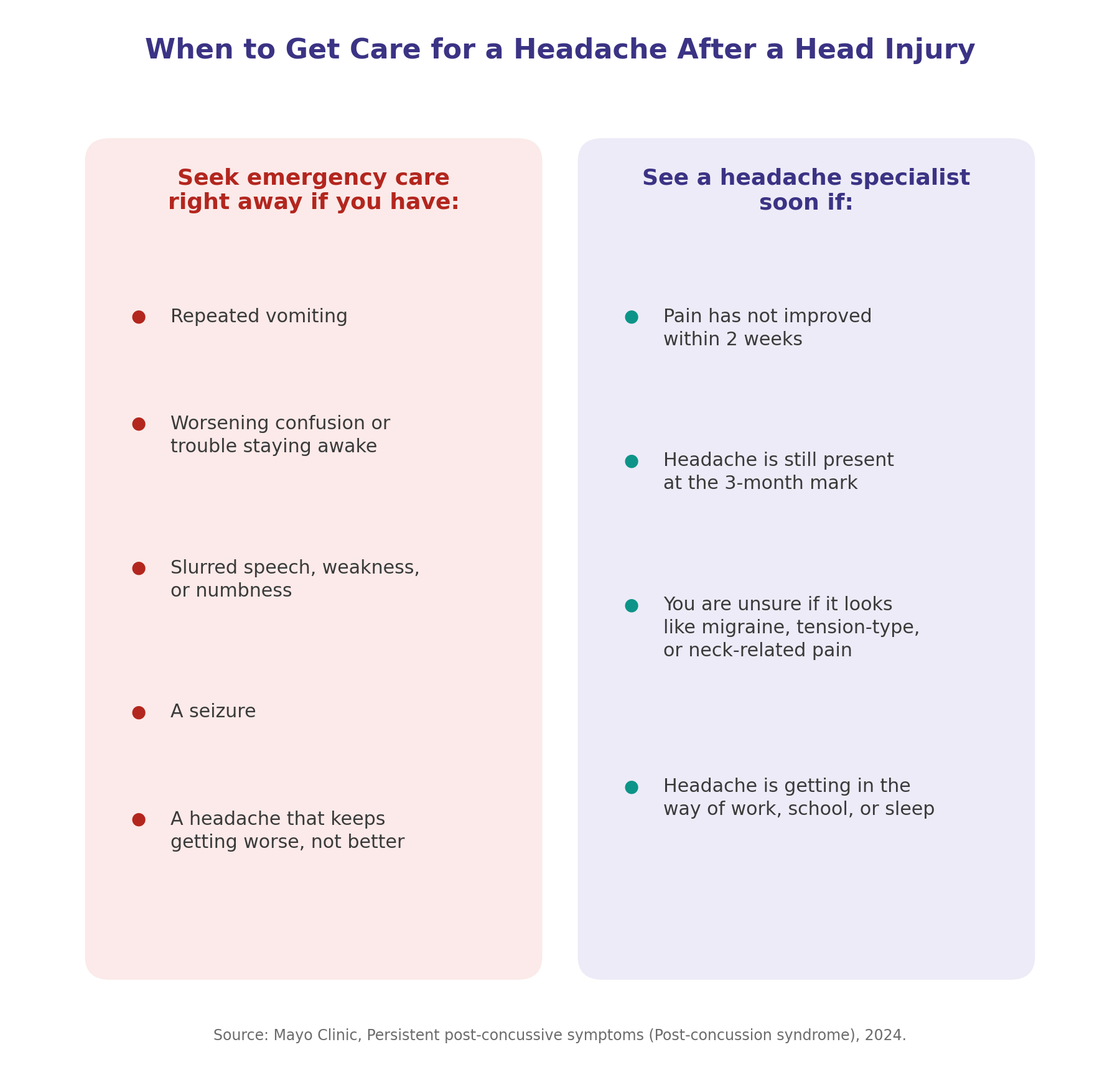
Get emergency care right away if a headache after a head injury comes with any of these:⁸
- Repeated vomiting
- Worsening confusion or trouble staying awake
- Slurred speech, weakness, or numbness
- A seizure
- A headache that keeps getting worse instead of better
Without those warning signs, still plan to see a clinician if the pain is not improving within a couple of weeks. The same goes if it is still present at 3 months. About a third of people with a lasting post-traumatic headache end up missing work because of it.⁹ Getting evaluated early is worth the visit.
You do not have to just wait this out
A headache after a concussion can feel like proof that something is permanently wrong. For most people, it is not. It is a nervous system recovering from an injury. It responds to the right treatment, especially when that treatment starts early.
Maybe your headache has lasted more than a few weeks. Maybe you are unsure if it looks like migraine, tension-type headache, or a neck problem. Either way, a headache specialist can help sort that out and build a plan around it.
Book a virtual consultation with Haven
Frequently asked questions
How soon after a concussion does a headache start?
Most post-traumatic headaches start within 7 days of the injury, often the same day. A new headache that starts weeks later is less likely to be caused by the concussion. It deserves its own evaluation.²
Is a headache after a concussion the same thing as a migraine?
Not exactly, but the two overlap a lot. Most post-concussion headaches take on migraine-like features. That includes throbbing pain, nausea, and light sensitivity, even in people who never had migraine before.⁴ Because of this overlap, migraine treatments are often used with success.
How long should a headache last after a concussion?
Many people improve within a few weeks. A headache is called "persistent" once it passes the 3-month mark.³ Reaching 3 months is a sign to seek specialist care. It is not a sign the pain is permanent.
Can I take ibuprofen for a post-concussion headache?
Over-the-counter options like ibuprofen or acetaminophen can help in the early weeks. Use them on your worst days, not every day. Frequent use can lead to medication overuse headache.⁷ Always check with your clinician first, especially if you have other concussion symptoms too.
What is post-concussion syndrome?
Post-concussion syndrome is a cluster of symptoms that continues well past the usual recovery window.⁸ It can include headache, dizziness, and trouble concentrating. Headache is usually the most persistent piece, and it often needs its own targeted treatment.
When is a headache after a head injury an emergency?
Seek emergency care right away for repeated vomiting, worsening confusion, or slurred speech. The same goes for new weakness, numbness, a seizure, or a headache that keeps getting worse instead of better.⁸ These signs need urgent care, not a wait-and-see approach.
Medically reviewed by Karissa Secora, DMSc, PA-C, AQH, Haven Headache & Migraine Center and peer-reviewed by Alicia Chang, MSN, APRN, FNP-BC, FNP-C, CEN, PHN
References
- Ashina H, Dodick DW, Barber J, et al. Prevalence of and Risk Factors for Post-traumatic Headache in Civilian Patients After Mild Traumatic Brain Injury: A TRACK-TBI Study. Mayo Clinic Proceedings. 2023;98(10):1515-1526. https://doi.org/10.1016/j.mayocp.2023.02.026
- Headache Classification Committee of the International Headache Society. 5.1 Acute headache attributed to traumatic injury to the head. ICHD-3. https://ichd-3.org/5-headache-attributed-to-trauma-or-injury-to-the-head-andor-neck/5-1-acute-headache-attributed-to-traumatic-injury-to-the-head/
- Headache Classification Committee of the International Headache Society. 5.2 Persistent headache attributed to traumatic injury to the head. ICHD-3. https://ichd-3.org/5-headache-attributed-to-trauma-or-injury-to-the-head-andor-neck/5-2-persistent-headache-attributed-to-traumatic-injury-to-the-head/
- Mavroudis I, Ciobica A, Luca AC, Balmus IM. Post-Traumatic Headache: A Review of Prevalence, Clinical Features, Risk Factors, and Treatment Strategies. Journal of Clinical Medicine. 2023;12(13):4233. https://doi.org/10.3390/jcm12134233
- Heslot C, Azouvi P, Perdrieau V, Granger A, Lefèvre-Dognin C, Cogné M. A Systematic Review of Treatments of Post-Concussion Symptoms. Journal of Clinical Medicine. 2022;11(20):6224. https://doi.org/10.3390/jcm11206224
- Kamins J. Models for Treating Post-traumatic Headache. Current Pain and Headache Reports. 2021;25(8):52. https://doi.org/10.1007/s11916-021-00970-3
- Cleveland Clinic. Post-Concussion Syndrome. https://my.clevelandclinic.org/health/diseases/24900-post-concussion-syndrome
- Mayo Clinic. Persistent post-concussive symptoms (Post-concussion syndrome). https://www.mayoclinic.org/diseases-conditions/post-concussion-syndrome/symptoms-causes/syc-20353352
- Sharma R, Rocha Cabrero F, De Jesus O. Posttraumatic Headache. StatPearls. NCBI Bookshelf. https://www.ncbi.nlm.nih.gov/books/NBK556134/
This article is for general education and is not medical advice. It is not a substitute for care from a qualified health professional. Always talk with your clinician before starting, stopping, or changing any treatment. If you have a sudden, severe headache, the worst headache of your life, or a headache with new symptoms like weakness, trouble speaking, or vision loss, seek emergency care right away.
Living with a headache that won't quit after a head injury? The specialists at Haven Headache & Migraine Center are here to help. *Book a virtual consultation.*