

Occipital Nerve Block for Chronic Headache Relief


Occipital nerve block: what it is and how it helps headaches
An occipital nerve block is a quick injection near nerves at the base of your skull. It uses numbing medicine, often with a steroid, to calm pain signals. It can ease migraine, cluster headache, and occipital neuralgia pain, sometimes within minutes.¹ It is not a cure. But it can bring real relief while you and your clinician plan next steps.
Key takeaways
- The injection targets your occipital nerves. These run from the base of your skull up toward the top of your head.¹
- It can help migraine, occipital neuralgia, cluster headache, and cervicogenic headache.¹²
- The procedure is quick. It takes about 15 to 20 minutes and does not need general anesthesia.¹
- Relief can start fast, but how long it lasts varies. Some people feel better for weeks. Others feel better for months.¹
- In 2025, the American Headache Society said this block must be offered to eligible migraine patients in the emergency room.⁶
- It is generally safe. Most side effects are mild and go away on their own.¹
What is an occipital nerve block?
Your occipital nerves sit at the back of your head. They come in three types: greater, lesser, and third occipital nerves. They branch off from nerves in your upper spine, called C2 and C3.¹ Together, they give feeling to your scalp.
During the block, a clinician injects a local anesthetic near one or more of these nerves. Lidocaine and bupivacaine are common choices, and the total amount injected is kept small. Many injections also include a steroid. The steroid helps calm inflammation around the nerve, which may extend the relief.¹
What conditions can an occipital nerve block treat?
This block can help several types of head pain. It works best when your pain traces back to irritation of the occipital nerves.³
- Migraine. The occipital nerves carry some of the pain signals involved in migraine attacks.¹
- Occipital neuralgia. This is sharp, shooting pain caused by irritation of the occipital nerves themselves.¹
- Cluster headache. This block can help ease attacks in some people.²³
- Cervicogenic headache. This is headache pain that starts in the neck.³⁴
- Postdural puncture headache. This can follow a spinal tap or epidural.³
Your clinician may also use this block to find the source of your pain. If the block relieves your pain, that points to the occipital nerve as the cause.¹
What happens during the procedure?
The procedure is simple and quick. You usually sit upright with your neck bent slightly forward. Some clinicians use a face-down position instead. Your clinician cleans the skin at the back of your head with an antiseptic.¹
Next, they guide a thin needle toward the nerve.¹ They often use landmarks on the back of your skull. Your pain might briefly feel worse as the needle reaches the right spot. After the injection, your clinician holds gentle pressure on the site for five to ten seconds. The whole visit usually takes under 15 to 20 minutes. Some clinicians treat both sides of your head in the same visit.
How well does an occipital nerve block work?
Research shows real, though variable, benefit. A 2023 review pooled 12 clinical trials with 586 people. It found meaningful drops in pain within 20 minutes. Pain kept improving for up to six weeks. On average, people saw about a 40 to 45 percent drop in headache pain.⁴
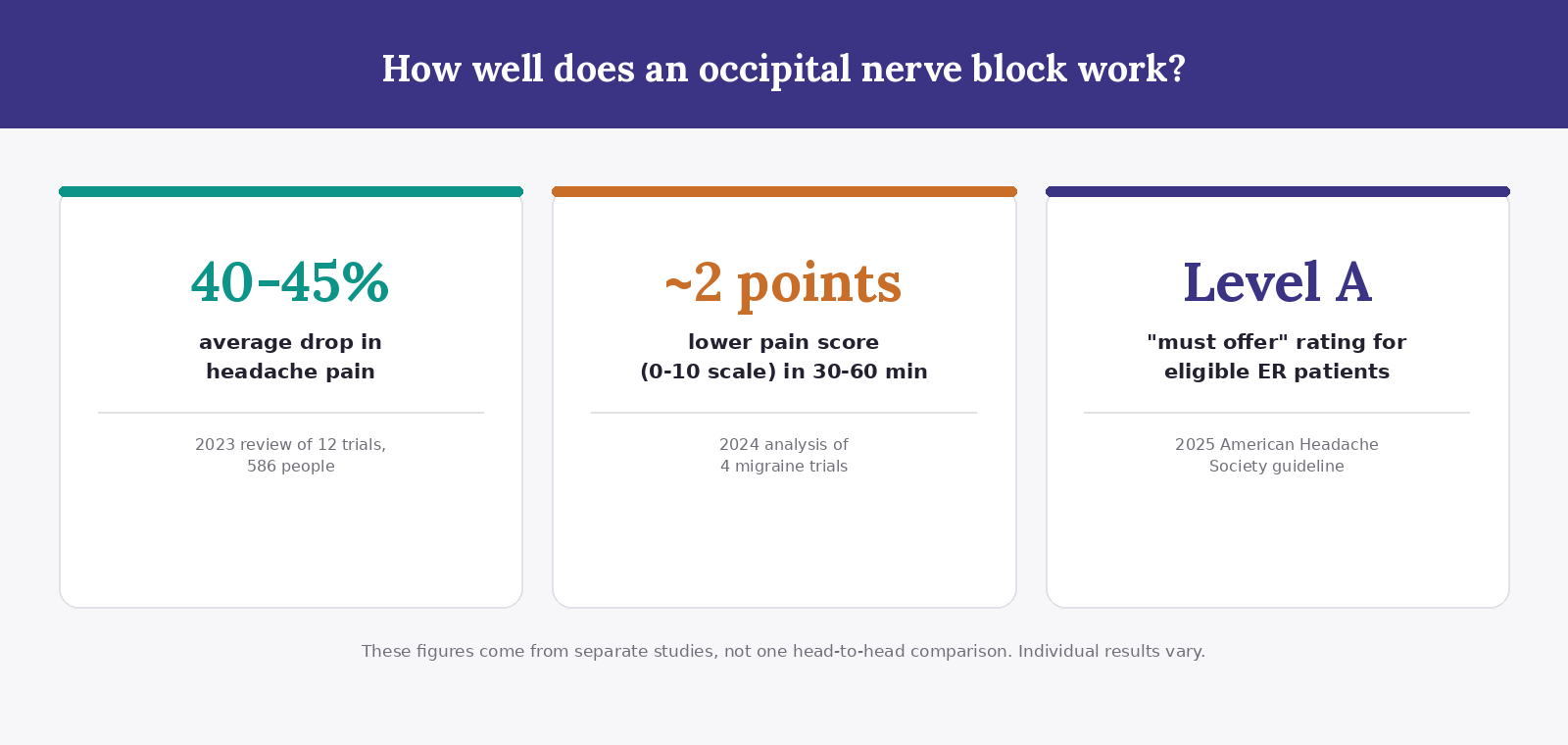
For migraine specifically, a 2024 analysis of four trials looked at pain scores on a 10-point scale. It found the block lowered scores by roughly 2 points within 30 to 60 minutes.⁵ A separate 2023 review called the block effective and safe across migraine, cluster headache, cervicogenic headache, and postdural puncture headache.³
This treatment has earned strong backing for emergency use, too. In 2025, the American Headache Society reviewed new trial data. It gave this block its highest rating, "must offer," for eligible adults with migraine in the emergency department. IV prochlorperazine, a nausea medicine, received the same top rating.⁶
Not everyone responds the same way. Results can be hard to predict from person to person. People with clear tenderness over the occipital nerve tend to respond best.¹
How long does relief from an occipital nerve block last?
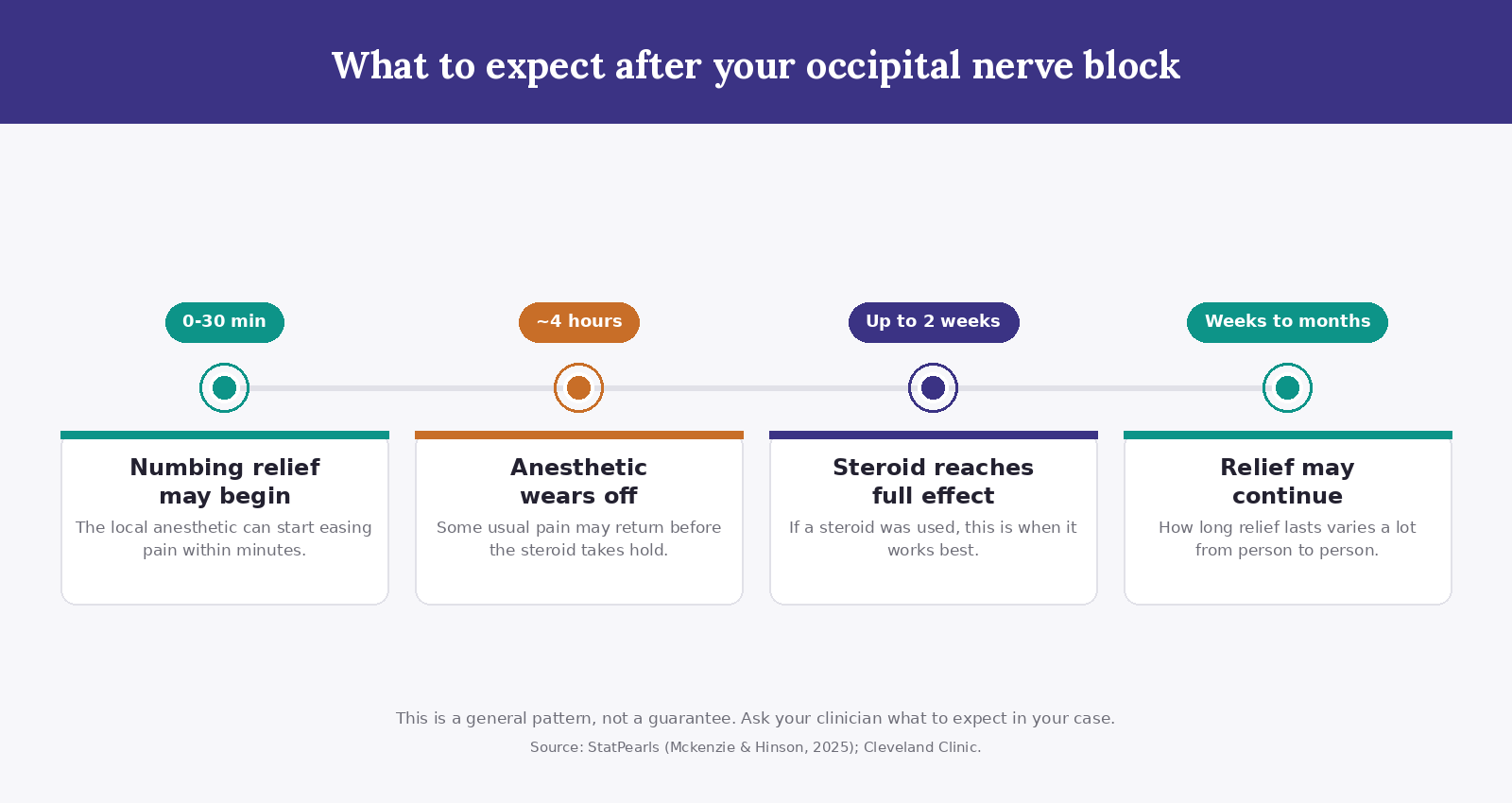
The numbing part wears off fast, often within about four hours. If a steroid was included, it takes longer to kick in, sometimes up to two weeks. Once it does, relief can last anywhere from a few weeks to several months.¹
There is a short gap to plan for. After the numbing wears off and before the steroid takes hold, some of your usual pain may return. This is expected. It does not mean the treatment failed.
Is an occipital nerve block safe?
Yes, for most people. It is considered a low-risk, outpatient procedure that does not need general anesthesia.¹ Serious complications are rare.
Common, mild effects include:
- Pain, redness, or swelling at the injection site.¹
- Temporary dizziness, numbness, or lightheadedness.¹
- A short-term flare in headache before things improve.
In rare cases, too much numbing medicine can reach your bloodstream. This can cause more serious effects, like an irregular heartbeat.¹ This is why a trained clinician gives the block in a monitored setting. Tell your clinician right away if any symptom feels severe or does not improve.
Who is a good candidate for an occipital nerve block?
This treatment tends to help people whose scalp is tender to the touch over the occipital nerve.¹ It can also be a good fit if:
- Oral preventive medicines have not worked well enough, or you are waiting for a newer medicine to take full effect.¹
- You are in the emergency department with a migraine attack that needs fast, injectable treatment.⁶
- You are pregnant and need options with a strong safety record. A 2025 study and a 2023 randomized trial both found this block to be safe and effective for migraine during pregnancy.⁷⁸
Pregnancy and breastfeeding still call for a conversation with your own clinician about risks and benefits, since research in this area remains limited.⁷
What conditions respond best, and how strong is the evidence?
This is a general summary, not a promise of how any one person will respond.
Frequently asked questions
Does an occipital nerve block hurt?
It involves a quick needle stick, and your pain might briefly feel worse during the injection.¹ Most people describe the discomfort as brief and manageable. The whole visit takes about 15 to 20 minutes.
How soon does an occipital nerve block start working?
Some people feel relief within 20 to 30 minutes.¹ If a steroid is included, full benefit can take up to two weeks to appear.
How often can you get an occipital nerve block?
This depends on your condition and how you respond. Clinicians generally avoid giving more than three blocks within six months.¹ If you need blocks more often, they will look at other options with you.
Is an occipital nerve block the same as Botox for migraine?
No. An occipital nerve block uses a local anesthetic, sometimes with a steroid, and can work within minutes to hours.¹ Botox is a separate treatment given every 12 weeks for chronic migraine and works differently in the body.
Can I get an occipital nerve block while pregnant?
It is sometimes considered for pregnant patients who need options with a strong safety history when other treatments are not a good fit. A 2023 randomized trial and a 2025 cohort study both support its use in pregnancy.⁷⁸ Always discuss the risks and benefits with your own clinician.
Will insurance cover an occipital nerve block?
Many insurance plans do cover it, especially when other treatments have not worked well. Coverage details vary, so check with your plan and your care team before scheduling.
A hopeful next step
Living with head pain that will not let up can feel exhausting. An occipital nerve block will not solve everything on its own. But for many people, it offers real, fast relief. It can also give you a clearer sense of what is driving the pain.
At Haven Headache & Migraine Center, our specialists can tell you whether this procedure fits your situation, and walk you through what to expect from start to finish.
Medically reviewed by: Karissa Secora, DMSc, PA-C, AQH, Haven Headache & Migraine Center
Peer reviewed by: Samantha Clem, PA-C, AQH, Haven Headache & Migraine Center
References
- Mckenzie D, Hinson MR. Occipital Nerve Block. StatPearls [Internet]. Updated July 30, 2025. Treasure Island (FL): StatPearls Publishing. https://www.ncbi.nlm.nih.gov/books/NBK580523/
- Cleveland Clinic. Occipital Nerve Block: What It Is, Procedure & Side Effects. Updated December 5, 2025. https://my.clevelandclinic.org/health/treatments/24934-occipital-nerve-block
- Castillo-Álvarez F, Hernando de la Bárcena I, Marzo-Sola ME. Greater occipital nerve block in the treatment of headaches. Review of evidence. Med Clin (Barc). 2023;161(3):113-118. https://pubmed.ncbi.nlm.nih.gov/37100680/
- Evans AG, Joseph KS, Samouil MM, Hill DS, Ibrahim MM, Assi PE, Joseph JT, Al Kassis S. Nerve blocks for occipital headaches: a systematic review and meta-analysis. J Anaesthesiol Clin Pharmacol. 2023;39(2):170-180. https://pmc.ncbi.nlm.nih.gov/articles/PMC10410037/
- Li W, Tang L. Influence of greater occipital nerve block on the relief of acute migraine: a meta-analysis. Medicine (Baltimore). 2024;103(42):e39955. https://pubmed.ncbi.nlm.nih.gov/39432635/
- Robblee J, Minen MT, Friedman BW, Cortel-LeBlanc MA, Cortel-LeBlanc A, Orr SL. 2025 guideline update to acute treatment of migraine for adults in the emergency department: The American Headache Society evidence assessment of parenteral pharmacotherapies. Headache. 2026;66(1):53-76. https://headachejournal.onlinelibrary.wiley.com/doi/10.1111/head.70016
- Smirnoff L, Moskatel L, Shaw B, He Z, Peretz A. A retrospective cohort study to evaluate the effectiveness and safety profile of occipital nerve blocks in the treatment of migraine during pregnancy. Headache. 2025 Nov-Dec;65(10):1727-1733. https://headachejournal.onlinelibrary.wiley.com/doi/full/10.1111/head.15001
- Bushman ET, Blanchard CT, Cozzi GD, Davis AM, Harper L, Robbins LS, Jones B, Szychowski JM, Digre KB, Casey BM, Tita AT, Sinkey RG. Occipital Nerve Block Compared With Acetaminophen and Caffeine for Headache Treatment in Pregnancy: A Randomized Controlled Trial. Obstet Gynecol. 2023;142(5):1179-1188. https://pmc.ncbi.nlm.nih.gov/articles/PMC10591891/
This article is for general education and is not medical advice. It is not a substitute for care from a qualified health professional. Always talk with your clinician before starting, stopping, or changing any treatment. If you have a sudden, severe headache, the worst headache of your life, or a headache with new symptoms like weakness, trouble speaking, or vision loss, seek emergency care right away.