

Is Tech Neck Triggering Your Migraines?


Neck Pain and Migraine: Is tech neck triggering your attacks?
Neck pain and migraine are closely linked — so closely that many people wonder which is causing which. A 2022 systematic review and meta-analysis found that neck pain affects a pooled 77% of people with migraine, compared to just 23% of people without headache disorders.¹ But neck pain in migraine is more complicated than it looks. Sometimes it is a symptom of the migraine attack itself. Sometimes it is a structural problem in the cervical spine that genuinely triggers attacks. And in many people, both things are true at once. Understanding the difference is what gets you to the right treatment.
Key takeaways
- Neck pain is present in roughly 77% of people with migraine — but in many cases it is a prodrome symptom of the attack, not a cause.¹
- The trigeminocervical complex (TCC) is the anatomical reason head and neck pain are so tightly linked: pain signals from the upper cervical spine and the trigeminal nerve converge on shared neurons in the brainstem.
- Forward head posture — the "tech neck" position from hours of screen and phone use — increases biomechanical load on the upper cervical spine and is an independent predictor of cervicogenic headache.²
- Cervicogenic headache (CGH) is a distinct secondary headache originating from cervical structures. It can coexist with migraine and is often confused for it.
- A 2024 RCT found that adding Mulligan manual therapy (a type of physical therapy intervention) to exercise reduced headache frequency in CGH by an additional 2–4 days per month compared to exercise alone, with effects maintained at 26 weeks.³
- Treating neck dysfunction helps cervicogenic headache. It does not treat the underlying neurological condition of migraine, which requires its own care.
The anatomy behind the connection: the trigeminocervical complex
To understand why neck pain and head pain overlap so thoroughly, you need to know about one structure: the trigeminocervical complex (TCC).
The TCC is a region of the upper spinal cord where sensory nerve fibers from the trigeminal nerve — the main pain pathway of the face and head — and sensory fibers from the upper three cervical spinal nerves (C1, C2, C3) converge on the same second-order neurons.⁴ This anatomical convergence means that pain signals from either source can be misread by the brain as coming from the other.
Pain originating in the upper cervical joints or muscles can be perceived as head pain — typically a dull ache starting at the back of the skull and radiating forward. Conversely, pain generated during a migraine attack can be felt as neck pain or stiffness, even though the neck itself is perfectly fine.
This bidirectional referral explains several clinically important patterns:
- Neck stiffness that appears before or during a migraine attack often reflects sensitization in the TCC — not a cervical problem
- Cervical facet joint disease or muscle dysfunction can activate the TCC and lower the threshold for migraine attacks
- Treating the neck can reduce attack frequency in people with genuine cervical dysfunction, but cannot address the underlying neurological basis of migraine
A 2025 narrative review in Cephalalgia summarized the current evidence: cervical musculoskeletal disorders as a source of neck pain are found in the minority of migraine patients — approximately 40% — while in the majority, neck pain reflects central sensitization within the TCC rather than a structural cervical problem.⁵
Neck pain as a migraine prodrome: the signal you may be misreading
One of the most important recent findings in migraine research is that neck pain is frequently a premonitory symptom — an early warning sign that a migraine attack is already underway, not a cause of it.
Prospective diary-based studies have identified neck pain as a premonitory symptom in up to 50% of migraine attacks.⁵ It typically appears within two hours of the headache phase and is more common in migraine without aura than with aura. The 2025 REFORM study found substantial overlap between what patients perceive as triggers and what are actually early symptoms of the unfolding attack.⁶
This matters practically: if you notice neck stiffness and reach for neck stretches or massage, you may be treating a symptom of an attack that has already begun — not preventing the next one. Recognizing neck pain as a potential prodrome can help you use your acute migraine treatment earlier, which is typically more effective.
What is "tech neck" and why does it matter?
Tech neck is the colloquial term for forward head posture (FHP) — the head drifting forward of the shoulders during sustained phone or computer use, with the chin tilted down and the upper back rounding.
The mechanical problem is one of load. The head weighs approximately 10–12 pounds in neutral alignment. When the neck is bent forward, more squeezing force builds up in the spine for the same amount of muscle effort. In other words, bending your head forward doesn't just use more muscle — it also presses down harder on the bones of your neck. A study from The Journal of Biomechanics reiterates the general idea that FHP puts more strain on your neck. The true amount of strain is different for different people, and depends on things like body build and even biological sex.⁷
Under sustained load, the suboccipital muscles must continuously fire to hold the head up. This compresses the upper cervical facet joints (especially C0/1, C1/2, and C2/3), the same joints whose innervation connects directly to the TCC. A 2025 cross-sectional study of 117 patients with neck pain and FHP found that a lower craniovertebral angle was an independent predictor of cervicogenic headache diagnosis (OR 0.878).²
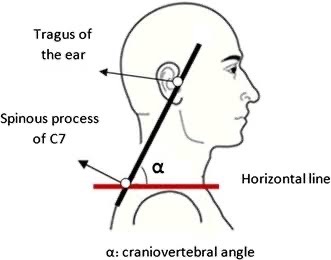
Image courtesy of European Spine Journal, Published by Springer. Online ISSN: 1432-0932
Office workers who spend more than three hours per day on computers show significantly higher rates of cervicogenic headache and neck-shoulder pain than their less sedentary counterparts.⁸
What is cervicogenic headache?
Cervicogenic headache (CGH) is a secondary headache disorder caused by a structural problem in the cervical spine.⁴ The pain originates from the neck and is referred upward into the head through the TCC pathway.
ICHD-3 diagnostic criteria for CGH require evidence that the headache is caused by a cervical disorder, with pain brought on or worsened by specific neck movements or sustained posture, and abolition of the headache by diagnostic blockade of a cervical structure.
Key features: CGH tends to be unilateral and non-pulsating, begins at the back of the skull and radiates forward, is clearly worsened by neck movement, and typically does not produce light sensitivity, sound sensitivity, nausea, or aura. The C2-3 facet joint is the most commonly implicated structure, accounting for roughly 70% of cases.⁴
CGH affects an estimated 1%–4.4% of the general population, shows a strong female predisposition (affecting women approximately four times more often than men), and has a mean age of presentation around 43 years.⁹
Cervicogenic headache vs. migraine: key differences
A critical clinical reality: these two conditions frequently coexist. Neck pain is associated with a 7.6-fold higher risk of developing chronic migraine.¹⁰ A 2024 systematic review by Al-Khazali et al. confirmed that neck disability scores are elevated in migraine — but cautioned that this often reflects allodynia and central sensitization rather than true musculoskeletal dysfunction.¹¹
What the evidence actually says about treating neck-related head pain
Physical therapy and manual therapy for cervicogenic headache. A 2022 systematic review found that upper cervical spinal manipulative therapy appears to be the most effective manual therapy technique for CGH, with improvements in headache frequency maintained over 40-week follow-up periods.¹²
A 2024 RCT published in the Journal of Physiotherapy tested Mulligan manual therapy (MMT) added to exercise versus exercise alone in 99 people with confirmed CGH. Adding MMT reduced headache frequency by an additional 2 days per month immediately post-intervention, growing to 4 fewer headache days per month at 26 weeks.³
A 2023 systematic review confirmed that craniocervical flexion training — targeting the deep neck flexors — is effective in reducing headache impact both as a standalone intervention and in combination with manual therapy.¹³
Key evidence-supported exercises:
- Deep cervical flexor training (chin tucks, craniocervical flexion progressions)
- Cervical range of motion exercises targeting restricted segments
- Upper thoracic mobility work
- Postural endurance training for the neck and shoulder girdle
What does not work for the migraine component. Current clinical guidelines do not recommend neck treatment as a primary intervention for migraine.⁵ Studies of neck muscle strengthening and joint mobilization in migraine populations have shown only minor improvements. Physical therapy addresses peripheral cervical input — not the central neurological basis of migraine.
Ergonomics and posture modification. Raising your phone or screen to eye level is the single highest-impact change for removing forward-flex load from the neck. Set your monitor so the top of the screen sits at or slightly below eye level. Take brief posture breaks every 20–30 minutes. A 2023 study found that young adult IT professionals developed measurable neck disability from sustained computer work well before symptoms became severe.¹⁴
Nerve blocks. Greater occipital nerve blocks serve two purposes for CGH: confirming the cervical diagnosis and providing therapeutic relief lasting weeks to months. They are typically performed by a headache specialist alongside physical therapy.
Frequently asked questions
Is my neck causing my migraine, or is migraine causing my neck pain?
Often both. Neck pain can be a prodrome symptom of migraine, or it can be part of ongoing central sensitization within the TCC. Separately, chronic cervical dysfunction can lower the migraine threshold. A 2025 Cephalalgia narrative review acknowledges this complexity explicitly and recommends a structured clinical evaluation to separate the contributions.⁵
Will treating my neck fix my migraine?
If cervical dysfunction is a consistent structural contributor, reducing it may lower attack frequency. But migraine is a neurological disease that requires its own management — physical therapy addresses one peripheral input, not the brain mechanisms that drive migraine.
How do I know if my headache is from my neck or from migraine?
CGH typically starts at the back of the skull, radiates forward, is clearly worsened by neck movement, and lacks light sensitivity, sound sensitivity, nausea, or aura. Migraine tends to be throbbing, comes with those sensory symptoms, and does not predictably change with neck position. A headache specialist can perform a cervical flexion-rotation test to detect a loss of range of motion, or reproduction of the headache pain.
My neck always stiffens before a migraine attack. Is that the neck causing it?
Probably not. Prospective diary studies show that neck pain and stiffness appear as premonitory symptoms in up to 50% of migraine attacks — meaning the migraine is already starting, and the neck stiffness is part of the attack. If this is your pattern, consider using your acute migraine medication early when you notice it.⁵
How much does tech neck actually contribute to headache?
For CGH, forward head posture severity is now a confirmed independent predictor of headache risk.² For people whose headaches fit a clear migraine pattern and occur regardless of neck position, tech neck is likely a secondary contributor. Office workers exceeding three hours of daily computer use show significantly elevated rates of CGH.⁸
Can neck injections help with migraine?
Greater occipital nerve blocks are used in both CGH and migraine. For migraine, they are typically used to treat severe acute attacks or as a bridge while preventive medications take effect. For CGH, they both confirm the diagnosis and provide relief.
Untangling neck pain from migraine is worth the effort
If your attacks consistently start with neck stiffness, are worsened by certain postures, or are closely tied to long screen sessions, bring that pattern explicitly to a headache specialist. A careful examination — including when neck pain appears relative to the headache, whether changing neck position affects the pain, and whether triptans work — can separate the contributions of each condition.
Treating both problems, when both are present, gives you more leverage over your pain than treating only one. Book an appointment with a Haven headache specialist and build a plan that accounts for the full picture.
Medically reviewed by Karly Kozlowski PA-C, BHS, MPA, Haven Headache & Migraine Center
Peer reviewed by Karissa Secora, DMSc, PA-C, AQH, Haven Headache & Migraine Center
References
- Al-Khazali HM, Younis S, Al-Sayegh Z, et al. Prevalence of neck pain in migraine: a systematic review and meta-analysis. Cephalalgia. 2022;42(7):663–673.
- Usen A, Gunduz MD. Cervicogenic headache in forward head posture: frequency and associated factors. J Oral Facial Pain Headache. 2025;39(3). PMC12520431.
- Satpute K, et al. Mulligan manual therapy added to exercise improves headache frequency, intensity and disability more than exercise alone in people with cervicogenic headache. J Physiother. 2024.
- Al Khalili Y, et al. Cervicogenic headache. StatPearls. NIH. Updated October 2022.
- Rees TA, et al. Neck pain in migraine: a narrative review and steps to correct evaluation and treatment. Cephalalgia. 2025.
- Thuraiaiyah J, Christensen RH, Al-Khazali HM, et al. Overlap between perceived triggers, premonitory symptoms and symptom persistence across migraine phases: A REFORM study. Cephalalgia. 2025.
- Reddy C, Zhou Y, Yin W, Zhang X. Advanced subject-specific neck musculoskeletal modeling unveils sex differences in muscle moment arm and cervical spine loading. Journal of Biomechanics. 2024;171:112181.
- Hwang U, et al. Classifying office workers with cervicogenic headache using posture-based deep learning models. Frontiers in Pain Research. 2025.
- Jobin K, et al. The treatment of cervicogenic headache with tDCS and exercise therapy. 2025. PMC12231782.
- Ishkanian G, et al. Involvement of cervical disability in migraine: a literature review. J Headache Pain. 2021. PMC8138615.
- Al-Khazali HM, et al. Systematic review and meta-analysis of Neck Disability Index and Numeric Pain Rating Scale in patients with migraine. Cephalalgia. 2024;44(8).
- Núñez-Cabaleiro E, Leiros-Rodríguez R. Effectiveness of manual therapy in the treatment of cervicogenic headache: A systematic review. Headache. 2022.
- Pardos-Aguilella P, et al. Effectiveness of therapeutic exercise for the management of cervicogenic headache: a systematic review. Physical Therapy in Sport. 2023.
- Stincel OR, et al. Assessment of forward head posture and ergonomics in young IT professionals. PMC. 2023. PMC9987472.
This article is for general education and is not medical advice. It is not a substitute for care from a qualified health professional. Always talk with your clinician before starting, stopping, or changing any treatment. If you have a sudden, severe headache, the worst headache of your life, or a headache with new symptoms like weakness, trouble speaking, or vision loss, seek emergency care right away.