

Migraine Elimination Diet: A Specialist's Complete Guide


Migraine Elimination Diet: what actually works — and how to do it safely
A migraine elimination diet is a structured way to find out which foods, if any, are making your attacks more frequent. Done carefully, it gives you real information. Done poorly, it creates a lot of unnecessary anxiety — and often no useful answers. This guide walks you through what the evidence actually shows, how to do it right, and when it's probably not worth your time.
Key takeaways
- Food triggers are real for some people with migraine — but they are not universal, and the evidence for eliminating entire food groups is limited.
- A short, targeted elimination period (four to six weeks) followed by careful reintroduction gives you the clearest signal.
- The strongest dietary evidence for migraine involves eating patterns — particularly increasing omega-3 fatty acids and reducing omega-6 fatty acids — rather than eliminating individual foods.
- A headache diary is the single most important tool before, during, and after any dietary change.
- Restrictive diets are not right for everyone. Children, people who are pregnant, and people with a history of disordered eating should not attempt elimination diets without close clinical guidance.
Does diet really affect migraine?
Yes — for some people. Diet doesn't cause migraine, which is a neurological disease driven by genetics and brain chemistry.¹ But certain foods can lower the threshold for an attack in people whose brains are already prone to them.
The relationship is messier than a simple "do not eat" list. Many commonly blamed foods — chocolate, citrus, cheese — are more likely cravings that show up during the prodrome, the early warning phase that can begin hours before pain starts. That craving for chocolate or a salty snack may be the brain signaling the start of an attack, not the food causing one. It's a distinction most elimination diet advice misses entirely.
A 2024 review from the Danish Headache Center looked at the full body of evidence.² Structured elimination diets, the ketogenic diet, and the DASH diet all showed reductions in attack frequency and severity in clinical trials — but most of those studies were small and designed differently, which makes it hard to know how much to generalize.²
Diet matters. It's one piece of the picture, not the whole thing.
What are the most common food triggers?
Research and clinical experience point to several food-related factors that seem to genuinely trigger attacks in a subset of people with migraine.¹²
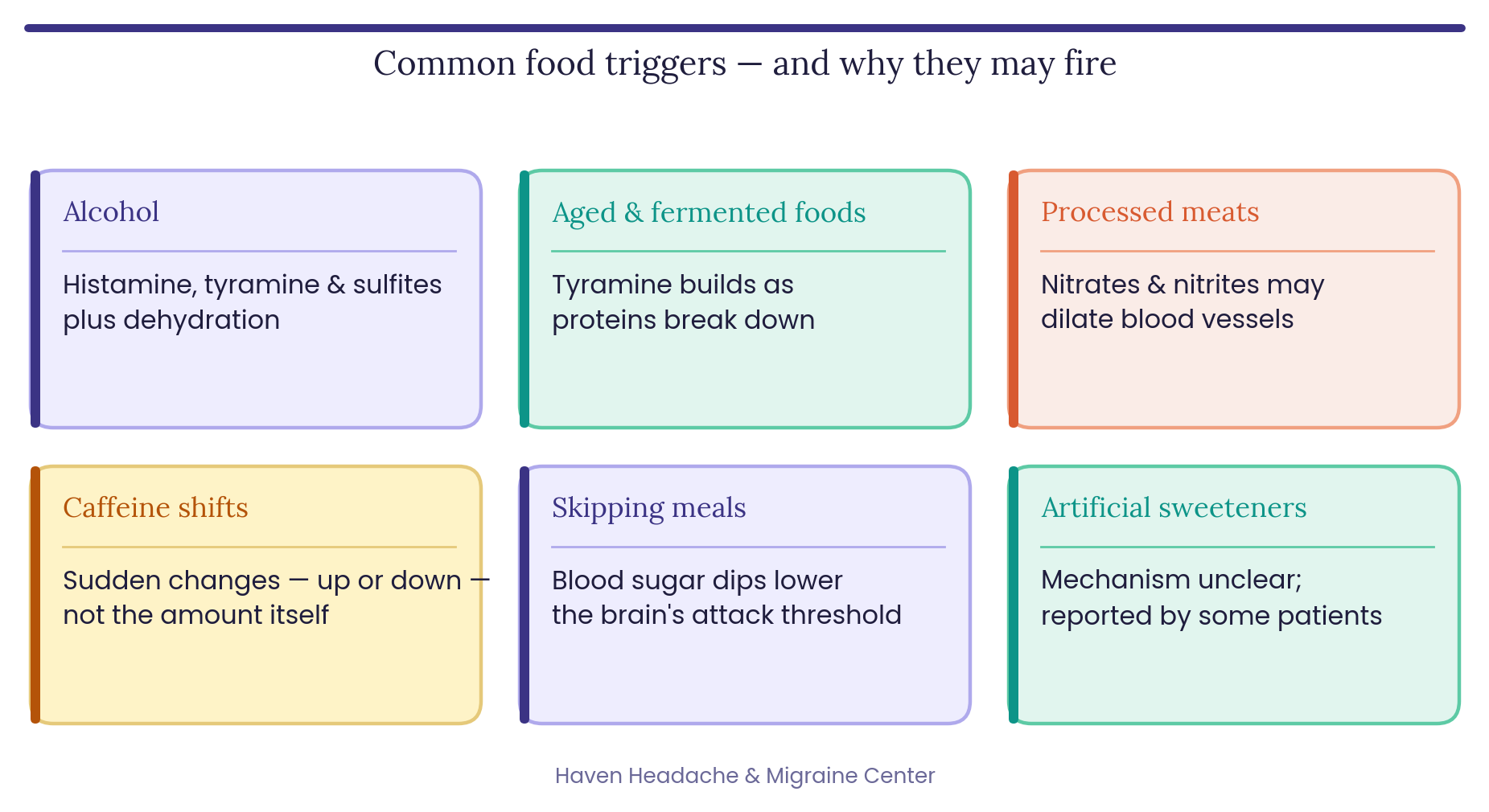
One important note on tyramine: a 2023 systematic review of seven studies found that the link between tyramine-containing foods and migraine remains mixed — some people are clearly affected, others are not.³ Blanket elimination of all aged cheese may not be necessary or helpful for you personally. Testing it is the only way to know.
What is a migraine elimination diet and how does it work?
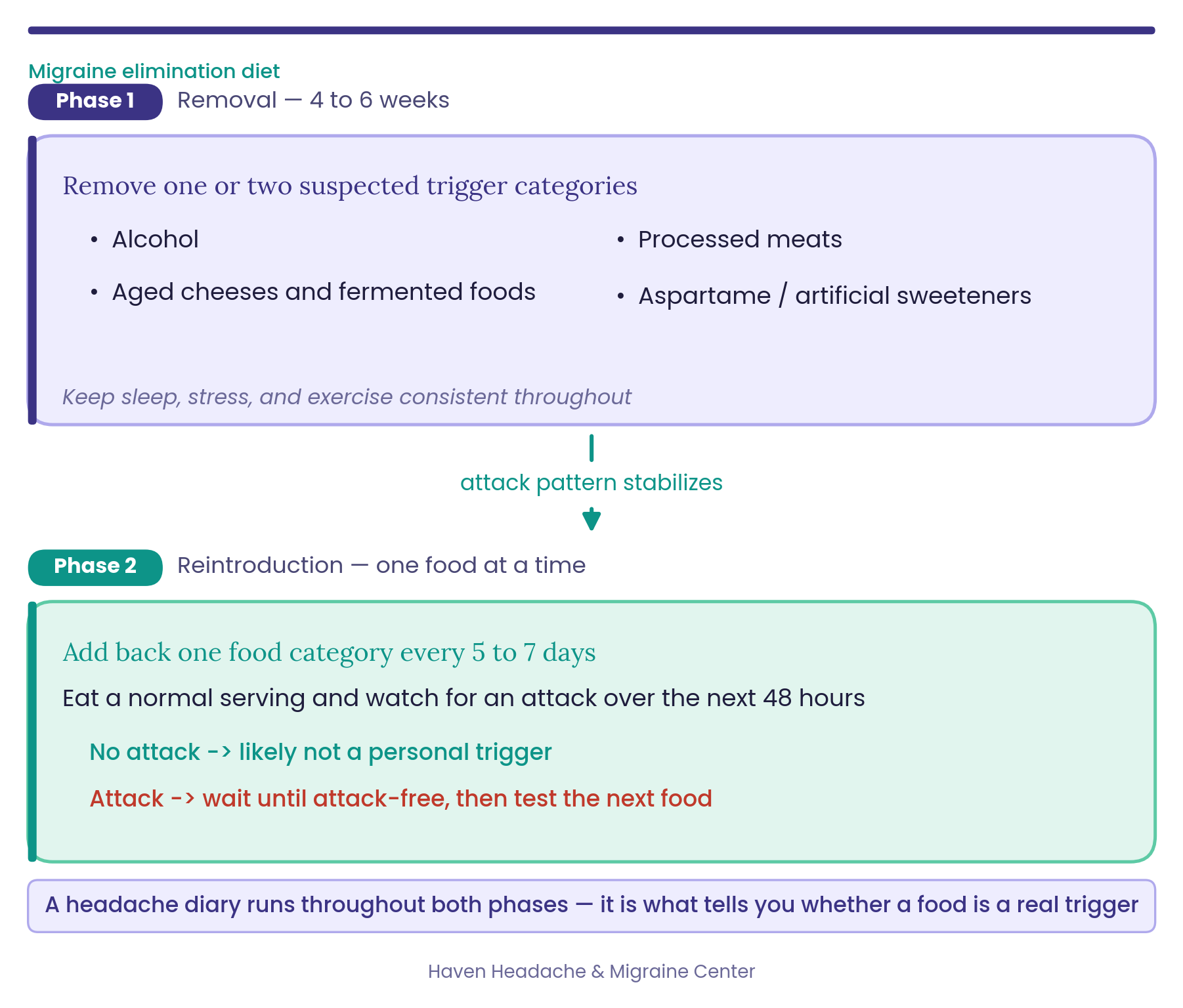
An elimination diet has two phases: a removal phase and a reintroduction phase. You temporarily take out suspected trigger foods, let your attack pattern stabilize, and then reintroduce foods one at a time to see which — if any — reliably produce attacks.
The key word is "reliably." A food is only a personal trigger if removing it lowers your attack frequency and reintroducing it raises it back up. A single coincidence is not a trigger.
Phase 1: removal (four to six weeks)
Remove the most common suspected triggers from your diet. Do not remove everything at once. Pick the category or two most suspicious based on your headache diary. Common choices:
- Alcohol
- Aged cheeses and fermented foods
- Processed meats
- Aspartame / artificial sweeteners
Keep everything else the same. Changing your sleep schedule, stress load, or exercise habits at the same time makes it impossible to know what caused any change in attack frequency.
Track your attacks in a headache diary throughout this period. Note date, duration, severity, and anything you ate in the 24 hours before the attack started.
Phase 2: reintroduction (one food at a time)
Reintroduce one food category every five to seven days. Eat a normal serving of the food and watch for an attack over the next 48 hours. If no attack occurs, that food is likely not your trigger. If an attack comes, wait until you are attack-free before testing the next food.
It's not a pleasant process. It takes patience and a decent amount of record-keeping. But it gives you actual personal data — which is far more useful than following a generic "migraine diet" list written for someone who isn't you.
Which diets have the strongest evidence?
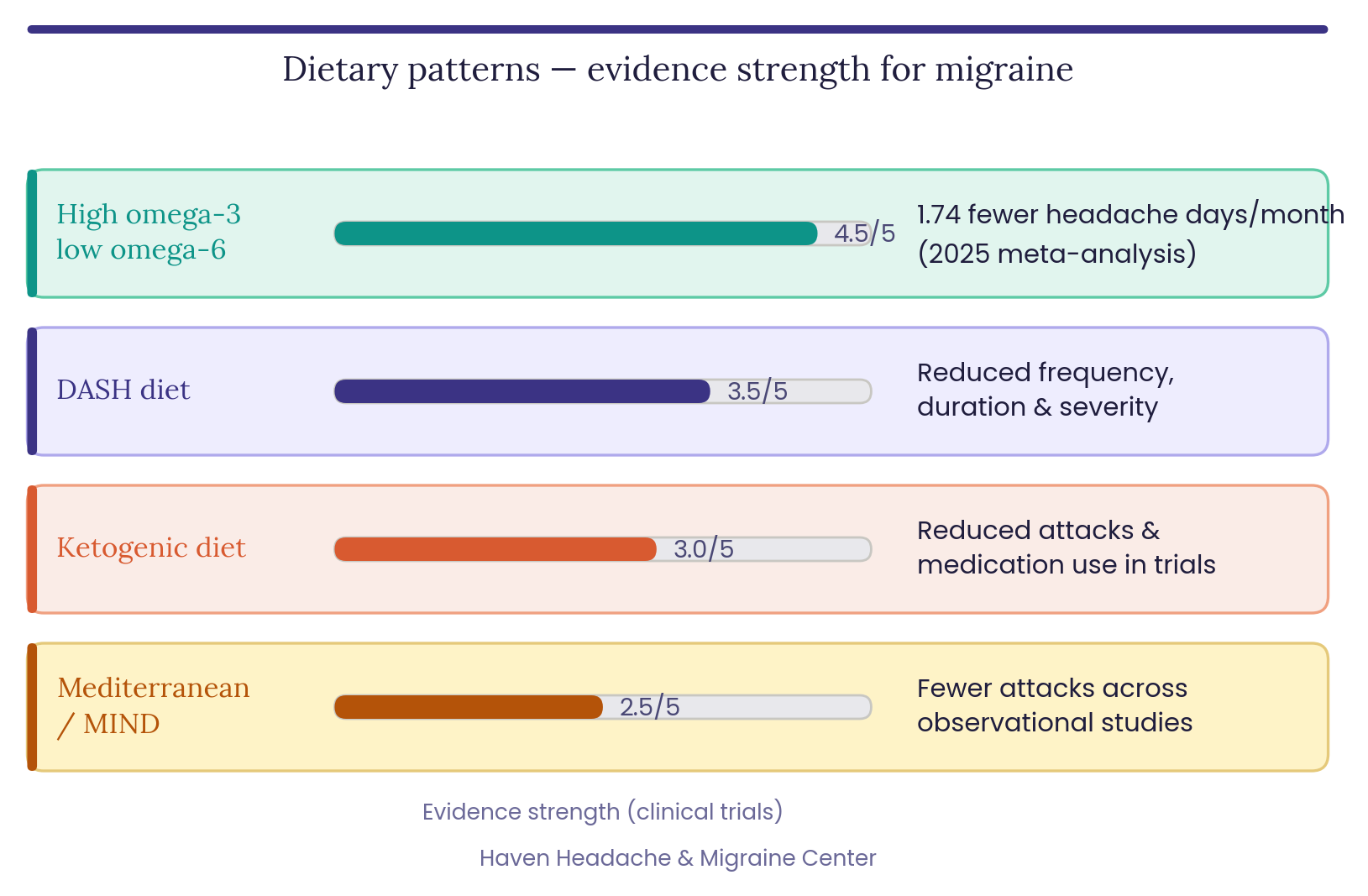
The omega-3 / omega-6 shift has the strongest data. Here's how that and a few other patterns stack up.
High omega-3, low omega-6 diet
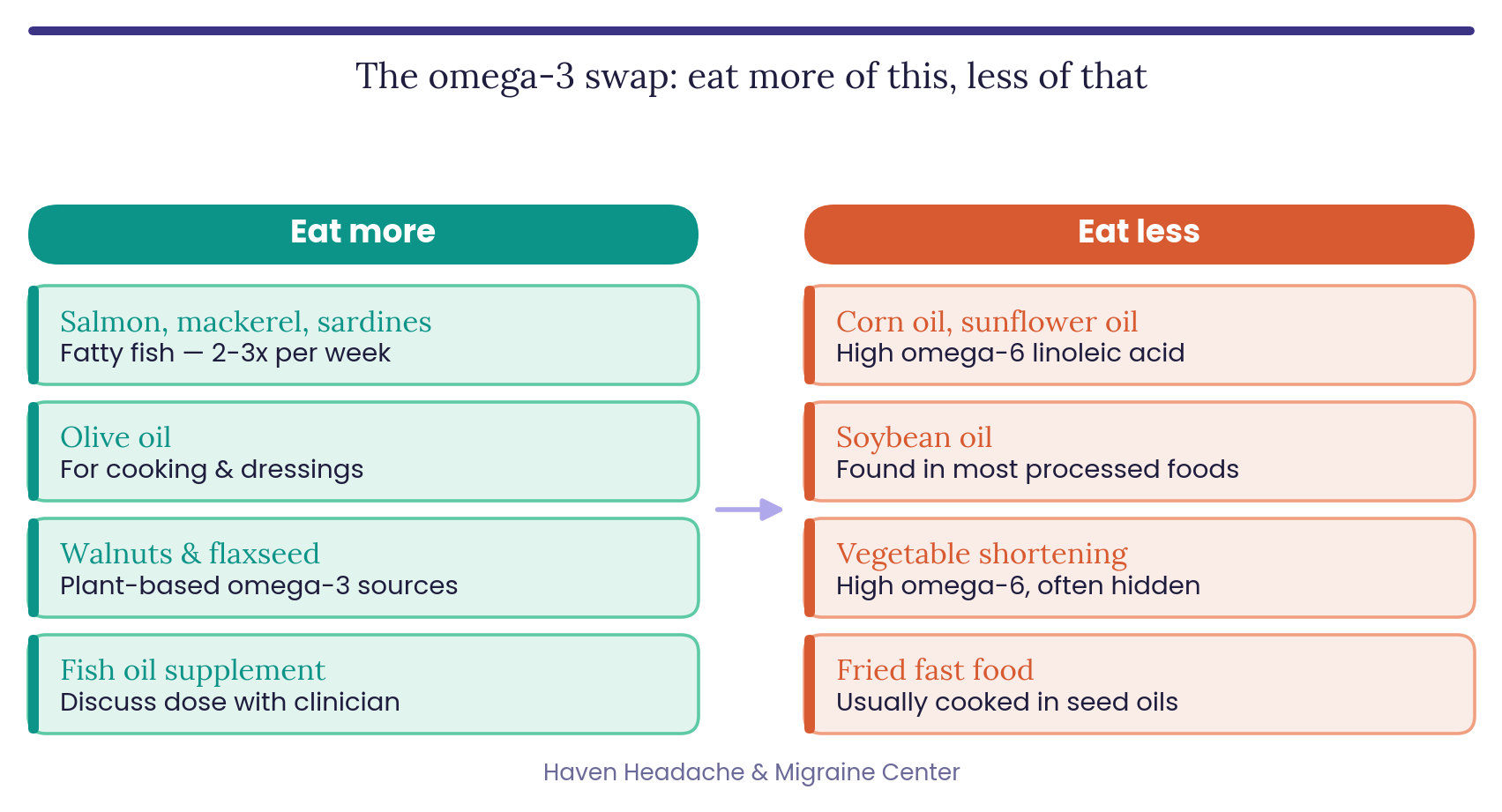
This one has the most consistent evidence. A 2021 randomized controlled trial of 182 adults with chronic and episodic migraine found that increasing omega-3 fatty acids (EPA and DHA, found in fatty fish like salmon, mackerel, and sardines) while reducing omega-6 linoleic acid (found in vegetable seed oils like corn, sunflower, and soybean oil) significantly reduced both the frequency and severity of attacks.⁴
A 2025 meta-analysis of clinical trials confirmed that omega-3 supplementation reduced migraine frequency by an average of 1.74 fewer headache days per month.⁵
The practical shift: eat more fatty fish (two to three servings per week), cook with olive oil instead of vegetable seed oils, and consider a fish oil supplement if you and your clinician decide it fits your care plan.⁴⁵
DASH diet
The DASH diet emphasizes fruits, vegetables, whole grains, lean proteins, and low-fat dairy, while limiting sodium, saturated fat, and added sugar. A 2024 review found it reduced migraine attack duration, frequency, and severity in clinical trials.² It also aligns closely with what a headache-brain-friendly pattern of eating looks like: consistent meals, no long fasting gaps, and anti-inflammatory foods.⁶
Ketogenic diet
A ketogenic diet is a very low-carbohydrate, high-fat diet that shifts the body into a state called ketosis. Some clinical trials have shown reductions in attack frequency and medication use.² The mechanism is not fully understood but may relate to how ketones affect brain metabolism.⁶
This diet is difficult to maintain and is not suitable for everyone. It should not be attempted without guidance from a clinician and a registered dietitian, as it can cause nutritional deficiencies and worsen other conditions.
Mediterranean and MIND diets
These patterns — emphasizing vegetables, legumes, whole grains, fish, and olive oil — are associated with better migraine symptoms across observational studies.⁶ They overlap significantly with the omega-3 / omega-6 shift described above.
What about food sensitivity testing?
You may have heard about IgG food sensitivity panels, which test your blood for antibodies to hundreds of foods and then suggest you avoid those that come back positive. Some randomized trials have shown reductions in attack frequency when people avoid their IgG-positive foods.²
The evidence is mixed. A 2025 sham-controlled trial of 98 adults found that a true IgG-guided elimination diet reduced migraine days, gut symptoms, and inflammatory markers more than a sham diet over 12 weeks.⁷ Other trials have found weaker results, especially past the first few weeks.² A lot of patients come in already doing IgG panels — and it's not that the test is worthless, it's that the evidence isn't strong enough for major headache organizations to recommend it broadly.² If you're considering it, bring it up with your headache clinician first.
How to use a headache diary to guide your diet
No elimination diet is worth doing without a headache diary. It's the only way to get a real baseline — and the only way to know whether what you changed actually made a difference.
The two things I always ask patients to track first: what time they ate, and how they slept the night before. Everything else is secondary, but worth capturing if you can:
- Date and day of week
- What you ate and drank (including any alcohol or caffeine)
- How many hours since your last meal when the attack started
- Sleep hours the night before
- Stress level (a simple 1-to-10 scale works)
- Menstrual cycle phase, if relevant
- Attack details: start time, peak intensity, duration, medications taken
After four to six weeks, patterns usually emerge. A lot of people find their attacks cluster around weekends — caffeine withdrawal from skipping the morning coffee — or around their period, or after bad sleep. That's just as useful as finding a food trigger. Sometimes more.
Practical tips for doing this safely
Don't skip meals. It's one of the most consistent dietary triggers, and it's easy to accidentally under-eat when you're cutting food groups. Keep a snack close. Aim to eat every four to five hours.
Drink water. Dehydration lowers the brain's threshold for an attack. Two liters a day is a reasonable floor — more if you exercise or it's hot.
Don't cut caffeine cold turkey. The problem with caffeine isn't how much you drink — it's variability. If you want to reduce it, taper slowly over several weeks. Same amount, same time, every day including weekends.
Pick one or two categories to eliminate, not six. Cutting too many things at once makes reintroduction uninterpretable and creates nutritional gaps. Start narrow.
Don't start this when your life is already chaotic. A major work deadline, a hormonal shift, a bout of bad sleep — any of those will muddy the data and may trigger more attacks on their own. Wait for a stable stretch.
Keep your clinician in the loop. This works best as part of a broader care plan, not as a substitute for it.
When diet is not the answer
Most people with migraine don't need a strict elimination diet. Food may not be a meaningful trigger for you at all. Sleep is the big one for most patients — followed by stress, hydration, and whether you're on the right preventive treatment. Diet is usually further down the list than people expect.
If you've tried dietary changes and seen nothing shift, that's actually useful information. It means your triggers likely lie elsewhere, and it's worth spending your energy there instead.
What Haven's approach looks like
Most patients who come to Haven have already been told to "try an elimination diet" — usually without any guidance on how to actually do it. We run a proper structured trial: a headache diary, a clear elimination plan, and a real read on the data at follow-up. When food turns out not to be the issue, we move on to what is.
If you want to work through this with someone who will look at the full picture — not just hand you a list — we're here.
Medically reviewed by: Karissa Secora, DMSc, PA-C, AQH, Haven Headache & Migraine Center
Peer reviewed by: Alicia Chang, FNP-BC, Haven Headache & Migraine Center
References
- Arzani M, Jahromi SR, Ghorbani Z, et al. Gut-brain axis and migraine headache: a comprehensive review. J Headache Pain. 2020;21(1):15. https://pmc.ncbi.nlm.nih.gov/articles/PMC7352457/
- Nguyen KV, Schytz HW. The evidence for diet as a treatment in migraine — a review. Nutrients. 2024;16(19):3415. https://pmc.ncbi.nlm.nih.gov/articles/PMC11478386/
- Sudharta H, Darmawan O, Barus JFA. Tyramine ingestion and migraine attack: a systematic review. Open Access Maced J Med Sci. 2023;11(F):156-162. https://oamjms.eu/index.php/mjms/article/view/11484
- Ramsden CE, Zamora D, Faurot KR, et al. Dietary alteration of n-3 and n-6 fatty acids for headache reduction in adults with migraine: randomized controlled trial. BMJ. 2021;374:n1448. https://pubmed.ncbi.nlm.nih.gov/34526307/
- Sabet H, Abbas A, Alkhawaldeh IM, et al. Omega-3 supplementation in migraine prophylaxis: an updated systematic review and meta-analysis. PharmaNutrition. 2025. https://www.sciencedirect.com/science/article/abs/pii/S2213434425000039
- Behrouz V, Hakimi E, Mir E. Impact of dietary patterns on migraine management: mechanisms of action and recent literature insights. Brain Behav. 2025;15(7):e70652. https://onlinelibrary.wiley.com/doi/10.1002/brb3.70652
- Zhao Z, Yang M, Wan F, Ning B, Song T, Fu J, Zhang L. Food-specific IgG-based elimination diet decreased IL-6, TNF-α, and CGRP and improved symptoms in adults with migraine. Front Nutr. 2025;12:1720389. https://www.frontiersin.org/journals/nutrition/articles/10.3389/fnut.2025.1720389/full
This article is for general education and is not medical advice. It is not a substitute for care from a qualified health professional. Always talk with your clinician before starting, stopping, or changing any treatment. If you have a sudden, severe headache, the worst headache of your life, or a headache with new symptoms like weakness, trouble speaking, or vision loss, seek emergency care right away.
Frequently asked questions
Do I need to follow an elimination diet to manage migraine?
Not necessarily. Many people with migraine do not have significant food triggers, and the most impactful changes involve sleep, stress, hydration, and finding the right preventive treatment. An elimination diet is useful when you and your clinician have reason to believe food plays a role in your specific attack pattern.
How long does a migraine elimination diet take?
The removal phase typically runs four to six weeks. Reintroduction adds another four to eight weeks if you are testing several food categories. Plan for two to three months total if you want interpretable results.
What foods should I cut out first?
Start with the category you most strongly suspect based on your headache diary. For most people, alcohol is the highest-yield target. Aged cheeses and processed meats are next if you eat them frequently. Avoid cutting everything at once.
Can a ketogenic diet help migraine?
Some clinical trials show reductions in attack frequency with a ketogenic diet. It is not a first-line recommendation because it is difficult to maintain and may not be suitable for everyone. Talk with a clinician and a dietitian before trying it.
Is caffeine a migraine trigger?
Caffeine is not simply good or bad for migraine. Consistent daily caffeine intake is fine for most people. The problem is variability — sudden increases or sudden drops are common triggers. Keeping the same amount at the same time every day, including weekends, matters more than the absolute amount.
Can omega-3 fatty acids really reduce migraine frequency?
Evidence from multiple clinical trials and a 2025 meta-analysis suggests that omega-3 supplementation reduces migraine frequency by close to two fewer headache days per month on average. Eating more fatty fish and cooking with olive oil rather than seed oils is a reasonable, low-risk dietary shift to discuss with your clinician.
Should children with migraine try an elimination diet?
Do not put children or teens on restrictive elimination diets without close guidance from a clinician and a registered dietitian. Nutritional needs during growth are significant, and unguided restriction can cause harm.