

Low-Pressure Headache & CSF Leak

.jpeg)
Low-pressure headache and CSF leak: what you need to know
A headache that gets worse the moment you stand up — and fades when you lie down — is not a typical headache. It is a red flag for something called a cerebrospinal fluid (CSF) leak, a condition that is far more common than most people realize and one that is, unfortunately, often missed for months or even years.
The good news: once it is found, there are effective treatments that can bring real relief.
Key takeaways
- A low-pressure headache, also called spontaneous intracranial hypotension (SIH), happens when fluid leaks from around the brain and spinal cord, lowering pressure inside the skull.
- The defining symptom is a headache that gets much worse when you sit or stand and improves when you lie flat.
- SIH is often misdiagnosed as migraine or tension headache, delaying care.
- Brain MRI, spinal imaging, and specialized myelography are the main tools for diagnosis.
- Treatment ranges from rest and hydration to an epidural blood patch (EBP) or, in some cases, surgery.
- Getting the right diagnosis is the first step toward recovery.
What is a CSF leak, and what causes low pressure?
Cerebrospinal fluid (CSF) is the clear liquid that cushions your brain and spinal cord. It keeps the brain floating gently inside the skull. When CSF leaks out faster than your body makes it, the fluid level drops and so does the pressure inside your skull.⁷
That drop in pressure causes the brain to sag slightly downward. The sag pulls on pain-sensitive structures — the meninges (the tissue layers around the brain) and the bridging veins — and that traction is what triggers the headache.⁹
The leak almost always happens in the spine, not the skull.⁷ Three main types of spinal leaks are recognized:³
- Ventral dural tear. A tiny slit in the front wall of the spinal canal, often caused by a calcified spinal disc pressing against the dura (the outer protective layer around the spinal cord).
- Meningeal diverticulum. A small outpouching of the protective lining at a spinal nerve root that can rupture.
- CSF-venous fistula (CVF). An abnormal connection between the spinal fluid space and a nearby vein, allowing CSF to drain continuously into the bloodstream.
Some leaks happen after a spinal procedure such as a lumbar puncture (spinal tap) or epidural injection. When a leak occurs with no clear cause, it is called spontaneous intracranial hypotension, or SIH.⁷
SIH is estimated to affect about 5 in every 100,000 people each year, though that number is thought to be an undercount because the condition is so often mistaken for something else.³ It is more common in women, and the average age at diagnosis is around 42.³
What does a low-pressure headache feel like?
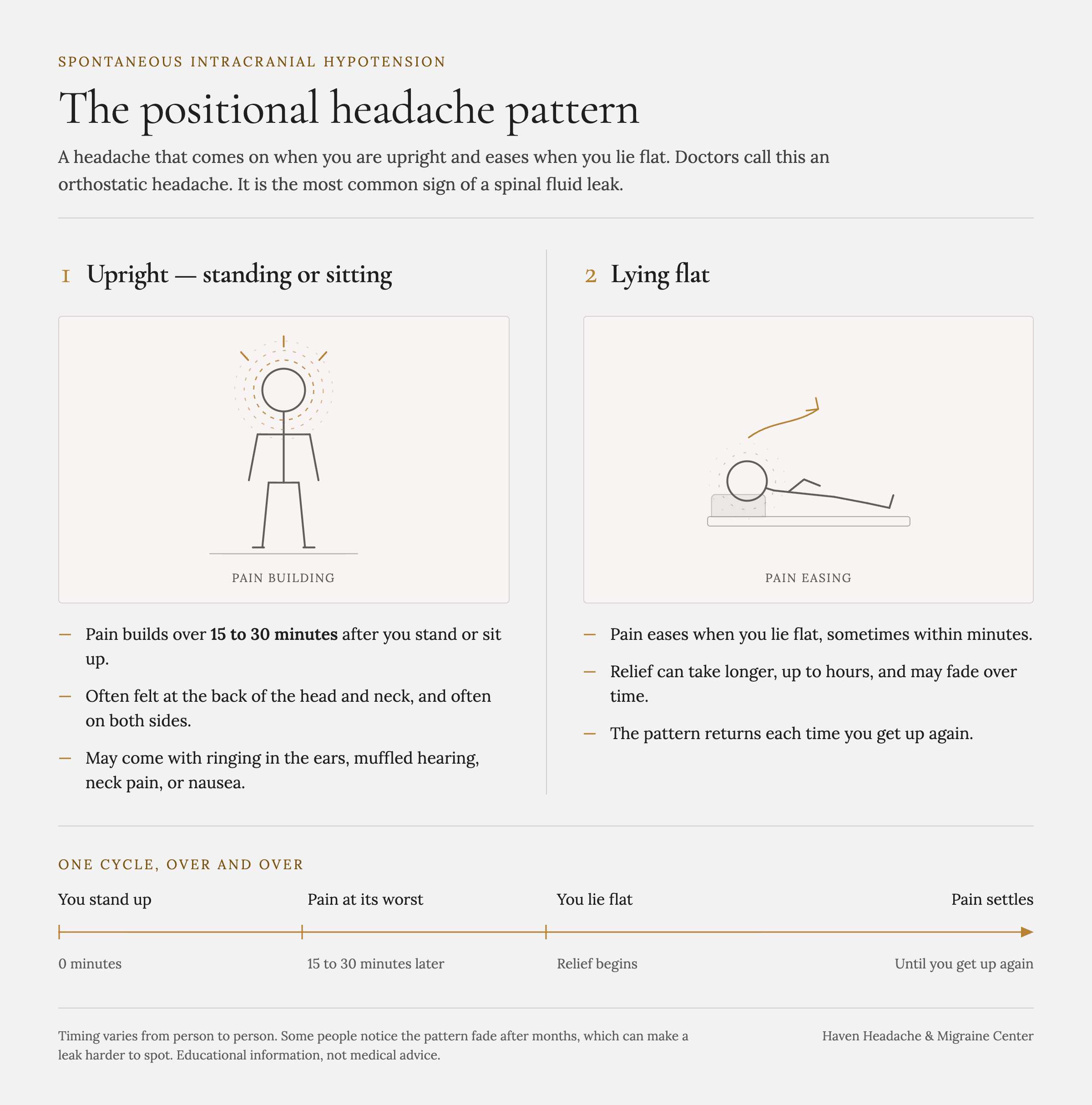
The hallmark is a positional headache — meaning it changes with body position.⁴
When you stand or sit, the headache comes on or gets much worse — often within 15 to 30 minutes. When you lie down flat, it eases or goes away entirely. This pattern is called an orthostatic headache.⁶
Other symptoms that often come with a low-pressure headache include:³,⁴
- Neck or back pain
- Nausea
- Ringing in the ears (tinnitus)
- Sensitivity to light (photophobia)
- Dizziness
- Muffled or muffled hearing
- Visual disturbances
- Brain fog or difficulty concentrating
In severe or long-untreated cases, some people develop complications such as bleeding around the brain (subdural hematoma) or cognitive changes.⁴
One important note: over time, the classic positional pattern can become less clear. If a leak goes on for months without treatment, some people find they need to lie down for longer and longer periods to feel relief.⁸ The headache may start to feel constant rather than positional, which can make diagnosis even harder.
Why is this condition so often missed?
SIH is one of the most underdiagnosed headache conditions in practice.⁸ Many people are told they have migraine or tension headache and prescribed treatments that do not help, sometimes for years before a CSF leak is considered.
There are several reasons for this:³,¹⁶
- General awareness of SIH outside of headache specialty centers is low.
- At least 19% of people with SIH have a brain MRI that looks completely normal.
- Spinal fluid pressure measured during a lumbar puncture is within the normal range for most people with SIH.
- The symptoms overlap with migraine, especially as the headache becomes less positional over time.
This is why seeing a headache specialist — someone trained specifically in headache disorders — makes such a difference. A specialist knows to look for the positional pattern and order the right imaging, even when standard tests look normal.
How is a CSF leak diagnosed?
Diagnosis starts with the clinical picture — that distinctive story of a headache that is clearly worse when upright and better when flat.³
Brain MRI with and without contrast is usually the first imaging test. It can show characteristic changes from low CSF pressure:⁹
- Diffuse enhancement (brightening) of the meninges on contrast images
- Downward sagging of the brain and brainstem
- Enlarged pituitary gland
- Enlarged dural venous sinuses
- Small collections of fluid around the brain (subdural hygromas or hematomas)
A scoring tool called the Bern Score uses these MRI findings to estimate how likely it is that a leak or CSF-venous fistula will be found on more detailed imaging.¹⁰ Even when the score is low, evaluation should continue if clinical suspicion is high.¹⁶
Spinal imaging looks for the source of the leak. Options include:³
- Spinal MRI — may show fluid collecting in the epidural space or enlarged meningeal pouches.
- CT myelography — contrast dye is injected into the spinal canal and imaged under CT scan, showing where fluid is escaping.
- Digital subtraction myelography (DSM) — a more sensitive technique for finding CSF-venous fistulas that can be missed on standard CT myelography.
Finding the exact location of a leak, especially a CVF, often requires specialized imaging not available everywhere. This is another reason why headache specialist centers with neuroradiology support are so important.
How is a CSF leak treated?
Treatment is matched to the severity of symptoms and whether the leak location can be found.⁹
Conservative care is tried first for mild or recent-onset symptoms. It includes bed rest, increased fluid intake, and caffeine, which may help slow the leak or support CSF production. These measures offer temporary relief but are not a lasting fix for most people.⁹
Epidural blood patch (EBP) is the most common procedure for SIH. A small amount of the person's own blood is injected into the epidural space of the spine. The blood clots and acts as a patch over the leak.¹¹ A non-targeted EBP (placed in the lower spine without knowing the exact leak site) can provide significant relief, and a targeted EBP — placed right at the leak location — tends to work better when the leak has been found.¹⁶
EBP relieves symptoms for many people, though some need more than one procedure. Long-term, permanent closure of the leak is less reliably achieved with EBP alone.¹³
Fibrin glue injection is an alternative to blood used in targeted procedures, particularly for leaks that have not responded to EBP.¹³
Surgical repair is considered when less invasive treatments have not worked. Surgeons can directly close a dural tear or ligating (tie off) a meningeal diverticulum or CVF. When a precise leak location is confirmed, surgery tends to have excellent outcomes.¹³
Transvenous embolization is a newer minimally invasive approach for CSF-venous fistulas. A catheter is threaded through a vein to block the fistula from inside. Early results are promising.¹
Most people with SIH improve with appropriate care, especially when the leak is found and targeted.⁴ Some need repeat procedures or a combination of approaches. A few require ongoing follow-up even after symptoms resolve.²⁰
When should you seek care right away?
If you have any of these, get emergency evaluation immediately:
- A sudden, severe headache — the worst of your life
- Headache with weakness, numbness, or difficulty speaking
- Headache with vision loss
- Confusion or loss of consciousness
These symptoms can signal serious complications and need urgent care.
Frequently asked questions
What makes a low-pressure headache different from migraine?
The clearest difference is position. A low-pressure headache gets much worse when you stand or sit and improves when you lie down flat. Migraine attacks are not consistently tied to body position in this way. Both can cause nausea and light sensitivity, which is one reason SIH is so often mistaken for migraine. A headache specialist can help tell them apart.
Can a CSF leak heal on its own?
Sometimes. Small leaks, especially after a spinal procedure, may close on their own with rest and fluids. Spontaneous leaks are less likely to resolve without treatment, and leaving them untreated for a long time can lead to complications. Talk with a headache specialist rather than waiting.
Is a lumbar puncture (spinal tap) needed to diagnose SIH?
Not always. Most people with SIH have spinal fluid pressure in the normal range, so a normal lumbar puncture result does not rule it out.¹⁶ Brain and spinal MRI are usually the more useful first tests.
What is an epidural blood patch and is it safe?
An epidural blood patch is a procedure where a small amount of your own blood is injected into the epidural space near the leak site. The blood clots and seals the hole. It is done with a needle and takes about 20–30 minutes. It is considered a low-risk procedure and is the most common treatment for SIH when conservative care has not worked.¹¹
Can SIH come back after treatment?
Yes, for some people. Symptoms can return weeks to years after an initially successful EBP.¹⁴ When that happens, a second procedure or surgery may be considered. Ongoing follow-up with a headache specialist helps catch recurrence early.
Is SIH related to migraine?
They are separate conditions, but they can occur in the same person. Some people with migraine develop a CSF leak that makes their headaches much worse or changes their pattern. A thorough evaluation by a headache specialist can untangle what is driving each person's symptoms.
Are there connective tissue conditions linked to SIH?
Possibly. There is some evidence linking SIH to hypermobile Ehlers-Danlos syndrome (hEDS) and Marfan syndrome, conditions that affect the strength of connective tissue, including the dura. The research is still developing and the connection is not confirmed in all studies.³ If you have a connective tissue condition and develop a positional headache, let your clinician know.
You deserve a clear answer
Living with a headache that keeps you pinned to bed is exhausting and frightening — especially when you have been told it is "just migraine" or "nothing serious." A CSF leak is real, it is diagnosable, and it is treatable.
The key is getting to a provider who knows what to look for. At Haven Headache & Migraine Center, we specialize in exactly these kinds of complex headache conditions — the ones that other providers miss. If your headache has a clear positional pattern, or if treatments for migraine have not helped, it may be time for a fresh evaluation.
Medically reviewed by: Stephanie Messina, MHS, PA-C, Haven Headache & Migraine Center
References
- NORD. Spontaneous Intracranial Hypotension. National Organization for Rare Disorders. Updated 2024. https://rarediseases.org/rare-diseases/spontaneous-intracranial-hypotension/
- Mehta D, Cheema S, Davagnanam I, Matharu M. Diagnosis and treatment evaluation in patients with spontaneous intracranial hypotension. Front Neurol. 2023;14:1145949. https://www.ncbi.nlm.nih.gov/pmc/articles/PMC10036855/
- Mehta D, Cheema S, Davagnanam I, Matharu M. Diagnosis and treatment evaluation in patients with spontaneous intracranial hypotension. Front Neurol. 2023;14:1145949. https://www.frontiersin.org/journals/neurology/articles/10.3389/fneur.2023.1145949/full
- University of Michigan Health. Spinal CSF Leak & Spontaneous Intracranial Hypotension (SIH) Program. https://www.uofmhealth.org/our-care/specialties-services/spinal-csf-leak-spontaneous-intracranial-hypotension-sih-program
- CSF Leak Association. Medical Guidelines Resources — Multidisciplinary Consensus Guideline for the Diagnosis and Management of SIH. 2023. https://csfleak.uk/resource/medical-guidelines
- UpToDate. Spontaneous intracranial hypotension: Pathophysiology, clinical features, and diagnosis. https://www.uptodate.com/contents/spontaneous-intracranial-hypotension-pathophysiology-clinical-features-and-diagnosis
- Hubbard L, Haber M, Bhimani AD, et al. Intracranial Hypotension. StatPearls. Treasure Island, FL: StatPearls Publishing. Updated July 2023. https://www.ncbi.nlm.nih.gov/books/NBK560764/
- DocPanel. How is Spontaneous Intracranial Hypotension Diagnosed? https://docpanel.com/intracranial-hypotension-caused-spontaneous-csf-leak-often-misdiagnosed
- Parmar H, et al. Spontaneous Intracranial Hypotension. StatPearls. Treasure Island, FL: StatPearls Publishing. Updated July 2023. https://www.ncbi.nlm.nih.gov/books/NBK559066/
- Callen AL, Friedman DI, Popoola S, et al. Diagnosis and Treatment of Spontaneous Intracranial Hypotension: Role of Epidural Blood Patching. Neurol Clin Pract. 2024;14(3):e200290. https://pmc.ncbi.nlm.nih.gov/articles/PMC11065326/
- Kranz PG, Rasmussen J, Amrhein TJ. A systematic review and meta-analysis of factors affecting the outcome of the epidural blood patching in spontaneous intracranial hypotension. PubMed. 2021. https://pubmed.ncbi.nlm.nih.gov/33611638/
- Piechowiak EI, Aeschimann B, Häni L, et al. Epidural Blood Patching in Spontaneous Intracranial Hypotension — Do we Really Seal the Leak? Clin Neuroradiol. 2023;33:211–218. https://link.springer.com/article/10.1007/s00062-022-01205-7
- ScienceDirect. Spinal CSF leaks in spontaneous intracranial hypotension: A single-institution analysis of incidence, typology and treatment outcomes. 2025. https://www.sciencedirect.com/science/article/abs/pii/S0303846725002616
- Hazama A, et al. Recurrent Spontaneous Intracranial Hypotension (SIH) and the Durability of Repeat Epidural Blood Patch (EBP). Cureus. 2023;15(7):e41457. https://pmc.ncbi.nlm.nih.gov/articles/PMC10404115/
- Choi SY, Seong M, Kim EY, et al. Outcome of epidural blood patch for imaging-negative spontaneous intracranial hypotension. Cephalalgia. 2023;43(2). https://pubmed.ncbi.nlm.nih.gov/36739515/
- Callen AL, Friedman DI, Popoola S, et al. Diagnosis and Treatment of Spontaneous Intracranial Hypotension: Role of Epidural Blood Patching. Neurol Clin Pract. 2024;14(3):e200290. https://pmc.ncbi.nlm.nih.gov/articles/PMC11065326/
- Johnson DR, Benson JC, Kim DK, et al. Efficacy of Epidural Blood Patching or Surgery in Spontaneous Intracranial Hypotension: A Systematic Review and Evidence Map. Am J Neuroradiol. 2023;44(6):730–739. https://www.ajnr.org/content/44/6/730
- International Headache Society. ICHD-3: Headache attributed to spontaneous intracranial hypotension. https://www.ichd-3.org/7-headache-attributed-to-non-vascular-intracranial-disorder/7-2-headache-attributed-to-low-cerebrospinal-fluid-pressure/7-2-3-headache-attributed-to-spontaneous-intracranial-hypotension/
- Quattrocchi S, et al. Recommendations for the diagnosis and treatment of spontaneous intracranial hypotension. Radiol Med. 2025. https://link.springer.com/article/10.1007/s11547-025-02116-6
- Schievink WI, Maya M, Moser F, et al. Progressive superficial siderosis despite complete remission of intracranial hypotension symptoms following epidural patching. Headache. 2024;64(4):460–463. https://pubmed.ncbi.nlm.nih.gov/38613228/
This article is for general education and is not medical advice. It is not a substitute for care from a qualified health professional. Always talk with your clinician before starting, stopping, or changing any treatment. If you have a sudden, severe headache, the worst headache of your life, or a headache with new symptoms like weakness, trouble speaking, or vision loss, seek emergency care right away.