

Headache Diary: How to Track Your Migraine Triggers


How to keep a headache diary (and actually get answers from it)
A headache diary is one of the most useful tools you can bring to a headache specialist. It shows your attack patterns, helps identify triggers, and gives your clinician the data they need to make the right diagnosis and pick the right treatment — all in one place.
You do not need a special notebook or a complicated system. You just need to record a few things consistently. Here is how.
Key takeaways
- A headache diary tracks your attacks day by day — frequency, severity, symptoms, medications, and possible triggers.
- Prospective tracking (recording as things happen) is far more accurate than trying to recall your headache history from memory.
- Your diary helps your clinician distinguish migraine from other headache types, spot medication overuse, and measure whether treatments are working.
- You can use a paper diary, a printable template, or a smartphone app. All work — consistency matters more than format.
- Even two to four weeks of data is helpful. Eight to twelve weeks gives a clearer picture of patterns.
- Bring your diary to every appointment.
Why does a headache diary matter?
Most people with migraine want to understand their triggers, but few actually keep a diary. A 2025 survey found that only 18% of people with migraine kept a detailed diary, even though most said they wanted better ways to identify what set off their attacks.¹⁶ Memory is unreliable when it comes to headache. Research shows that when people are asked to recall their headache days in the past four weeks, the number they report often differs meaningfully from what they actually recorded day by day.¹⁴ Pain intensity and duration tend to be overestimated in retrospect, and the exact timing of attacks — and what preceded them — is easily forgotten.¹⁵
That gap matters. Your clinician needs accurate numbers. The difference between 8 headache days a month and 15 is the difference between episodic and chronic migraine — two different diagnoses with different treatment approaches.⁵ And the number of days you take acute medication each month can determine whether medication overuse headache (MOH) — a real, reversible condition — is part of what is making things worse.¹¹
The diary fills that gap. It gives you both objective data and a narrative your provider can actually use.²
What should I record in my headache diary?
You do not need to track everything at once. Start with the basics. Add more detail once the habit feels manageable.¹
Here is what to track, in order of priority:
The essentials (start here)
Add these when you are ready
A 2024 study that tracked people with chronic migraine day by day found that higher stress, poorer sleep quality, dehydration, fatigue, and neck pain were all linked to worse pain days, while good sleep and waking up feeling rested were linked to milder ones.¹⁷ This is exactly the kind of pattern a diary can help you and your clinician spot.
A note on triggers: triggers are complex. Many people have a threshold — it takes several things stacking up at once, not just one food or one stressful day, to cross into an attack.⁴ Do not try to track every possible trigger from day one. Watch for patterns over weeks.
How do I know if medication overuse is happening?
Your diary is the best early-warning system for medication overuse headache (MOH) — a condition where taking acute headache medication too often paradoxically makes headaches more frequent.¹¹
Per the ICHD-3, the key thresholds are:¹¹
- Triptans (like sumatriptan or rizatriptan): more than 10 days a month for over 3 months
- Simple pain relievers (ibuprofen, acetaminophen, aspirin): more than 10 days a month for over 3 months
- Combination analgesics or opioids: more than 10 days a month for over 3 months
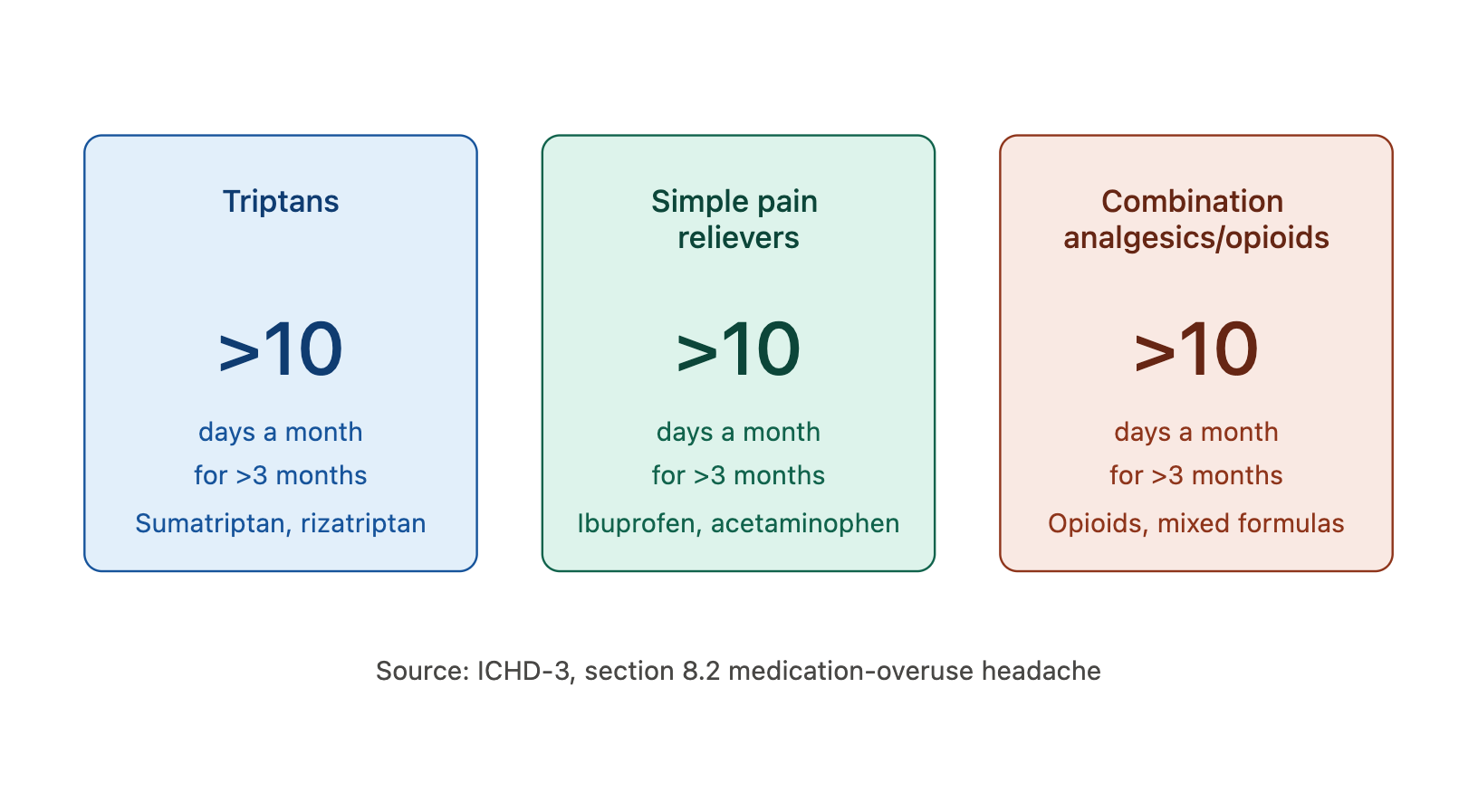
If you are hitting those numbers, your diary will show it clearly. That information lets your clinician step in before the cycle becomes entrenched. MOH affects an estimated 1% to 5% of people overall, but that share climbs to as high as 70% among people who already have chronic daily headache — and in most cases, it improves once the overused medication is identified and addressed.¹²¹⁸
This is one of the most important things a diary can do. It is hard to notice yourself drifting into overuse without written records.
Paper or app — which is better?
Both work. The right choice is whichever one you will actually use every day.¹
Electronic diaries have one practical advantage: they reduce the chance you forget to log an entry, and they make it easier to spot patterns across weeks of data.³ A 2024 study on a clinical electronic headache diary found a 96.4% compliance rate when the diary was integrated into ongoing care.³
Whatever format you pick, try to fill it in the same day — as close to the event as possible. Waiting three days to reconstruct a bad attack from memory loses the accuracy that makes the diary useful.
What do I do on days when I have no headache?
Log those too. A note that says "headache-free day" is useful data.⁷ It tells your clinician your baseline. It lets both of you track whether treatment is increasing your good days. And it can reveal patterns — like always having a headache-free stretch mid-month — that help with diagnosis.
If you are in a stable period and headaches are rare and predictable, it may be enough to track only headache days. Talk with your clinician about what level of detail is useful at each stage.⁶
How long should I keep the diary?
For a new evaluation, aim for at least four weeks before your first appointment if possible, or start right away and bring what you have. Eight to twelve weeks gives a fuller picture — enough to catch hormonal cycles, weather patterns, and the effect of any new treatments.⁵
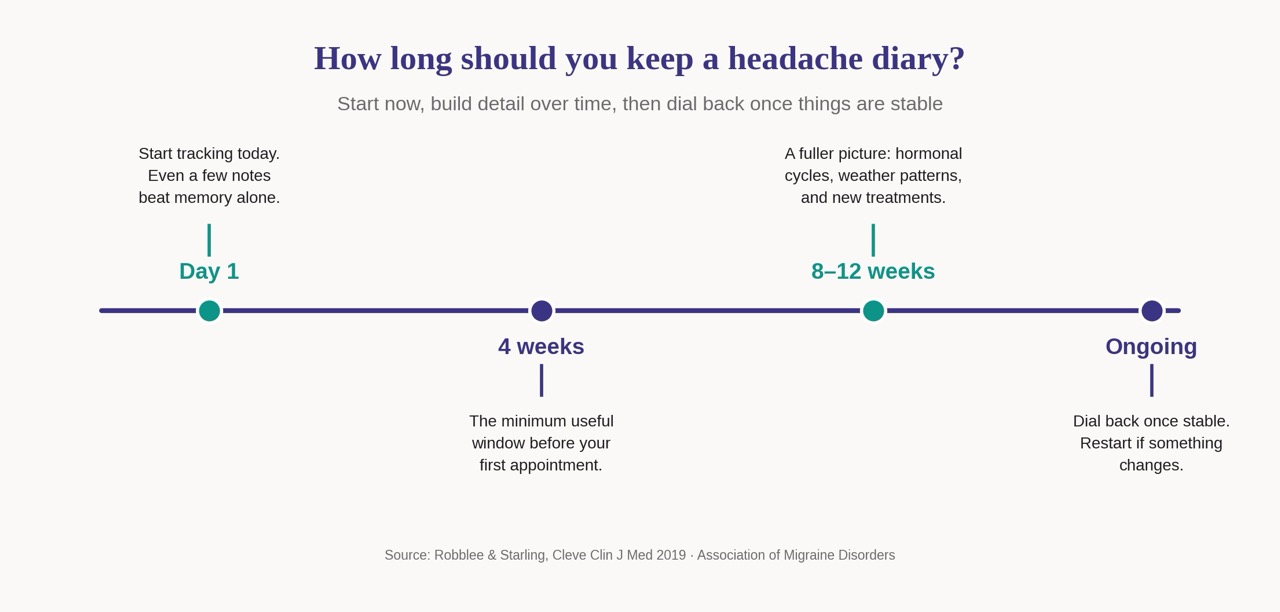
Once you are in a stable period, you can dial back tracking. Many people restart when something changes — a new medication, a new life stressor, or an uptick in attacks. Think of the diary as a tool you pick up when you need answers and put down when things are under control.⁶
What should I bring to my appointment?
Bring your diary — all of it, not just a summary you created from memory. Your clinician wants to see the actual day-by-day record. If you use an app, many let you export a PDF report. That is an excellent thing to share.
Your clinician will look for:²
- Total headache days per month
- Monthly acute medication days (and which medications)
- Pattern of attacks (time of day, day of week, around menstruation, seasonal)
- Which treatments helped and which did not
- Functional impact — how many days were you unable to work or care for yourself or others?
This information shapes every decision about your care: what diagnosis fits, whether preventive treatment makes sense, which acute treatment to try, and how to measure success.
Frequently asked questions
Do I have to track everything in the diary to make it useful?
No. Start with date, duration, pain level, and what medication you took. Even that minimum is far more useful than memory alone. Add more fields when the habit feels easy.¹
How many headache days a month is too many?
Chronic migraine is defined as 15 or more headache days per month for more than three months, with at least 8 of those days having migraine features.¹¹ Fewer than 15 is episodic migraine. Your diary is how you and your clinician count accurately. If you are nearing or crossing that line, it matters — because it changes the diagnosis and the treatment plan.
My diary shows I take pain relievers about 12 times a month. Is that a problem?
It may be. For common over-the-counter pain relievers like ibuprofen and acetaminophen, the ICHD-3 threshold for medication overuse is 10 or more days a month. For triptans, it is 10 or more days a month.¹¹ Show your diary to a headache specialist. They can assess whether overuse is contributing to your headache frequency.
I forget to fill it in during attacks because I feel too sick. What should I do?
That is completely normal. Fill in what you can after the attack — even a few notes later that day are better than nothing. Some apps let you enter data retroactively. You can also keep a one-line shorthand during attacks and fill in detail later.⁸
Can a diary actually help me find my triggers?
It can reveal patterns, but triggers are rarely as simple as one food causing one attack. Most people with migraine have a threshold — multiple factors accumulate before an attack fires. Your diary can show correlations worth exploring. A headache specialist can help you interpret the data and figure out what is signal and what is noise.⁴
What if I already know my triggers — do I still need a diary?
Yes, for different reasons. Knowing triggers does not tell you how many headache days you are having, whether medication use is creeping up, or whether treatment is working. The diary answers those questions, which matter just as much for getting good care.²
My doctor never mentioned a headache diary. Should I bring it up?
Yes. Research shows that both clinicians and patients report better communication when a diary is part of care.⁵ If your current provider has not asked about one, it may be worth seeking a headache specialist — someone whose entire practice is built around the kind of detailed, pattern-based evaluation a diary supports.
Do most people with migraine actually keep a headache diary?
Not yet. A 2025 survey found only 18% of people with migraine kept a detailed diary, even though most said they wanted better ways to identify their triggers.¹⁶ That gap is part of why so many people go years without a clear picture of their own patterns.
Your diary is the start of a better conversation
A headache diary is not about proving how bad things are. It is about giving your care team the clearest possible picture of what is happening — so they can help you more effectively.
It does not have to be perfect. Start simple, stay consistent, and bring what you have to your next appointment. At Haven Headache & Migraine Center, your diary is one of the first things we want to see. It tells us more than any single test — and it starts the conversation that leads to better care.
Medically reviewed by: Alicia Chang, FNP-BC, Haven Headache & Migraine Center
Peer reviewed by Karly Kozlowski PA-C, BHS, MPAS, Haven Headache and Migraine Center
References
- National Headache Foundation. Tracking Diaries: Keeping a Diary Can Help Your Doctor Help You. https://headaches.org/resources/headache-diary-keeping-a-diary-can-help-your-doctor-help-you/
- Minen M, George A, Lebowitz N, Katara A, Snyder I. Headache providers' perspectives of headache diaries in the era of increasing technology use: a qualitative study. Front Neurol. 2024;14:1270555. https://www.frontiersin.org/journals/neurology/articles/10.3389/fneur.2023.1270555/full
- van der Arend I, et al. Practical experience with the use of electronic headache diaries and video consultations. Headache. 2024. https://hoofdpijnonderzoek.nl/wp-content/uploads/2024/08/van-der-arend-et-al-2024-practical-experience-with-the-use-of-electronic-headache-diaries-and-video-consultations-in.pdf
- American Migraine Foundation. Headache Journals: Tracking Your Migraine. https://americanmigrainefoundation.org/resource-library/headache-journals/
- Robblee J, Starling AJ. SEEDS for success: Lifestyle management in migraine. Cleve Clin J Med. 2019;86(11):741–749. https://www.ccjm.org/content/86/11/741
- Association of Migraine Disorders. How to Track Your Migraine Attacks. https://www.migrainedisorders.org/how-to-track-your-migraine-attacks/
- Newport Beach Headache Specialists. Migraine Tracking Tools & Patterns. https://orthorepair.com/blog/how-to-track-migraine-patterns-effectively-newport-beach-headache-specialist-tools/
- Cove. How to Track Migraine Attacks and Learn Your Triggers. https://www.withcove.com/learn/migraine-forecasting-and-tracking
- Migraine Canada. Detailed guide on how to use a headache diary. https://migrainecanada.org/how-to-use-a-migraine-diary/
- The Migraine Trust. Keeping a headache diary. https://migrainetrust.org/live-with-migraine/self-management/keeping-a-migraine-diary/
- International Headache Society. ICHD-3: 8.2 Medication-Overuse Headache. https://ichd-3.org/8-headache-attributed-to-a-substance-or-its-withdrawal/8-2-medication-overuse-headache-moh/
- Association of Migraine Disorders. Addressing Medication Overuse Headache (MOH) in Clinical Practice. https://www.migrainedisorders.org/medication-overuse-headache-in-clinical-practice/
- Kebede B, Mohammed A, Tamene A, Abebe A, Dhugasa MA. Medication overuse headache: a review of current evidence and management strategies. Front Pain Res. 2023;4:1194134. https://pmc.ncbi.nlm.nih.gov/articles/PMC10442656/
- Smitherman TA, et al. Comparing prospective headache diary and retrospective four-week headache questionnaire over 20 weeks. Cephalalgia. 2022. https://pmc.ncbi.nlm.nih.gov/articles/PMC9060397/
- van der Lee HL, et al. The occurrence of recall bias in pediatric headache: a comparison of questionnaire and diary data. Headache. 2001. https://www.researchgate.net/publication/12160906_The_Occurrence_of_Recall_Bias_in_Pediatric_Headache_A_Comparison_of_Questionnaire_and_Diary_Data
- Elmazny A, et al. Migraine triggers and lifestyle modifications: an assessment of patients' awareness and the role of healthcare providers in patient education. J Headache Pain. 2025;26(1):189. https://doi.org/10.1186/s10194-025-02107-y (PubMed)
- Vives-Mestres M, et al. Clinical factors associated with day-to-day peak pain severity in individuals with chronic migraine: a cohort study using daily prospective diary data. Headache. 2024;64(8):995-1004. https://doi.org/10.1111/head.14745 (PubMed)
- Nguyen JT, Dergalust S, Nanda U. Medication Overuse Headache. Phys Med Rehabil Clin N Am. 2025;36(4):801-807. https://doi.org/10.1016/j.pmr.2025.07.006 (PubMed)
This article is for general education and is not medical advice. It is not a substitute for care from a qualified health professional. Always talk with your clinician before starting, stopping, or changing any treatment. If you have a sudden, severe headache, the worst headache of your life, or a headache with new symptoms like weakness, trouble speaking, or vision loss, seek emergency care right away.