

Gabapentin For Migraine Prevention: What Patients Should Know

If your provider has suggested gabapentin, here is the heart of it. Gabapentin can be a real option for preventing migraine. For the right person, it is a sensible and valuable choice. Specialists reach for it in specific situations, where calming overactive nerves is exactly what a patient needs. Matched to the right person and used with care, it can be a meaningful part of a complete migraine plan.
This guide walks you through how it works, what the studies show, who tends to benefit most, the side effects to watch, and the questions worth asking. The aim is a clear and honest picture you can actually use.
Key takeaways
- Gabapentin (brand name Neurontin) is an option for preventing migraine attacks.
- It suits specific patients, it is not a first choice for everyone.
- It works by calming nerve cells that fire too easily, which may reduce how often attacks happen.
- It fits some people particularly well, such as those who also have nerve pain, diabetics, or who have not responded to other preventives.
- The right migraine preventive treatment depends on getting the diagnosis right first.
- Never stop gabapentin suddenly. You lower the dose slowly with your provider.
What is migraine — and why does the right diagnosis matter?
Before talking about gabapentin, it helps to understand what migraine actually is. Migraine is a brain disease — not just a bad headache. During a migraine attack, abnormal brain activity triggers the trigeminovascular system — a network of nerves and blood vessels — setting off a chain of symptoms that goes far beyond head pain.
A 2021 review in The Lancet described migraine as one of the most disabling neurological conditions in the world, affecting people across all ages and geographies. It now affects more than 1 billion people worldwide (that means 1 out of every 7 person globally) and is a leading cause of disability.
Migraine versus tension headache: knowing the difference
Migraine and tension headache feel very different. Here is what sets them apart:
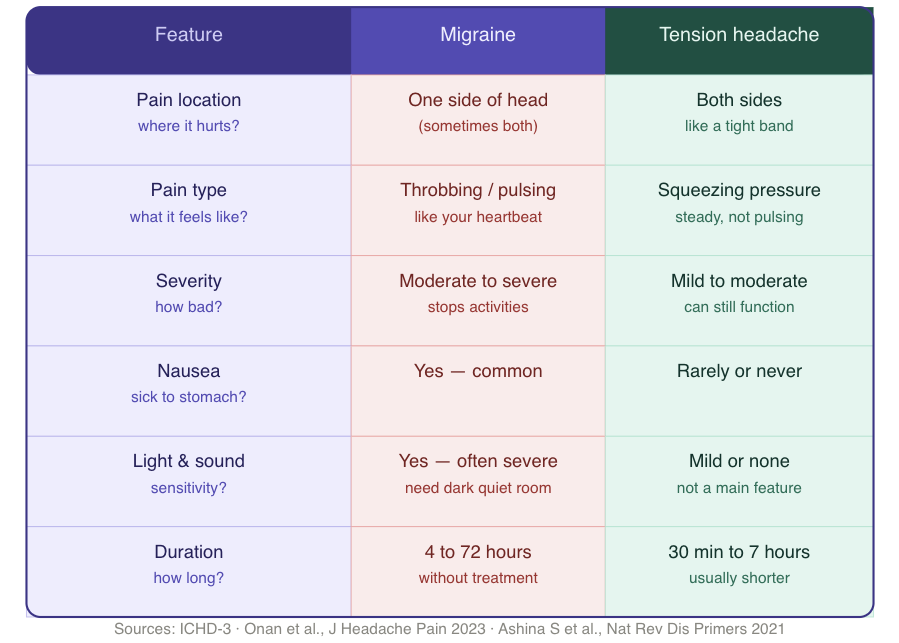
Figure 1. Side-by-side comparison of migraine and tension headache symptoms based on ICHD-3 diagnostic criteria and the 2023 Onan review.
What migraine feels like
Migraine pain is usually:
- On one side of the head (though it can affect both sides)
- Throbbing or pulsing — like your heartbeat in your head
- Moderate to severe — bad enough to stop normal activities
- Made worse by movement, like walking up stairs
Along with the pain, migraine often brings:
- Nausea or vomiting
- Strong sensitivity to light (called photophobia)
- Strong sensitivity to sound (called phonophobia)
- Sensitivity to smell
- Blurry vision
A migraine attack without treatment can last 4 to 72 hours. It can wipe out a whole day or more and severely disrupt work, school, and daily life.
What a tension headache feels like
Tension headache pain is usually:
- On both sides of the head
- Steady pressure or tightness — like a band squeezing your skull
- Mild to moderate — annoying, but you can still function
- Not made worse by normal movement
Tension headaches do not usually come with nausea or strong light and sound sensitivity. That absence is one of the biggest ways to tell them apart from migraine. A tension headache usually lasts 30 minutes to a few hours — much shorter than a migraine attack.
What is migraine with aura?
About one in three people with migraine also experience aura. Aura is a group of sensory changes that happen before or during the headache phase. They usually last 20 to 60 minutes and go away on their own.
Aura can look like:
- Zigzag lines or flashing lights in your vision
- Blind spots
- Tingling or numbness in your face, hand, or arm
- Trouble finding words
The 2023 review by Onan and colleagues noted that aura is a key feature that distinguishes migraine from tension headache — tension headaches do not cause aura. If you have these sensory changes, migraine is a much more likely diagnosis.
The four phases of a migraine attack
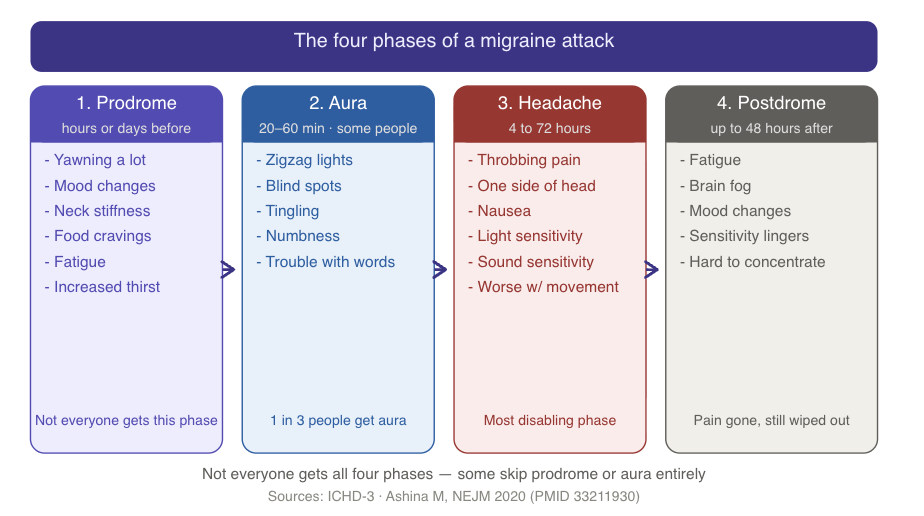
Figure 2. Migraine attacks can move through up to four stages: prodrome (warning signs hours or days before), aura (sensory changes in some people), the headache phase, and postdrome — the so-called “migraine hangover” afterward.
Not everyone goes through all four phases. Some people only get the headache phase. But understanding the full picture helps you recognize what is happening in your body — and helps your provider choose the right preventive treatment, including whether gabapentin makes sense for you.
When to go to the ER
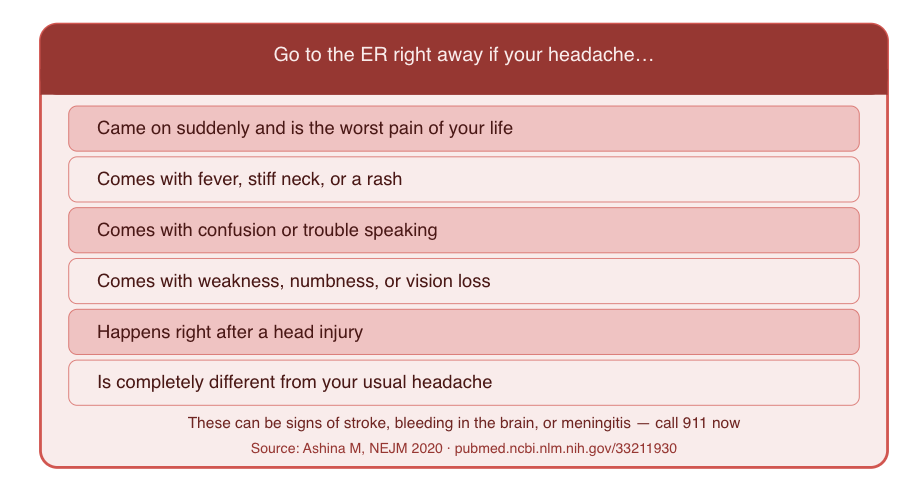
Figure 3. Some headache symptoms are emergencies. Call 911 or go to the ER right away if your headache comes on suddenly as the worst pain of your life, or if it comes with fever, new onset stiff neck, confusion, weakness, vision loss, or trouble speaking. These can be signs of a stroke or other serious condition.
What is gabapentin?
Gabapentin is a prescription medicine. The FDA approves it for some seizures and for certain kinds of nerve pain. Providers also use it off-label to help prevent migraine. Off-label means the FDA has not approved it specifically for migraine, but it is legal and common for providers to prescribe medicines off-label when there is good reason to do so.
How does gabapentin work for migraine?
The idea is simple at its core. Gabapentin calms nerve cells that fire too easily. When nerves fire less, they tend to send fewer pain signals.
Picture a tiny door on each nerve cell. That door lets in a mineral called calcium, and calcium helps the nerve fire. Gabapentin attaches to it. With the door partly blocked, less calcium enters, so the nerve settles and fires less often.
A 2020 review in the New England Journal of Medicine described this calming of the trigeminovascular system as central to how migraine pain is generated and why medicines that quiet nerve activity can reduce attack frequency. Gabapentin's mechanism fits directly into that picture.
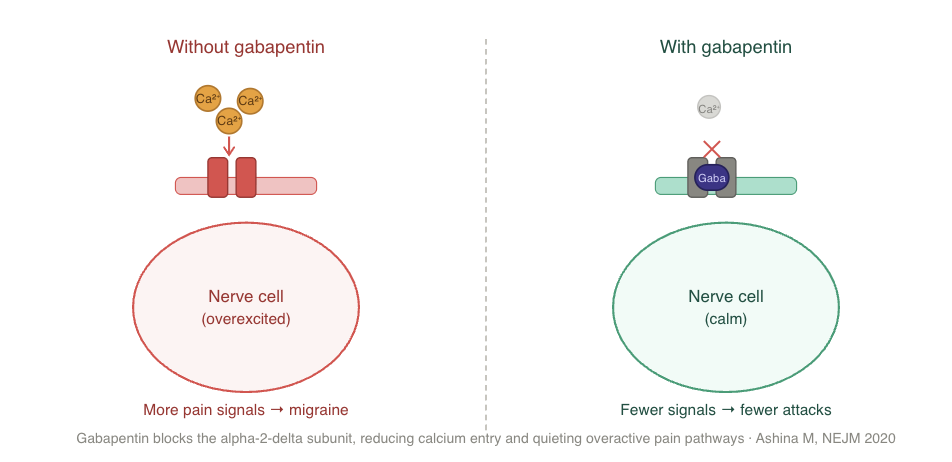
Figure 4. Gabapentin attaches to nerve cells so that less calcium gets in, which is thought to keep overactive nerves calmer and quiet the signals behind a migraine attack.
What does the research say about gabapentin for migraine?
Here is the honest short version. The studies are mixed. In one trial, among adults who built up to a higher daily dose, about 46 out of 100 cut their migraine days in half. Across larger studies, the average effect has not been strong, and experts say the overall evidence is not yet settled.
The 2021 Lancet review on migraine epidemiology and systems of care underscored that preventive treatment choices should be individualized, with the evidence base weighed alongside each patient's full clinical picture. That is exactly how headache specialists approach gabapentin — not as a broad first-line choice, but as a considered option for the right person.
So why might your provider still recommend it? Because trials report averages across many people, and you are not an average. Some people respond well to gabapentin even when the group numbers look modest. Your provider looks at your whole picture. That is thoughtful, personal care — not a contradiction.
Who is the right candidate for gabapentin?
This is where gabapentin really shines. For the right person, it can be an excellent preventive choice. A few situations stand out.
- You also live with nerve pain. Gabapentin is approved for some nerve pain, such as the pain that lingers after shingles or you have chronic diabetes and suffer from neuropathy. One medicine may then ease two problems at once.
- Other preventives have not helped enough. When better-supported options fall short, or their side effects are too much, gabapentin offers a different path worth considering.
- You cannot take the usual options. Some people have health reasons that rule out the first-choice preventives. Gabapentin can fill that gap.
- Sleep is also a struggle. Gabapentin makes some people drowsy, so an evening dose may help with sleep — a welcome side benefit rather than the main goal.
A brief note on perimenopause. Gabapentin can ease hot flashes. If you are managing both hot flashes and migraine, your provider might choose it partly for the hot flashes. Its help for migraine itself is still not well proven on its own, so it is best seen as one part of a broader plan.
The thread is simple: for the right person, chosen with care, gabapentin can be a genuinely valuable part of a migraine plan.
What are the most common side effects?
Most people tolerate gabapentin well. Still, it helps to know what can come up. Most side effects depend on the dose — milder at a low dose and more noticeable as the dose climbs. That is why your provider starts low and goes up slowly.
Table 1. Side effects of gabapentin listed by symptom, what you might feel, and what can help.
Are there any serious risks?
Yes, and one deserves plain attention. In 2019, the FDA warned that gabapentin can cause serious breathing problems in some people. The risk rises when it is taken with opioids or other medicines that slow the brain, and in people with lung problems or older age.
Tell your provider about everything you take, including alcohol. If you or someone near you has slow or shallow breathing, will not wake up, or is unusually drowsy, treat it as an emergency and get help right away.
Is gabapentin habit-forming?
It can be. With regular use, the body can grow used to gabapentin. This is called dependence. Not everyone becomes dependent, but one rule stands firm: do not stop the medicine all at once. Stopping quickly can bring on withdrawal — a period of feeling unwell as the body adjusts.
If drug or alcohol use has been part of your story, share that with your provider before you start. There is no judgment in it, and it helps your provider plan. If you both decide to stop, you will lower the dose slowly over time.
How long does it take to work?
A preventive medicine is one you take every day to make attacks happen less often. It is not a painkiller, and it does not work right away. Give gabapentin about ~3 months at a steady dose before you judge it.
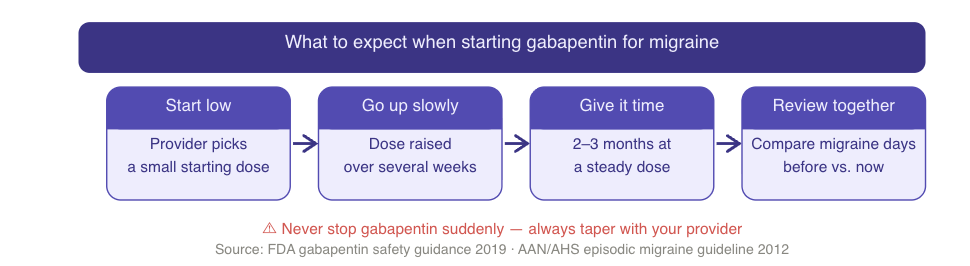
Figure 5. Because preventive medicines work slowly, gabapentin is started low, raised over weeks, and given ~3 months before you and your provider decide whether it is helping.
A simple way to track it helps a lot. Write down how many migraine days you have each month. After a couple of months, compare those numbers with where you began. Now you and your provider have real evidence to guide the next step.
What questions should I ask my provider?
Bring these to your next visit.
- Given my situation, is gabapentin a good fit for me?
- Are there preventives with stronger evidence we should try first?
- What dose do we start at, and how quickly do we go up?
- What should I do if the side effects become hard to manage?
- How and when will we know if it is working?
Frequently asked questions
What is gabapentin used for in migraine?
You take it every day to make attacks happen less often. It will not stop a migraine attack that has already started.
Is gabapentin FDA-approved for migraine?
No. It is approved for some seizures and certain nerve pain. For migraine, providers use it off-label.
Does gabapentin work for migraine?
The studies are mixed. The average effect in large studies has not been strong, and experts say the proof is not yet settled. Even so, some people respond well, and for the right person it can be a valuable preventive option.
Who should consider gabapentin for migraine?
It fits best for people who also have nerve pain, who have not done well on other preventives, or who cannot take the usual options. Your provider can tell you if you are a good candidate.
What dose of gabapentin is used for migraine?
There is no single dose that fits everyone. Your provider starts low and raises it slowly to find a level that works for you. Do not change your dose on your own.
Can I stop taking gabapentin suddenly?
No. Stopping suddenly can cause withdrawal. Always lower the dose slowly with your provider.
How will I know if gabapentin is working?
After about ~3 months at a steady dose, compare your migraine days with where you began. That comparison tells you and your provider whether it is helping.
You have good options either way
Living with migraine is hard, and trying one medicine after another can wear you down. Whatever the research says about any single drug, you are not out of choices. Many treatments exist, and the right plan is the one built around you.
If you would like a clear, expert look at your options, the specialists at Haven Headache & Migraine Center are here to help. Book a virtual consultation at havenheadache.com.
Medically reviewed by: Stephanie Messina, MHS, PA-C, Haven Headache & Migraine Center
References
- Ashina M. Migraine. New England Journal of Medicine. 2020;383(19):1866–1876. https://pubmed.ncbi.nlm.nih.gov/33211930/
- Ashina M, Katsarava Z, Do TP, et al. Migraine: epidemiology and systems of care. Lancet. 2021;397(10283):1485–1495. https://pubmed.ncbi.nlm.nih.gov/33773613/
- International Headache Society. ICHD-3: Migraine. https://ichd-3.org/1-migraine/
- U.S. Food and Drug Administration. FDA warns about serious breathing problems with gabapentin and pregabalin. 2019. https://www.fda.gov/drugs/drug-safety-and-availability/fda-warns-about-serious-breathing-problems-seizure-and-nerve-pain-medicines-gabapentin-neurontin
- Onan D, et al. Debate: differences and similarities between tension-type headache and migraine. Journal of Headache and Pain. 2023;24(1):92. https://pubmed.ncbi.nlm.nih.gov/37474899/
- International Headache Society. ICHD-3: Tension-type headache. https://ichd-3.org/2-tension-type-headache/
- Mathew NT, Rapoport A, Saper J, et al. Efficacy of gabapentin in migraine prophylaxis. Headache. 2001;41(2):119–128. https://pubmed.ncbi.nlm.nih.gov/11251695/
- Linde M, et al. Gabapentin or pregabalin for the prophylaxis of episodic migraine in adults. Cochrane Database of Systematic Reviews. 2013;(6):CD010609. https://pubmed.ncbi.nlm.nih.gov/23797675/
- Silberstein SD, et al. Evidence-based guideline update: pharmacologic treatment for episodic migraine prevention in adults. Neurology. 2012;78(17):1337–1345. https://pubmed.ncbi.nlm.nih.gov/22529202/
⚠️ This article is for general education and is not medical advice. It is not a substitute for care from a qualified health professional. Always talk with your clinician before starting, stopping, or changing any treatment. If you have a sudden, severe headache, the worst headache of your life, or a headache with new symptoms like weakness, trouble speaking, or vision loss, seek emergency care right away.
A simple way to track it helps a lot. Write down how many migraine days you have each month. After a couple of months, compare those numbers with where you began. Now you and your provider have real evidence to guide the next step