

Does Alcohol Trigger Migraine? Why Wine Gets Blamed

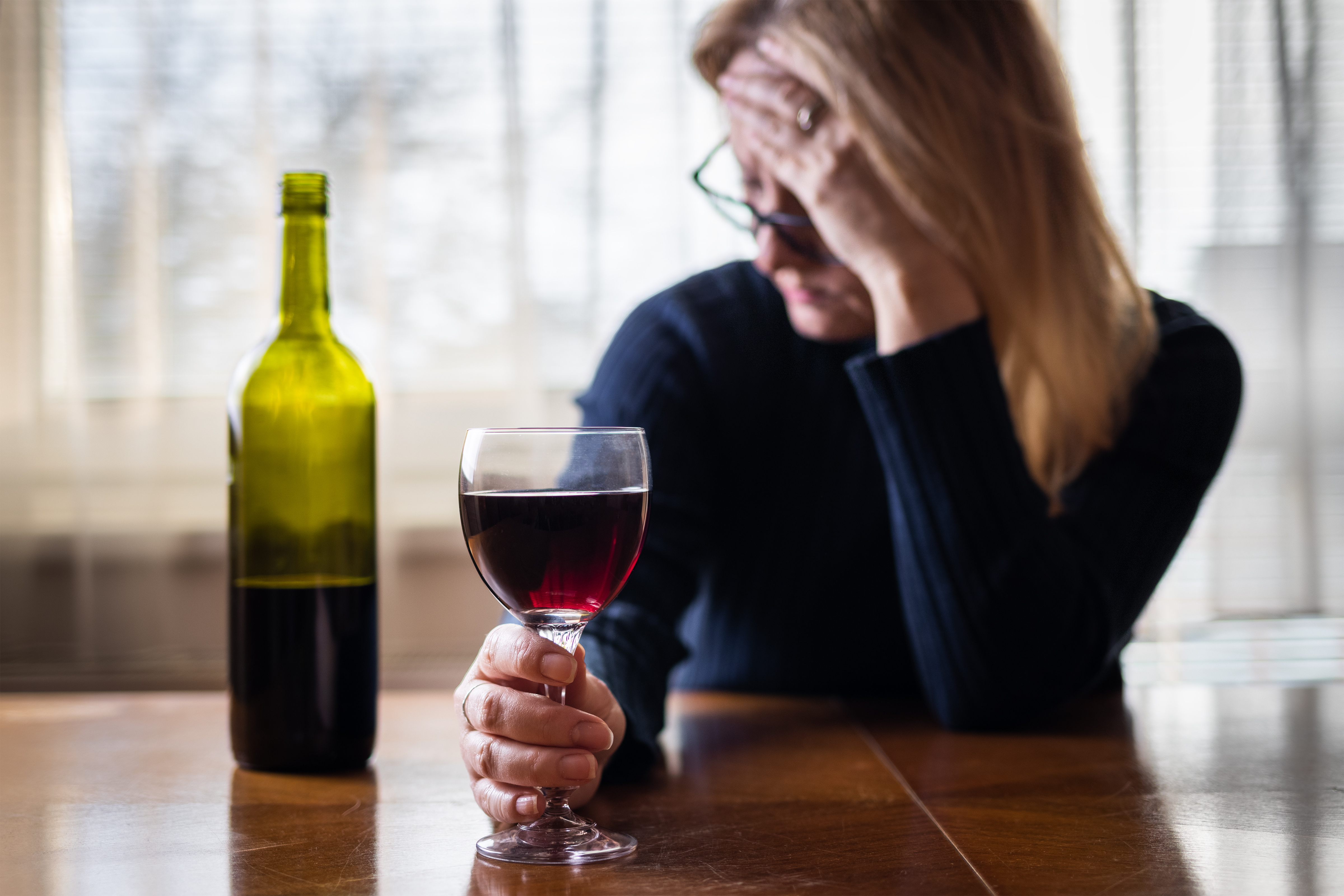
Many people with migraine believe alcohol, especially red wine, sets off their attacks. Some do react quickly and predictably, but when researchers study this closely, the link is weaker and messier than most people expect. Red wine is the most blamed drink, yet solid evidence is still hard to find. Here is what the research actually shows, and how to figure out your own pattern.
Key takeaways
- Red wine is the drink people with migraine blame most often for attacks, more than beer or spirits.¹
- A 2025 meta-analysis found no clear evidence that wine drinking raises migraine risk overall.²
- A large prospective study found alcohol did not raise the odds of a migraine attack the next day — and risk was even slightly lower two days later.³
- A separate "morning after" headache, caused by alcohol withdrawal, is common and can look a lot like migraine.⁴
- No single ingredient in wine has been proven to be the trigger. Histamine, tyramine, and sulfites are all suspects, but the evidence for each is mixed.⁵
Is red wine really worse than other alcohol for migraine?
Red wine has the worst reputation, and for some people, that reputation is earned. Surveys have long found that people with migraine name red wine as a trigger more often than beer, white wine, or spirits.¹
But belief and proof are not the same thing. Some studies from France and Italy have found white wine causes just as many headaches in local populations.¹ A recent meta-analysis pooled the best available studies on wine and migraine. It found no clear evidence that wine drinking raises the risk of migraine overall. The researchers noted the studies were still too limited to fully settle the question.²
In short: red wine's bad reputation is common, but it is not fully backed by strong data. It may be a real trigger for you personally, even if it is not a confirmed trigger for migraine in general.
What's actually in wine that might trigger migraine?
Researchers have looked at several compounds in wine as possible culprits. None has been proven to be the clear cause.⁵
Here is what each suspect does and why the evidence is mixed:
- Histamine. Red wine has more histamine than white wine. Alcohol also blocks an enzyme your body uses to clear histamine, which could let it build up.⁵
- Tyramine. Also found in aged cheese and cured meats. Both red and white wine actually contain very little tyramine, which weakens this theory.⁵
- Sulfites. These preservatives are added to many wines. They are more strongly linked to asthma reactions than to headache.⁵
- Tannins and flavonoid phenols. These give red wine its dry, mouth-coating taste. Some researchers think they may affect serotonin, a brain chemical involved in migraine, but this remains a theory.⁵
- Ethanol itself. Plain alcohol widens blood vessels and acts as a diuretic. For some people, alcohol alone may be enough without any of wine's other ingredients.⁵
No single compound has been proven to trigger migraine in controlled studies.⁵
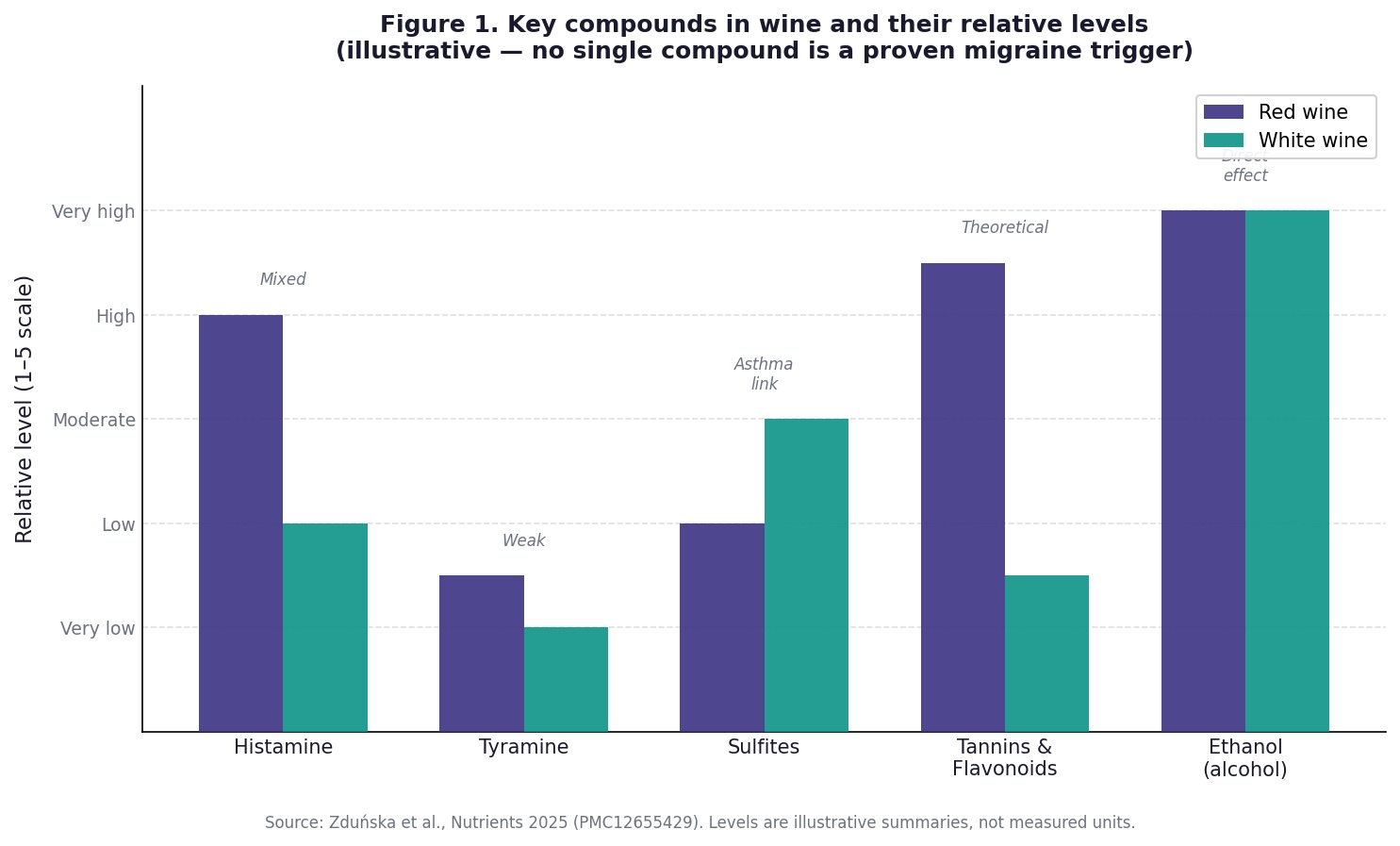
Figure 1 — Wine compounds bar chart — compares histamine, tyramine, sulfites, tannins, and ethanol levels in red vs. white wine, with evidence-quality labels. Placed after the compound table.
There are many ways how alcohol may contribute to a migraine attack but not all are confirmed.
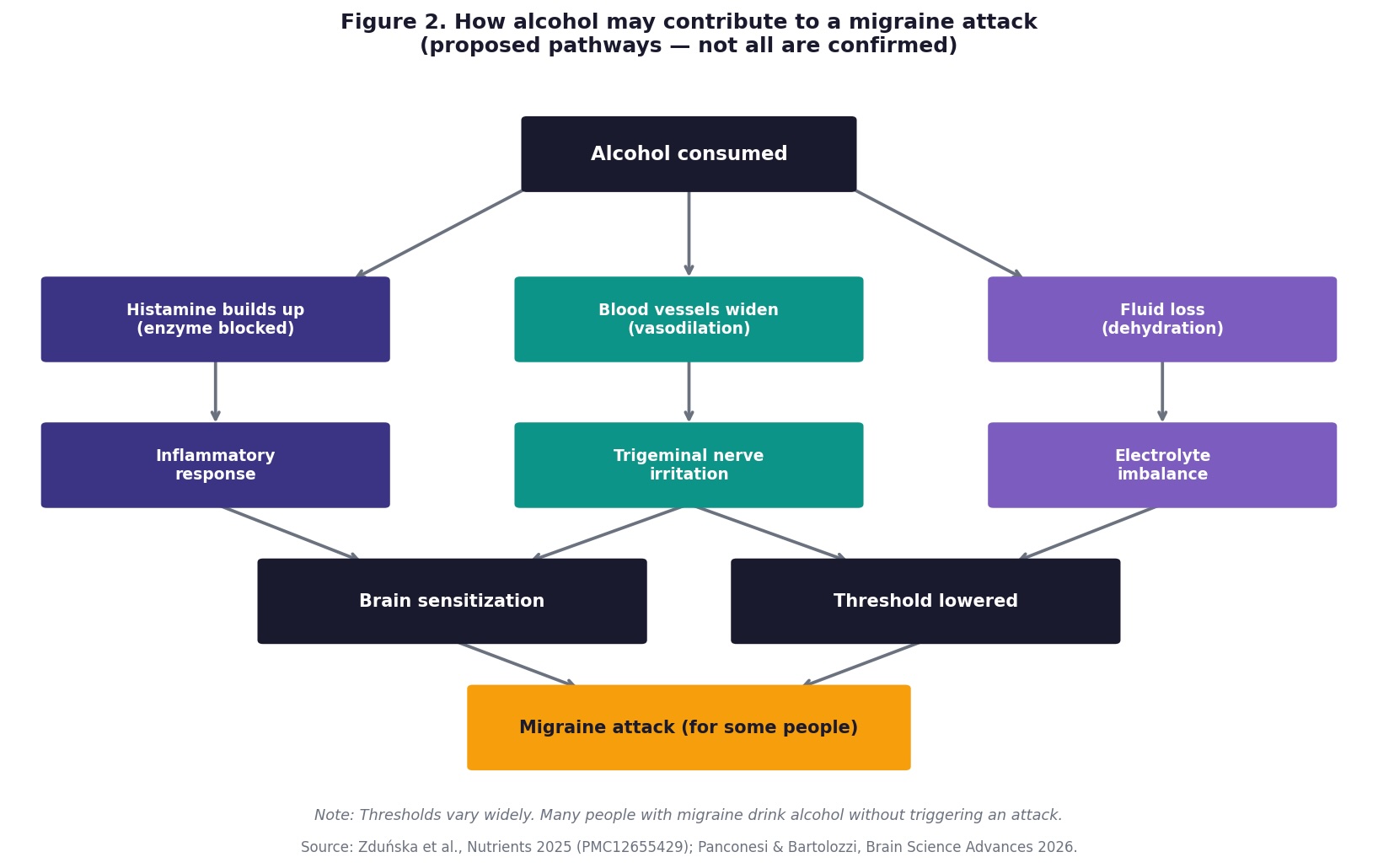
Figure 2 — Mechanism pathway diagram — shows the three proposed biological routes from alcohol consumption to a migraine attack (histamine, vasodilation, dehydration). Placed at the top of the "what's in wine" section.
What does the strongest research actually show?
Older surveys ask people to look back and guess what caused their last migraine attack. Alcohol and red wine often top these lists. But memory is not a reliable measuring tool — especially for something as widely suspected as wine.³
A large 2022 study tracked real-time drinking and migraine attacks going forward, instead of asking people to remember. It followed almost 500 people with migraine who already drank alcohol in small amounts. The study found that alcohol did not raise the odds of a migraine attack the next day. Two days later, the odds of an attack were actually about 25% lower after drinking than after not drinking.³
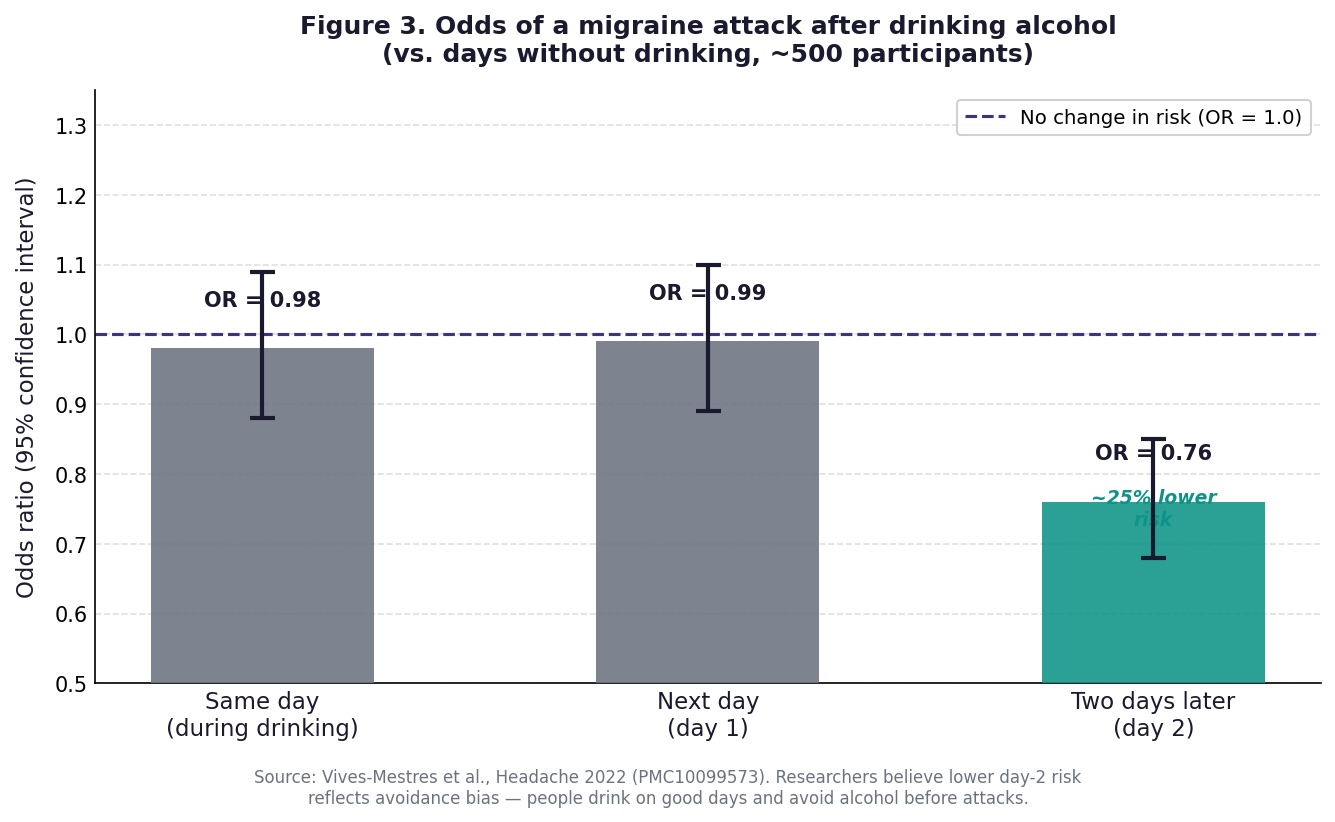
Figure 3 — Prospective study odds ratios — visualizes the ~500-person study showing no next-day risk increase and a 25% lower day-2 odds ratio, with confidence intervals. Placed inside the "strongest research" section.
This doesn't mean alcohol prevents migraine. The researchers believe it more likely reflects a pattern where people already avoid alcohol before an attack, or only drink on days when they feel well.³ A 2026 research update looked at this same question and reached a similar conclusion. Recent studies keep pointing to a limited role for alcohol as a migraine trigger. They also confirm that people with migraine tend to drink less overall.⁶
Is that "wine hangover" actually a migraine?
Not always. If your head pain shows up the morning after drinking, that may be something different. This can happen once your blood alcohol level has dropped back to zero. Doctors call this a delayed alcohol-induced headache — a distinct condition, separate from a true migraine trigger reaction.⁴'
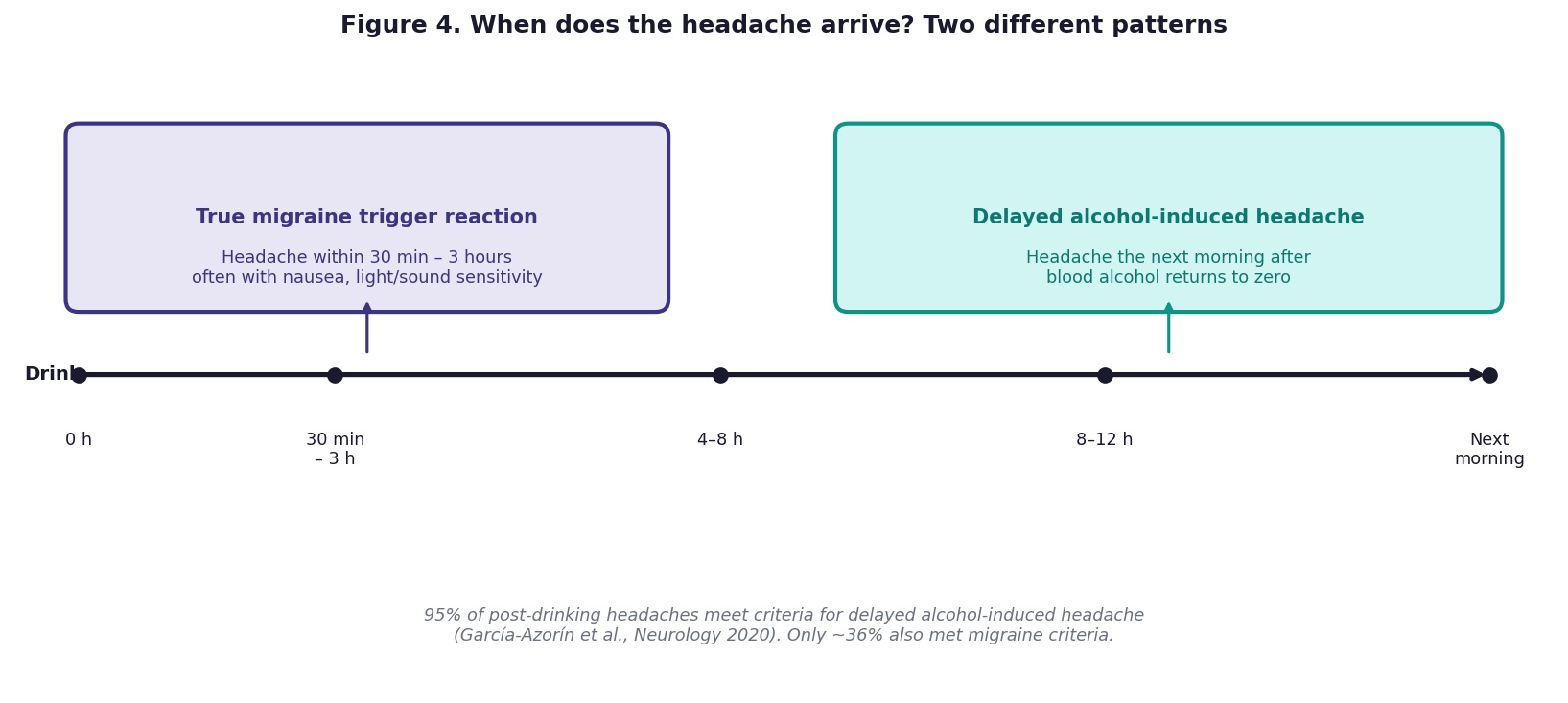
Figure 4 — Timing guide timeline — clearly distinguishes a true migraine trigger reaction (30 min–3 hrs) from a delayed alcohol-induced headache (next morning), grounded in the García-Azorín Neurology 2020 data. Placed inside the "hangover vs. migraine" section.
A study of more than 1,100 people looked at headaches that showed up after drinking. 95% met the criteria for delayed alcohol-induced headache. Only about 36% of them also happened to meet the criteria for migraine.⁴ In other words, a rough morning after wine doesn't automatically mean wine triggered a true migraine attack. It may be a more ordinary hangover headache — one anyone can get, with or without migraine.
How can you figure out if alcohol is your trigger?
Since the research is mixed, your own pattern matters more than any general rule. A few steps can help:
- Track your drinks and attacks. A headache diary can help. Note what you drank, how much, and when your symptoms started. A real pattern will show up — or it won't.
- Watch the timing. A true trigger reaction to alcohol often shows up within 30 minutes to 3 hours. A delayed hangover-type headache shows up the next morning instead.⁴
- Check for other factors that day. Stress, poor sleep, skipped meals, and dehydration often travel with a night of drinking. Any of these could be the real trigger. Learn more about telling dehydration headache from migraine.
- Test one variable at a time. If you suspect red wine specifically, try a small amount on a low-stress, well-rested day, separate from other suspected triggers.
- Notice if your threshold shifts. Some people react to wine only when combined with other stress on the body. Learn more in our guide to how migraine triggers actually work.
Should you avoid alcohol completely?
There is no single right answer for everyone. If you have clearly linked a specific drink to your attacks, avoiding it makes sense. But avoiding all alcohol just because it is a commonly blamed trigger — without confirming it is your own trigger — may cost you more in quality of life than it saves you in migraine days.³
If you do drink, keep amounts small. Stay mindful of your overall pattern, since alcohol carries health risks unrelated to migraine too. A headache specialist can help you weigh your migraine frequency, other health factors, and your own trigger pattern. This works better than following a blanket rule.
You don't have to guess alone
Figuring out your own triggers can feel like detective work. Alcohol is one of the more confusing suspects. You don't have to sort it out from guesswork or old wives' tales. A headache specialist at Haven can help you build a clear picture of your migraine pattern — including where alcohol really fits into it. Together, you can build a plan that works for your life.
Start Your Migraine Care
If you are considering a neuromodulation device for migraine, Haven Headache & Migraine Center can help you understand your options and next steps.
Haven Headache & Migraine Center
Website: https://www.havenheadache.com/ Phone: (424) 444-7399 Email: hello@havenheadache.com
Book here: Start with a free intro call
Medically reviewed by: Stephanie Messina, PA-C, Haven Headache & Migraine Center, and peer-reviewed by Karissa Secora, DMSc, PA-C, AQH
References
- American Migraine Foundation. Alcohol and Migraine. https://americanmigrainefoundation.org/resource-library/alcohol-and-migraine/
- Lucerón-Lucas-Torres M, Ruiz-Grao MC, Pascual-Morena C, Priego-Jiménez S, López-González M, Álvarez-Bueno C. Association between wine consumption and migraine: a systematic review and meta-analysis of cross-sectional studies. Alcohol and Alcoholism. 2025;60(2):agaf004. https://academic.oup.com/alcalc/article/60/2/agaf004/8015343
- Vives-Mestres M, Casanova A, Puig X, Ginebra J, Rosen N. Alcohol as a trigger of migraine attacks in people with migraine. Results from a large prospective cohort study in English-speaking countries. Headache. 2022;62(10):1329–1338. https://pmc.ncbi.nlm.nih.gov/articles/PMC10099573/
- García-Azorín D, Farid-Zahran M, Gutiérrez-Sánchez M, et al. Clinical characterization of delayed alcohol-induced headache: a study of 1,108 participants. Neurology. 2020. https://www.neurology.org/doi/10.1212/WNL.0000000000010607
- Zduńska A, Cegielska J, Zduński S, Domitrz I. Migraine and Alcohol — Is It Really That Harmful? Nutrients. 2025;17(22):3620. https://pmc.ncbi.nlm.nih.gov/articles/PMC12655429/
- Panconesi A, Bartolozzi ML. Alcohol and Headache: an Update. Brain Science Advances. 2026;12(2). https://journals.sagepub.com/doi/10.26599/BSA.2026.905013
This article is for general education and is not medical advice. It is not a substitute for care from a qualified health professional. Always talk with your clinician before starting, stopping, or changing any treatment. If you have a sudden, severe headache, the worst headache of your life, or a headache with new symptoms like weakness, trouble speaking, or vision loss, seek emergency care right away.
Frequently Asked Questions
For some people, yes. But large studies have not found that alcohol reliably raises migraine risk for most people who drink in small amounts.³
Histamine, tyramine, sulfites, tannins, and ethanol have all been studied as possible causes, but no single one has been proven to be the trigger.⁵
Not always. It may be a delayed alcohol-induced headache — a distinct condition that can happen to anyone after drinking, separate from a migraine trigger reaction.⁴
Track your drinks, timing, and symptoms in a headache diary, and watch for other factors like stress, poor sleep, or dehydration that might be the real cause.
Not necessarily. If you haven't confirmed alcohol as your trigger, a blanket ban may not help. A headache specialist can help you make this decision based on your own pattern.