

Candesartan for Migraine Prevention: An Underused Option


Candesartan for Migraine: The Underused Preventive
If other anti-hypertensive medications, like beta-blockers and calcium channel blockers, have not helped your migraine, or you cannot take them, there is another option worth knowing about: candesartan.
Candesartan is a blood pressure pill that also prevents migraine attacks. In clinical trials, it worked about as well as propranolol, a widely used beta-blocker.¹² The real difference is how it feels day to day.
Candesartan skips many of the side effects that make beta-blockers and calcium channel blockers hard to live with, like trouble exercising, weight gain, swelling in the legs and feet, and low mood. It can also be worth a try when other preventives have not done enough. Yet many people, and many clinicians, have never thought to reach for it.

Key Takeaways
- Candesartan is an angiotensin II receptor blocker (ARB) — a type of blood pressure medicine. Two randomized controlled trials support its use for migraine prevention.¹²
- In a head-to-head trial, candesartan worked about as well as propranolol for lowering attack frequency, and it was well tolerated.²
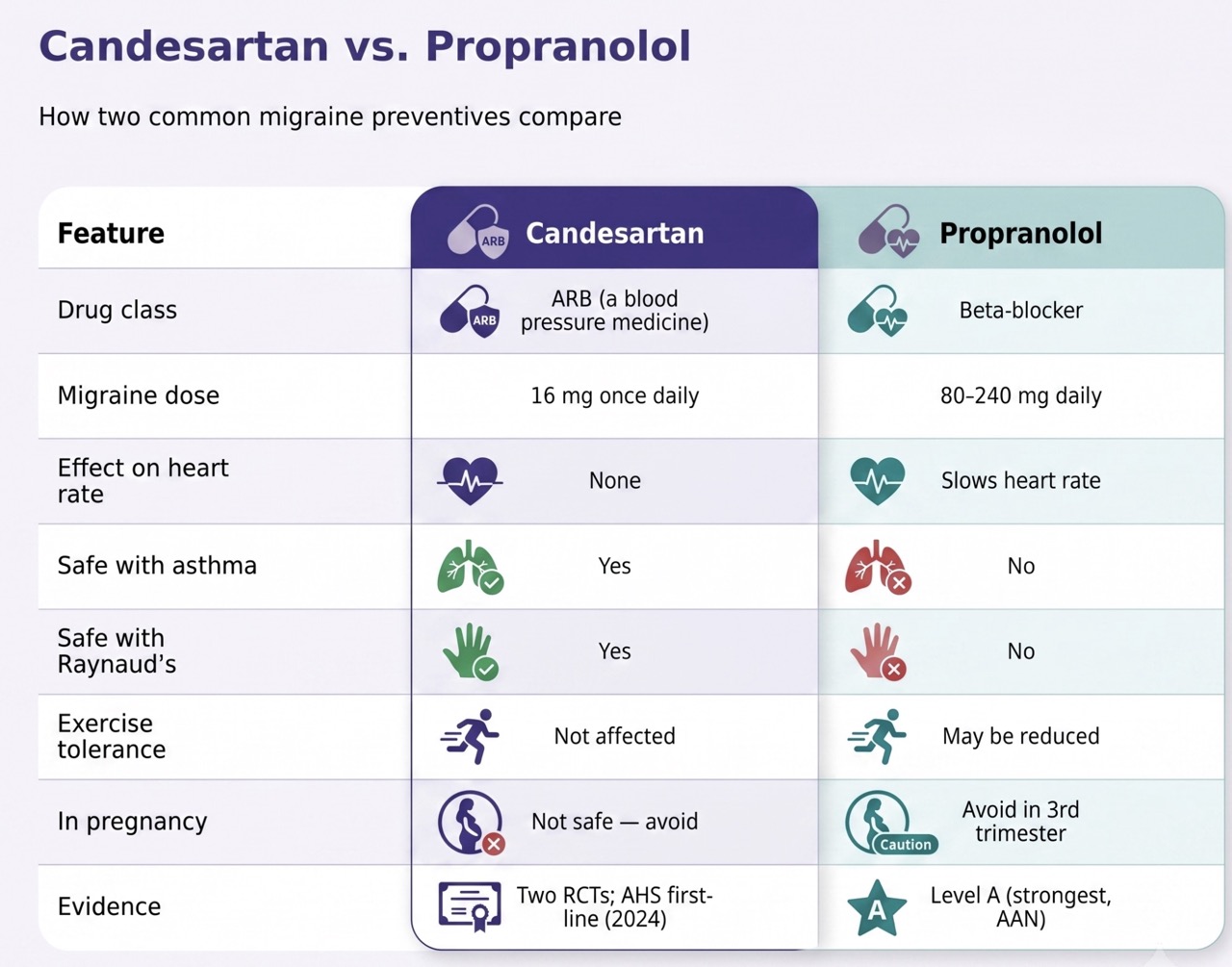
- The dose used in both trials is 16 mg once daily.
- It avoids some common beta-blocker side effects. It does not slow your heart rate or cause exercise intolerance, and it is usable in people with asthma or Raynaud's phenomenon.
- In 2024, the American Headache Society named candesartan a first-line option for migraine prevention.³
- It is not safe in pregnancy. It also calls for monitoring of kidney function and potassium.
Why is candesartan used for migraine?
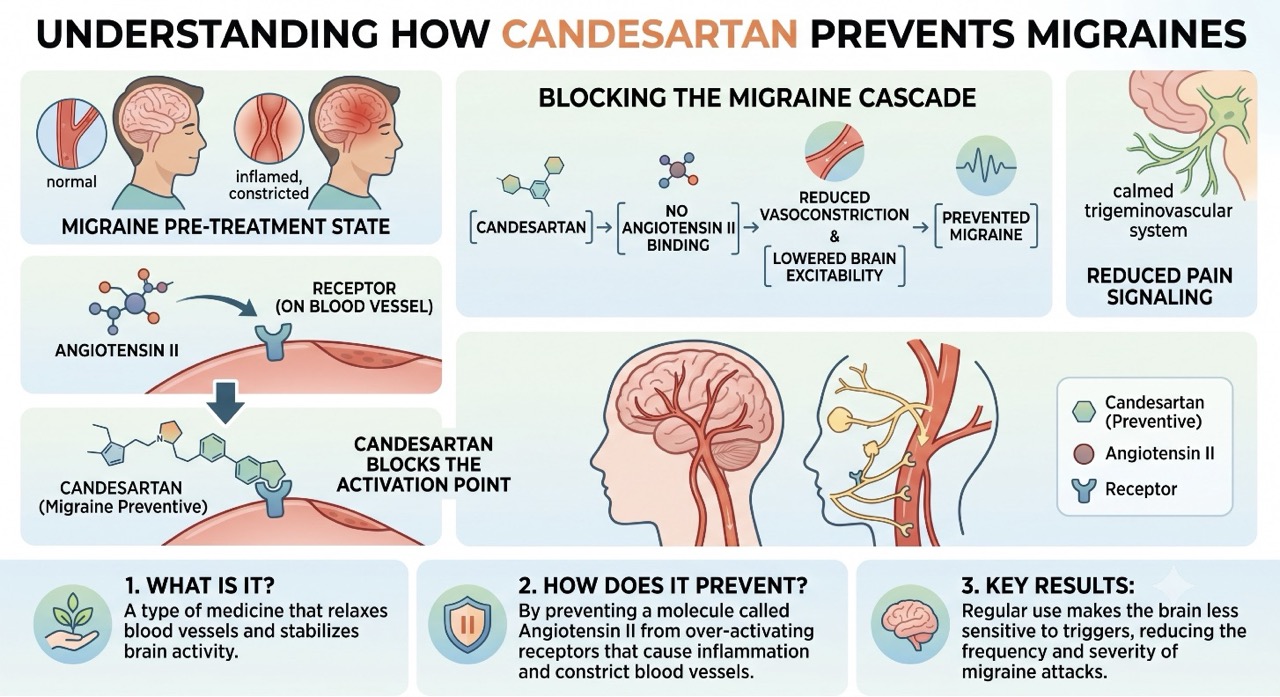
Candesartan is in the angiotensin II receptor blocker family. It blocks angiotensin II, a hormone that tightens blood vessels and raises blood pressure.
How it prevents migraine is not fully understood. It likely works by acting on the body's renin-angiotensin system — the system that controls blood pressure — and by calming the blood-vessel and pain pathways tied to migraine.⁴ The exact pathway matters less than the trial evidence, which is strong for a drug that rarely comes up by name.
What do the clinical trials show?
The main evidence comes from two Norwegian trials.
The first, by Tronvik and colleagues in 2003, was a double-blind, crossover trial in 60 people with episodic migraine. Candesartan 16 mg daily cut the number of days with headache, the number of migraine days, and attack frequency compared with placebo.¹
The second, by Stovner and colleagues in 2014, was the bigger test. It was a triple-blind, three-arm crossover trial. It compared candesartan 16 mg daily, propranolol 160 mg daily, and placebo in 72 people with migraine. Both active drugs beat placebo. And candesartan was non-inferior to propranolol — meaning it held its own head-to-head.²
A 2023 systematic review and meta-analysis of blood-pressure medicines for migraine backs this up. It found that candesartan significantly lowered how often headaches happened.⁵
That comparison matters. Propranolol carries a Level A rating — the strongest evidence tier — from the American Academy of Neurology for migraine prevention.⁶ Only a handful of drugs reach that tier. Candesartan matching propranolol is a meaningful result.
Who is candesartan a good fit for?
Candesartan is worth raising with your headache specialist if:
- Beta-blockers gave you fatigue, exercise intolerance, cold hands and feet, or low mood that hurt your quality of life
- You have asthma, COPD, or Raynaud's phenomenon, where beta-blockers are a poor fit
- You have high blood pressure that an ARB could treat at the same time
- You tried propranolol or metoprolol and did not get enough relief
It is a poorer fit for some people. It is not safe if you are pregnant or trying to conceive, because ARBs can harm a developing baby. It also needs caution if you have significant kidney problems or low blood pressure to start with.
What side effects does candesartan cause?
Candesartan is usually well tolerated. Unlike propranolol, it does not slow your heart rate, does not affect exercise, and does not carry the same risk of low mood or fatigue.
Side effects to know about:
- Low blood pressure, mainly when you stand up. This is more likely at higher doses or with other blood pressure drugs.
- High potassium. This matters most in people with kidney disease or those on certain diuretics or diabetes medicines.
- Dizziness, especially early on.
- Dry cough. This is less common than with ACE inhibitors, a related class, but it can happen.
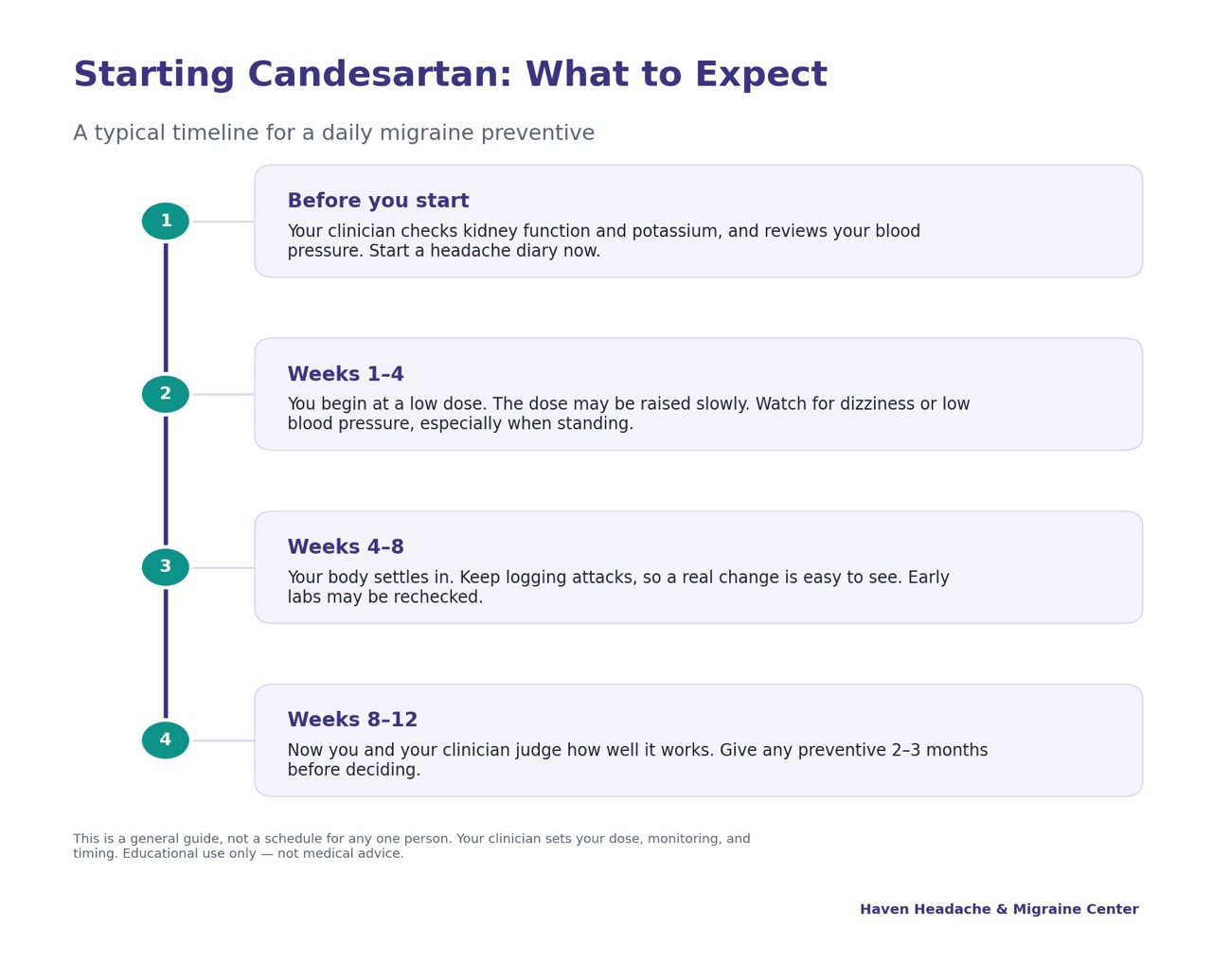
Your clinician should check kidney function and potassium before you start, then now and then during treatment. This is extra important if you already have a kidney condition.
How long does candesartan take to work for migraine?
As with other preventives, give it 2 to 3 months before you judge it. A headache diary helps a lot here. It makes a real change easier to tell apart from normal week-to-week ups and downs.
Is candesartan in the migraine prevention guidelines?
Yes, and its standing has grown. The 2012 American Academy of Neurology and American Headache Society guideline rated candesartan Level C, meaning "possibly effective." That rating rested on the single 2003 trial available at the time.⁶ The stronger head-to-head trial came the next decade.²
The 2019 American Headache Society position statement lists candesartan among oral preventives with evidence of efficacy.⁷ Then, in a 2024 update, the Society went further and named candesartan a first-line option, citing its trial evidence and real-world track record.³ Many headache specialists already reach for it, often when beta-blockers do not fit.
When to talk to a headache specialist
Are your attacks frequent or disabling? Have you tried a preventive or two without enough relief, or with side effects you could not live with? A headache specialist can walk you through the full set of options. That includes drugs like candesartan that rarely come up in a primary care visit.
At Haven Headache & Migraine Center, our clinicians review your full history. Then we build a plan made for you, one that looks past the usual first choices when those have not worked.
Book a virtual consultation with Haven
Frequently asked questions
Does candesartan prevent migraine attacks?
Yes. Two randomized controlled trials found that candesartan 16 mg daily lowers migraine attack frequency compared with placebo. A head-to-head trial found it worked about as well as propranolol, which has one of the strongest evidence ratings for migraine prevention.
What dose of candesartan is used for migraine?
The dose used in both trials is 16 mg once daily. That sits in the middle of candesartan's approved blood pressure range of 8 to 32 mg. Your clinician may start lower and raise it based on how you tolerate it and your blood pressure.
How does candesartan differ from propranolol for migraine?
Both lower attack frequency by a similar amount in the one head-to-head trial. The main differences are how they work and their side effects. Candesartan does not slow your heart rate, does not cause exercise intolerance, and is usable in people with asthma or Raynaud's phenomenon — all things that can rule out a beta-blocker like propranolol.
Is candesartan safe if I have high blood pressure?
Yes, and it may be a good choice in that case, since it treats both at once. If your blood pressure runs low-normal, your clinician will watch for it dropping too far, especially early on.
Can I take candesartan if I am pregnant or trying to conceive?
No. ARBs like candesartan are not safe in pregnancy because of serious risk to the baby. Tell your clinician before you start if you are pregnant, planning a pregnancy, or breastfeeding. Other preventives with safer pregnancy profiles exist.
Why isn't candesartan used more often for migraine?
Mostly habit and guideline timing. Propranolol, amitriptyline, and topiramate have longer track records and older top-tier ratings. Candesartan's strongest trial came out in 2014, after the major U.S. guidelines were last updated. Many primary care clinicians reach for the older, better-known drugs first. A headache specialist is more likely to consider it.
Medically reviewed by Stephanie Messina, MHS, PA-C, Haven Headache & Migraine Center
Peer reviewed by Samantha Clem, PA-C, Haven Headache & Migraine Center
References
- Tronvik E, Stovner LJ, Helde G, Sand T, Bovim G. Prophylactic treatment of migraine with an angiotensin II receptor blocker: a randomized controlled trial. JAMA. 2003;289(1):65–69. PMID: 12503978. https://pubmed.ncbi.nlm.nih.gov/12503978/
- Stovner LJ, Linde M, Gravdahl GB, et al. A comparative study of candesartan versus propranolol for migraine prophylaxis: a randomised, triple-blind, placebo-controlled, double cross-over study. Cephalalgia. 2014;34(7):523–532. PMID: 24335848. https://pubmed.ncbi.nlm.nih.gov/24335848/
- Charles AC, Digre KB, Goadsby PJ, Robbins MS, Hershey A. Calcitonin gene-related peptide-targeting therapies are a first-line option for the prevention of migraine: an American Headache Society position statement update. Headache. 2024;64(4):333–341. PMID: 38466028. https://pubmed.ncbi.nlm.nih.gov/38466028/
- Naoe EEL, Tabuzo MMB, Jamora RDG. Candesartan for treatment of migraine headache: a scoping review. Clin Ther. 2025;47(9):807–812. PMID: 40571531. https://pubmed.ncbi.nlm.nih.gov/40571531/
- Carcel C, Haghdoost F, Shen J, et al. The effect of blood pressure lowering medications on the prevention of episodic migraine: a systematic review and meta-analysis. Cephalalgia. 2023;43(6):3331024231183166. PMID: 37350141. https://pubmed.ncbi.nlm.nih.gov/37350141/
- Silberstein SD, Holland S, Freitag F, Dodick DW, Argoff C, Ashman E. Evidence-based guideline update: pharmacologic treatment for episodic migraine prevention in adults. Neurology. 2012;78(17):1337–1345. PMID: 22529202. https://pubmed.ncbi.nlm.nih.gov/22529202/
- American Headache Society. The American Headache Society position statement on integrating new migraine treatments into clinical practice. Headache. 2019;59(1):1–18. PMID: 30536394. https://pubmed.ncbi.nlm.nih.gov/30536394/
This article is for educational purposes only and is not medical advice. It is not a substitute for diagnosis, treatment, or guidance from a qualified clinician. Always talk with your doctor or a headache specialist about your symptoms and before starting, stopping, or changing any treatment. If you experience a sudden severe headache, the worst headache of your life, or a headache with weakness, vision loss, confusion, or fever, seek emergency care immediately.
Living with headache or migraine? The specialists at Haven Headache & Migraine Center are here to help. *Book a virtual consultation.*