

7 Migraine Trigger Myths You Should Stop Believing


A lot of common advice about migraine triggers is outdated — and some of it can actually backfire. Many foods people restrict for years, like chocolate and red wine, may not be causing attacks the way most people think. And trying to avoid every possible trigger can raise anxiety and make the brain more reactive, not less.
Here is what the research actually says.
Key takeaways
Chocolate cravings before a migraine attack are often a prodrome symptom — a sign the attack has already started in the brain — not the cause.¹
Red wine is frequently blamed, but alcohol itself — not just one type — is the more likely culprit for most people.²
Trigger diaries are useful, but confirmation bias causes most people to overestimate how reliable their triggers really are.
Triggers usually only cause an attack when enough of them stack together on a high-vulnerability day. That is the threshold model.
Attacks that hit on weekends or the first day of vacation are often "let-down" migraine — driven by stress going away, not coming on.
Avoiding every possible trigger can shrink your life without shrinking your attack frequency.
Migraine is a neurological disease with a genetic component. No amount of trigger avoidance eliminates it — but the right treatment plan can give you far more good days.
Myth 1: Chocolate causes migraine
This is probably the most repeated — and most misunderstood — trigger claim in migraine history.
Chocolate appears on every trigger list. But when researchers tested it in blinded conditions — where participants did not know whether they were eating chocolate or a placebo — it did not reliably produce more attacks than the placebo. The chocolate was not the culprit.
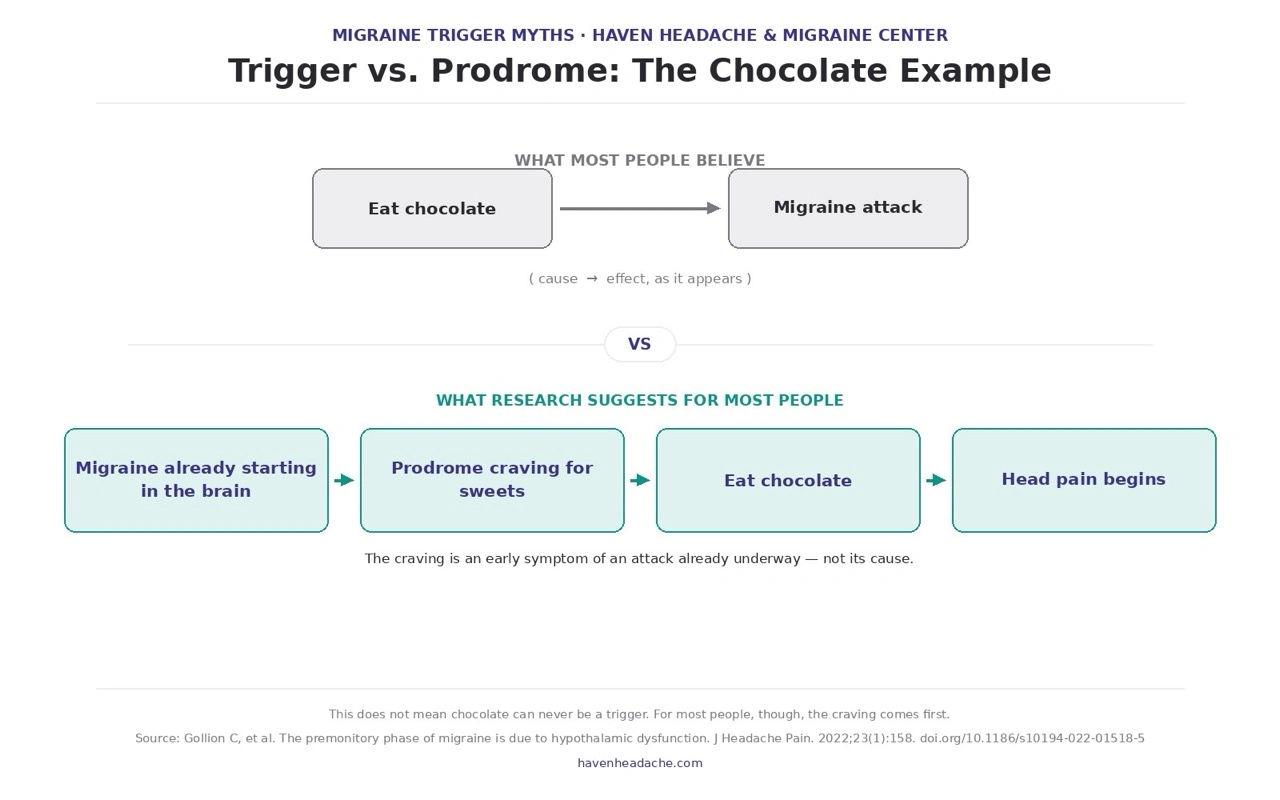
What is more likely happening: the migraine brain, during the prodrome phase (the hours before head pain begins), drives strong cravings for sweet and carbohydrate-rich foods. You feel the urge for chocolate, eat it, and then the headache arrives. It looks like cause and effect — but the craving was already an early symptom of an attack already in motion.¹
A 2022 review published in the Journal of Headache and Pain found that food cravings in the prodrome phase are linked to hypothalamic activity and the release of neurotransmitters like dopamine and neuropeptide Y — not to the food itself.¹
This does not mean chocolate can never be a trigger for anyone. But for most people, eliminating chocolate is not doing what they think it is.
Myth 2: Red wine always triggers migraine
Red wine has a strong reputation as a migraine trigger. For some people, it genuinely is one. But the science behind why is more complicated than most trigger lists suggest.
Histamine, tyramine, sulfites, and tannins have all been blamed at various points. Research has not consistently pointed to any single compound as the reliable mechanism. White wine, which contains far less of these compounds, also triggers attacks in many people who tolerate red wine without problems.
A 2025 review in Nutrients concluded that the relationship between alcohol and migraine is complex, and that alcohol itself — through its effects on dehydration, vasodilation, and signaling in the brain — is likely the more important variable across all beverage types.² If you have switched from red wine to white wine hoping for fewer attacks, you may not have addressed the real problem.
Myth 3: You can identify your triggers by keeping a list
Trigger lists have real value. But they come with a bias problem that most people do not account for.
When you try to recall what happened before an attack, your brain is much better at remembering the times your "trigger" was followed by a headache than the many times you ate or experienced the same thing with no attack at all. This is confirmation bias — and it leads most people to overestimate how reliable their triggers are.
Research on prospective headache tracking (where exposures are logged in real time, not from memory) consistently shows weaker trigger-attack relationships than people expect.
A structured headache diary — tracking headache days, sleep, stress, menstrual cycle, and potential exposures in real time — gives you far better information than a retrospective trigger list. It also reveals patterns you might miss, like consistent attacks around hormonal shifts or weather changes, that a simple food list would never catch.
Myth 4: Avoiding your triggers is always the right approach
Trigger avoidance sounds like good sense. Taken too far, it is counterproductive.
First, the practical problem: avoiding all potential triggers often means giving up social meals, travel, exercise, caffeine, and most of normal life. That trade-off raises anxiety — and anxiety itself increases attack frequency.
Second, there is a neurological argument against over-restriction. Some headache specialists believe that protecting the migraine brain from every variation may lower its threshold for triggering over time, not raise it. The brain adapts to whatever conditions it encounters; removing challenge does not always build resilience.
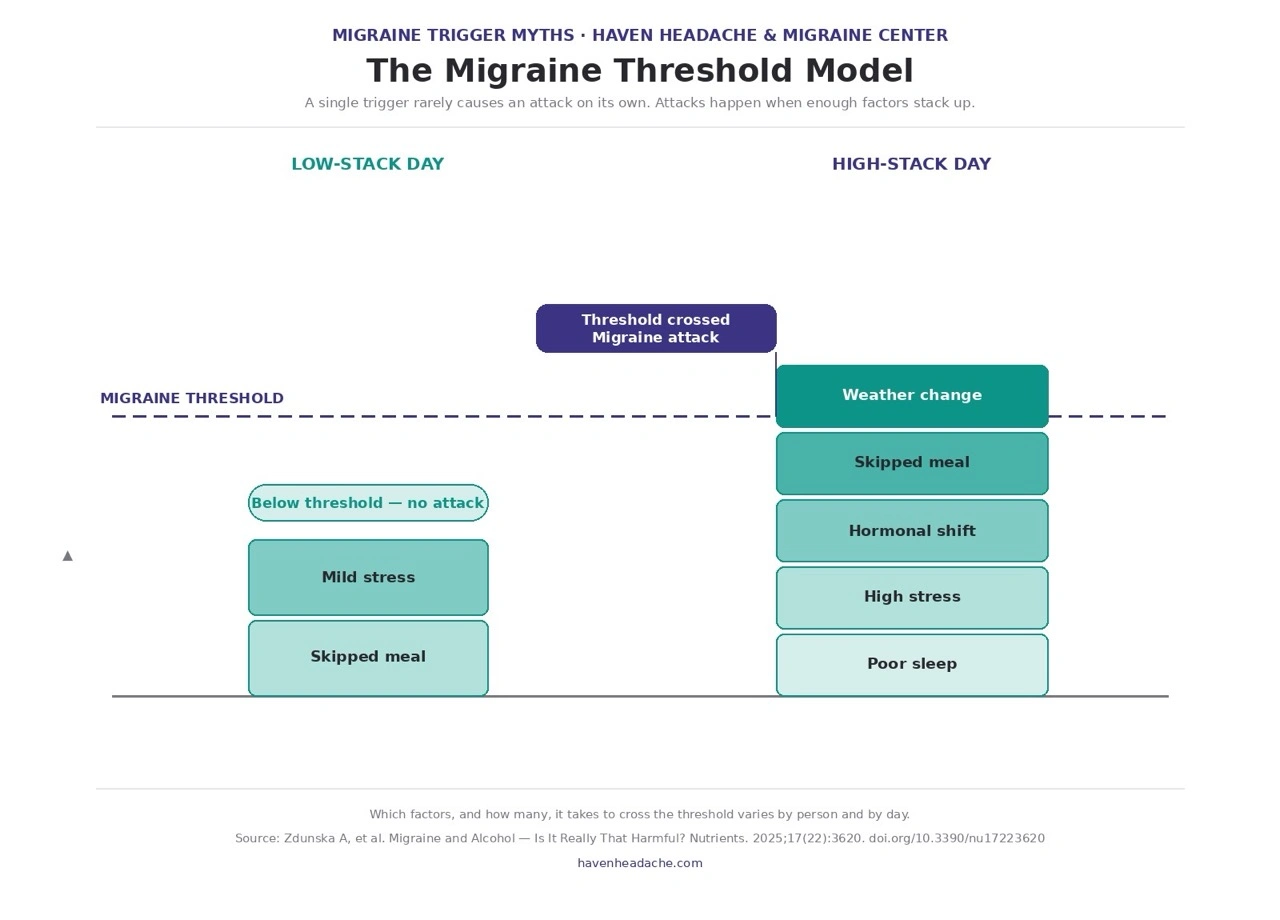
The better framework is the threshold model: your brain has a tipping point. A single trigger rarely crosses it on its own. Attacks happen when enough factors stack — poor sleep, high stress, hormonal shift, skipped meal, weather change — on the same day. Managing your baseline through preventive treatment, consistent sleep, and regular meals is usually more powerful than eliminating any single food or situation.²
Myth 5: Weather changes trigger migraine
Weather sensitivity is real — and research backs it up.
A large 2023 study published in Headache analyzed over 336,000 hourly headache events from smartphone app users and found that low barometric pressure, drops in barometric pressure in the six hours before an attack, higher humidity, and rainfall were all significantly associated with headache occurrence.⁴ A 2025 review also confirmed that heat waves and high humidity were linked to more frequent migraine attacks.⁵
So yes, weather matters. The myth is not that weather affects migraine — it does for many people. The myth is that it is a complete cause on its own, and that nothing can be done about it.
Weather usually pushes an already-elevated threshold over the edge rather than triggering an attack all by itself. Preventive treatment often reduces weather-related attacks even though you cannot change the forecast.
Myth 6: If you reduce stress, your migraine will improve
Stress management is genuinely helpful for migraine prevention. But there is a specific pattern that catches people off guard: the let-down migraine.
Many people with migraine have their worst attacks not when stress is highest, but immediately after it ends — Saturday morning after a hard week, or the first morning of a vacation. This is a well-documented phenomenon, thought to involve the rapid drop in cortisol (a stress hormone that has some protective effect at high levels) when the stressor resolves.
If you experience let-down migraine, you cannot prevent it by reducing stress alone. What helps is keeping your schedule consistent through the transition — maintaining regular sleep and wake times, staying hydrated, and avoiding big swings in caffeine intake as you shift from a high-stress period to a lower-stress one.
Myth 7: If you find all your triggers, you won't need medication
This is perhaps the most consequential myth, because it places the entire burden on the person with migraine — and frames medication as something to avoid rather than a legitimate, effective tool.
For people with infrequent, low-severity attacks, lifestyle management may be enough. For most people with moderate to high frequency migraine, behavioral strategies work best as a complement to medication, not a substitute.
Migraine is a neurological disease with a strong genetic component. No amount of trigger avoidance changes the underlying brain. A 2024 study found that patients with migraine who received preventive CGRP medications reported significantly better quality of life and health outcomes than those on standard care alone — outcomes that trigger avoidance cannot replicate on its own.⁶
The right question is not "how do I avoid every trigger." It is "what combination of prevention, acute treatment, and lifestyle strategies gives me the best quality of life?" A headache specialist can help you answer that honestly.
Trigger vs. prodrome: what is really happening before your attack
One of the most helpful things you can understand about migraine is the difference between a trigger and a prodrome symptom.
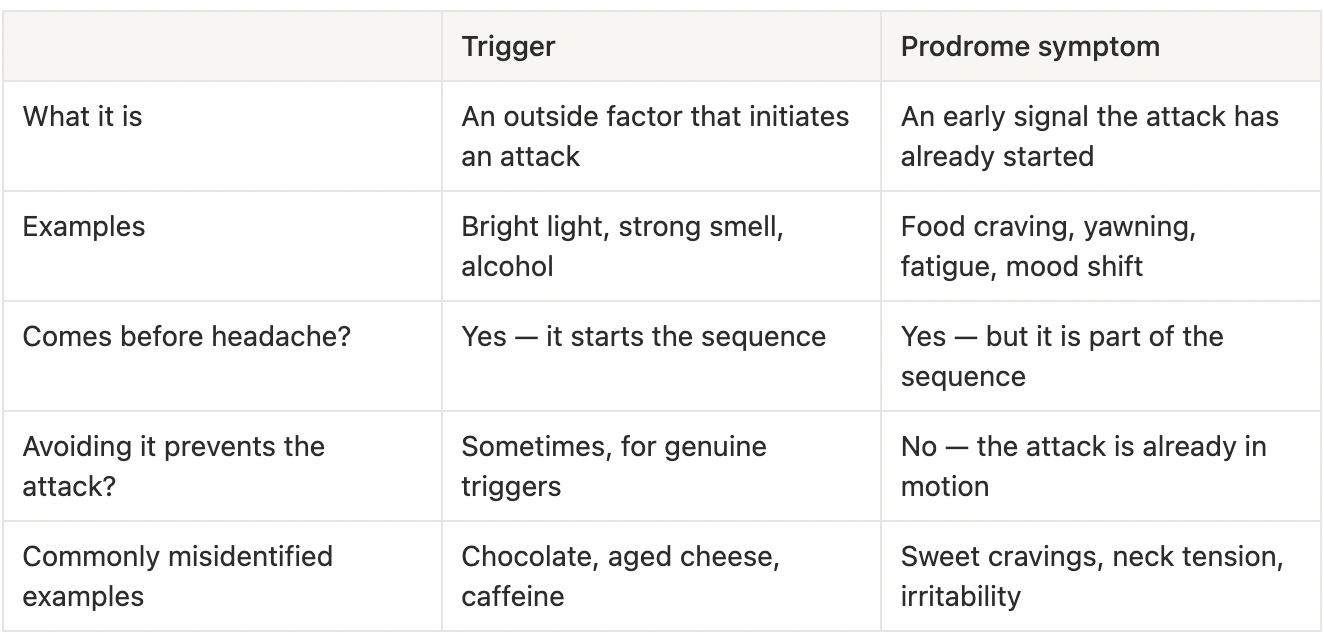
A trigger is something from outside the body — food, light, smell, stress — that sets off an attack. A prodrome symptom is an early signal from the brain that an attack is already underway, before the head pain begins. These symptoms can include mood changes, fatigue, yawning, neck stiffness, and cravings for sweet or salty foods.
The reason so many foods get misidentified as triggers is this sequence: the brain enters the prodrome phase → you crave chocolate or salt → you eat it → the headache arrives → you blame the food.
Recognizing prodrome symptoms as early warning signs — not causes — is one of the most practically useful shifts in thinking for people with migraine. It can reduce unnecessary restriction, reduce self-blame, and help you use your acute medication earlier in the attack cycle.
Frequently asked questions
Is chocolate really a migraine trigger?
For most people, the link reflects the prodrome phase driving a craving for sweets before head pain begins — not the chocolate triggering the attack. Research on hypothalamic activity during the migraine prodrome shows that food cravings are driven by brain changes already underway, not by the food itself.¹ Chocolate may be a true trigger for some people, but it is far more often misidentified than it is the real cause.
Does red wine trigger migraine?
For some people, yes. But the specific compound responsible is not clearly established. A 2025 review found that alcohol itself — through its effects on dehydration and vasodilation — is likely more important than any single component like histamine or sulfites.² Switching from red to white wine does not reliably help if alcohol is the true driver.
Why do I get migraine after stress ends instead of during it?
This is called the let-down phenomenon. When a sustained stressor resolves, cortisol drops quickly. That hormonal shift appears to lower the brain's migraine threshold, triggering attacks on weekends, vacation days, or after major deadlines. Keeping sleep timing, meals, and caffeine consistent through the transition can help reduce let-down attacks.
Is trigger avoidance always helpful?
Not always. Avoiding all potential triggers can raise anxiety, limit daily functioning, and may not lower attack frequency over time. Managing overall brain threshold through preventive treatment, good sleep, and regular meals is usually more effective than trying to eliminate every individual trigger.
Can weather really trigger migraine?
Yes, for many people. A 2023 study using data from over 336,000 headache events confirmed associations between low or dropping barometric pressure, high humidity, and more frequent attacks.⁴ Weather sensitivity is real, but it typically acts by pushing an already-elevated threshold over the edge. Preventive treatment often reduces weather-related attacks even when you cannot control conditions outside.
Do I need medication if I manage my triggers well?
Trigger management can support medication — but for most people with moderate to high frequency migraine, it does not replace it. Migraine is a neurological disease with a genetic component, and preventive treatments like CGRP medications have been shown to meaningfully improve quality of life in ways that lifestyle changes alone cannot achieve.⁶ A headache specialist can help you figure out the right combination.
You do not have to figure this out alone
Living with migraine is hard enough without spending years eliminating foods that were never causing your attacks in the first place. The science has moved forward. The approach to triggers is more nuanced now — and that is actually good news, because it means you may have more freedom than you think.
If you are ready to build a real plan — one that includes understanding your actual triggers, your threshold, and the treatments that work for your brain — a Haven specialist can help.
Book a virtual consultation with Haven → Alicia Chang, MSN, APRN, FNP-BC, FNP-C, CEN, PHN
References
- Gollion C, De Icco R, Dodick DW, Ashina H. The premonitory phase of migraine is due to hypothalamic dysfunction: revisiting the evidence. J Headache Pain. 2022;23(1):158. https://doi.org/10.1186/s10194-022-01518-5
- Zdunska A, Cegielska J, Zdunski S, Domitrz I. Migraine and Alcohol — Is It Really That Harmful? Nutrients. 2025;17(22):3620. https://doi.org/10.3390/nu17223620
- Zdunska A, et al. Migraine and Alcohol — Is It Really That Harmful? Nutrients. 2025. https://doi.org/10.3390/nu17223620 (Threshold model discussion.)
- Katsuki M, Tatsumoto M, Kimoto K, et al. Investigating the effects of weather on headache occurrence using a smartphone application and artificial intelligence. Headache. 2023;63(5):585–600. https://doi.org/10.1111/head.14482
- Kushner P, Kalita P, Revel FB, et al. Climate Change and Air Pollution-Related Health Effects on Pain. Int J Environ Res Public Health. 2025;22(11). https://doi.org/10.3390/ijerph22111721
- Varnado OJ, Jackson J, Scharf L, et al. Patient-reported outcomes related to migraine burden among patients treated with standard-of-care preventive medications or calcitonin gene-related monoclonal antibodies. Curr Med Res Opin. 2024;40(12):2179–2190. https://doi.org/10.1080/03007995.2024.2427884
This article is for general education and is not medical advice. It is not a substitute for care from a qualified health professional. Always talk with your clinician before starting, stopping, or changing any treatment. If you have a sudden, severe headache, the worst headache of your life, or a headache with new symptoms like weakness, trouble speaking, or vision loss, seek emergency care right away.