

Biofeedback for migraine: how it works and does it help?


Biofeedback for migraine is a drug-free therapy. It teaches you to notice body signals like muscle tension and skin temperature. Then it teaches you to change them. A 2025 review found it can lower how often migraine attacks happen. It can also lower how severe they are.¹ Results vary from person to person. At Haven Headache & Migraine Center, our clinicians average 10 years of experience in headache medicine. We can help you decide if biofeedback fits your migraine plan.
Key takeaways
- Biofeedback uses sensors that show your body signals you usually cannot feel, like muscle tension or skin temperature.
- A 2025 review found biofeedback lowered migraine frequency and severity. This was compared with getting no treatment.¹
- A separate 2025 review found mixed results when biofeedback stood alone. That is why it is often paired with other tools.²
- Training usually runs about 8 to 12 weekly sessions. Home practice between sessions seems to help.¹
- Biofeedback is not a cure. It works best as one part of a full migraine care plan.
- Haven's clinicians can review your headache pattern. They can help you decide if biofeedback is worth trying.
What is biofeedback for migraine?
Biofeedback is a mind-body therapy. It uses small sensors on your skin. The sensors show you real-time information about signals you cannot normally sense. These signals include muscle tension, skin temperature, and heart rate.³⁴
Migraine is a common brain disease. In 2021, about 4.3% of adults in the United States said headache or migraine bothered them a lot in the past 3 months. Women were affected more often than men.⁵ Stress and muscle tension can act as migraine triggers for some people. Learning to notice and calm these signals may help lower migraine burden over time.⁴
How does biofeedback work?
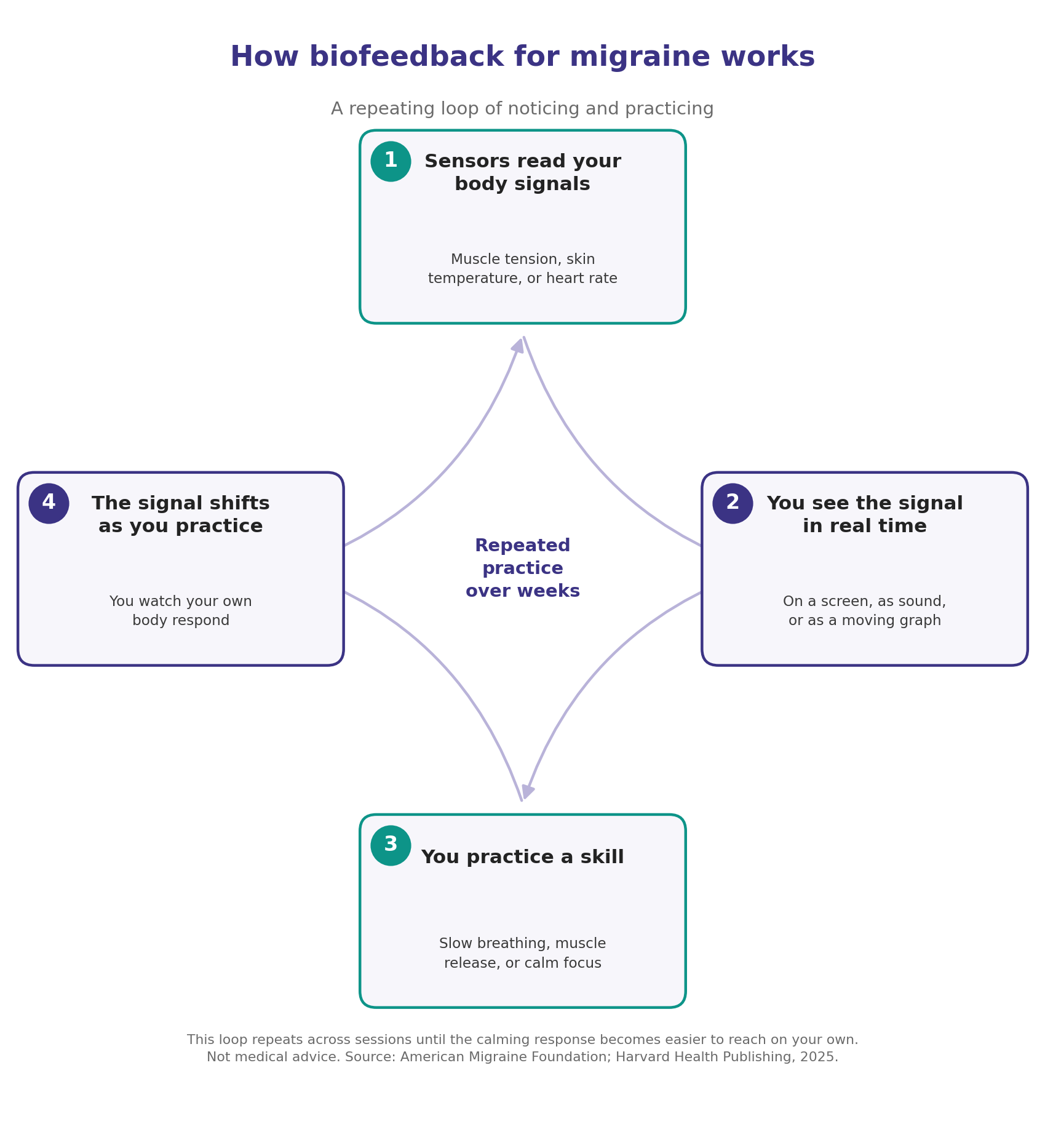
During a session, a trained provider places sensors on your skin. The sensors pick up signals like muscle tension or skin temperature. Some also track heart rate patterns tied to your breathing.⁴⁶
You watch these signals change. You may see them on a screen, hear them as a sound, or watch them on a graph. Your provider guides you through skills like slow breathing and muscle release. As you practice, you see your own signals shift in real time. Over weeks of practice, many people find this calming response gets easier to reach. In time, some can reach it even without the equipment.⁶
What types of biofeedback are used for migraine?
Providers use a few different signals. Sometimes they use just one. Sometimes they combine a few.¹
These are not head-to-head comparisons. Each type comes from separate studies. No single type has been shown to work best for everyone.¹
Does biofeedback help migraine? What does the research show?
For many people, yes, at least to a degree. But the evidence is mixed. A 2025 systematic review and meta-analysis looked at randomized trials. It found that biofeedback lowered both migraine frequency and severity. This was compared with people who got no treatment at all.¹
Other reviews are more careful with their claims. A large 2025 review for the Agency for Healthcare Research and Quality looked at behavioral migraine treatments. It found the evidence for biofeedback used alone was inconclusive. Results varied a lot between studies.² This does not mean biofeedback cannot help you. It means the size of the benefit is hard to predict for any one person. Biofeedback tends to work best as part of a larger plan. It is not usually a stand-alone treatment.²
Home practice between sessions seems to matter. Studies with regular home practice tended to show stronger results than studies without it.¹ Biofeedback may be worth discussing if your migraine attacks seem linked to tension, anxiety, or trouble relaxing.
What to expect when you start biofeedback
Training is usually gradual. It often starts with a few sessions to learn the basics. Then it moves into regular practice. Home practice tends to grow over time.
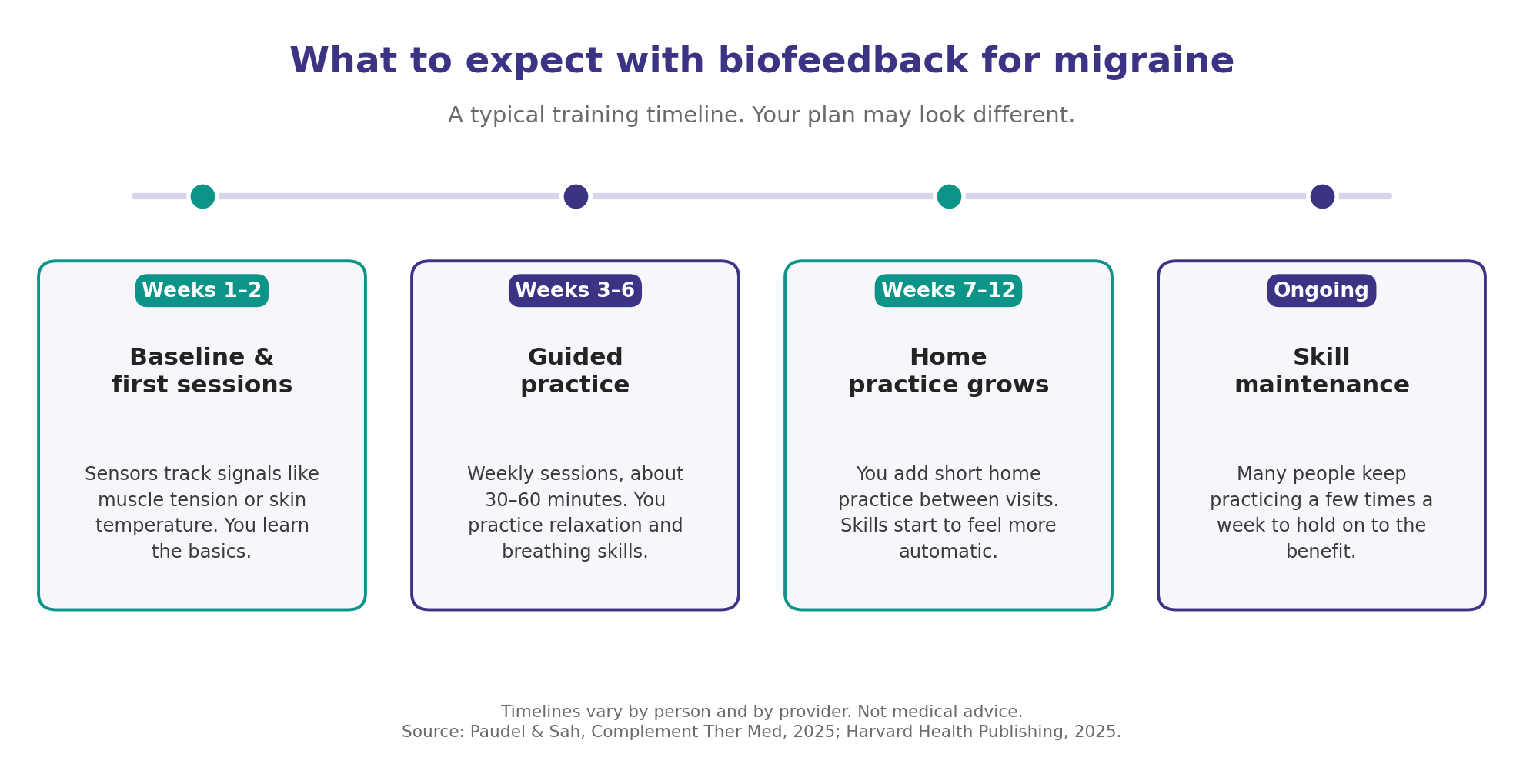
Sessions often run weekly. Each one lasts about 30 to 60 minutes, over roughly 8 to 12 weeks.¹ After training, many people keep practicing on their own a few times a week. This helps them hold on to the benefit.⁶ Your own timeline may look different, and that is normal.
Who may benefit from biofeedback?
Biofeedback may be worth discussing if you want a non-medication option. It may also help if you want to add behavioral tools to your current plan. It can be useful if you have frequent attacks and want a way to build skills between visits.
Most insurance plans require you to try other preventive options first. This is often needed before certain treatments get approved. Haven does not prescribe opioids or barbiturates for migraine.
How Haven uses biofeedback in migraine care
Haven provides individualized headache care. You can get care through telehealth statewide. Our clinicians bring years of headache experience. They focus on evidence-based care built around what you need.
If your provider recommends biofeedback, Haven can help you understand how it fits your plan. Easy text-based communication also helps you stay connected with your care team between visits.
When should you talk to a specialist?
Reach out to a specialist if migraine attacks get in the way of your daily life. Also reach out if attacks last several days or happen many times a month. The same is true if your medication does not restore normal function within about 2 hours.
Go to the emergency room or call 911 right away if you ever have a sudden, severe headache, or the worst headache of your life. Also seek care right away if you notice stroke-like symptoms, such as sudden weakness, trouble speaking, or vision loss.
Frequently asked questions
How long does biofeedback take to help?
It can take several weeks of regular practice before you notice a change. Results vary from person to person.¹
Is biofeedback a replacement for migraine medicine?
Usually not. It is most often used alongside medication and other parts of a migraine plan.²
Can Haven help me decide if biofeedback is right for me?
Yes. Haven's clinicians can review your headache pattern. They can talk with you about whether biofeedback may fit your plan.
Does biofeedback work for everyone?
No. Research shows a real benefit for many people. But the evidence is mixed, and some people see little change.¹²
What happens during a typical biofeedback session?
A provider attaches sensors to your skin. Then they guide you through relaxation or breathing skills. You watch your body's signals change in real time.⁶
Does Haven accept insurance?
Haven is in-network with most major PPO plans, Medicare, TriCare, Hill Physicians, and Brown & Toland HMO plans. HMO patients are seen on a cash basis.
Start your migraine care
You do not have to figure this out alone. If you are curious about biofeedback for migraine, Haven Headache & Migraine Center can help. We can help you explore whether it fits your care plan.
Haven Headache & Migraine Center
Website: https://www.havenheadache.com/
Phone: (424) 444-7399
Email: hello@havenheadache.com
Book here: Start with a free intro call
Medically reviewed by: Karissa Secora, DMSc, PA-C, AQH, Haven Headache & Migraine Center
Peer reviewed by: Samantha Clem, PA-C, AQH, Haven Headache & Migraine Center
References
- Paudel P, Sah A. Efficacy of biofeedback for migraine: A systematic review and meta-analysis. Complementary Therapies in Medicine. 2025;90:103153. https://www.sciencedirect.com/science/article/pii/S0965229925000287
- Treadwell JR, Tsou AY, Rouse B, et al. Behavioral interventions for migraine prevention: A systematic review and meta-analysis. Headache: The Journal of Head and Face Pain. 2025;65:668-694. https://pmc.ncbi.nlm.nih.gov/articles/PMC11951403/
- American Headache Society. Behavioral treatment for migraine. https://americanheadachesociety.org/resources/primary-care/behavioral-treatment-for-migraine
- Cleveland Clinic. Biofeedback. https://my.clevelandclinic.org/health/treatments/13354-biofeedback
- Centers for Disease Control and Prevention, National Center for Health Statistics. QuickStats: Percentage of Adults Bothered a Lot by Headache or Migraine, National Health Interview Survey, 2021. MMWR. 2023;72:611. https://www.cdc.gov/mmwr/volumes/72/wr/mm7222a6.htm
- Harvard Health Publishing. Could biofeedback help your migraines? 2025. https://www.health.harvard.edu/mind-and-mood/could-biofeedback-help-your-migraines
This article is for general education and is not medical advice. It is not a substitute for care from a qualified health professional. Always talk with your clinician before starting, stopping, or changing any treatment. If you have a sudden, severe headache, the worst headache of your life, or a headache with new symptoms like weakness, trouble speaking, or vision loss, seek emergency care right away.