

Altitude and Migraine: Why Travel Can Trigger Attacks

.jpeg)
Heading into the mountains can set off a migraine attack. Sometimes it triggers a close cousin instead: high-altitude headache. Both are common once you climb above about 2,500 meters, roughly 8,200 feet. The reason isn't complicated — there's less oxygen up there, and your brain notices right away. Plan ahead, though, and you can cut your risk before you ever leave home.
Key takeaways
- A controlled hypoxia study found headache in as many as 8 in 10 healthy volunteers within hours of exposure to oxygen levels similar to 4,500 meters, and about a quarter had migraine-like features.¹
- Migraine history is a major risk factor for high-altitude headache. One research group put the increase at roughly 6-fold.²
- The official headache classification links living above about 1,000 meters to migraine attacks that happen more often and hit harder.³
- Even people with no personal history of migraine can develop migraine-like attacks from low oxygen alone.²
- Simple prep, hydration, a slower climb, the right medicine plan, can cut your risk before you leave home.⁴
What happens to your body at high altitude?
High-altitude air holds less oxygen. Your body and brain both notice the difference. Doctors call this state hypoxia, meaning your tissues aren't getting quite enough oxygen.²
Push past about 2,500 meters, or 8,200 feet, and that oxygen drop gets steep enough to cause trouble for lots of people, migraine or not. One result is high-altitude headache on its own. Another is acute mountain sickness, a broader problem that layers on nausea, poor appetite, fatigue, light sensitivity, dizziness, or trouble sleeping.³
Is it a migraine attack or a high-altitude headache?
They can hit on the same trip and feel nearly identical. A few clues help tell them apart.
The two can overlap, and migraine raises your odds of getting high-altitude headache too. When you can't tell which is which, treat both the same way at first: rest, hydrate, and take your usual pain relief.³
Several things stack the odds against you: a personal history of migraine, low blood oxygen, pushing too hard physically, and drinking less than about 2 liters of fluid a day.¹
Why does low oxygen set off head pain?
The full picture isn't mapped out yet, but a few mechanisms keep showing up in the research. Low oxygen widens blood vessels in the brain. It raises CGRP, a protein tied to migraine pain, along with a related protein called PACAP. And it may set off cortical spreading depression, a brain process linked to migraine aura.¹,⁵
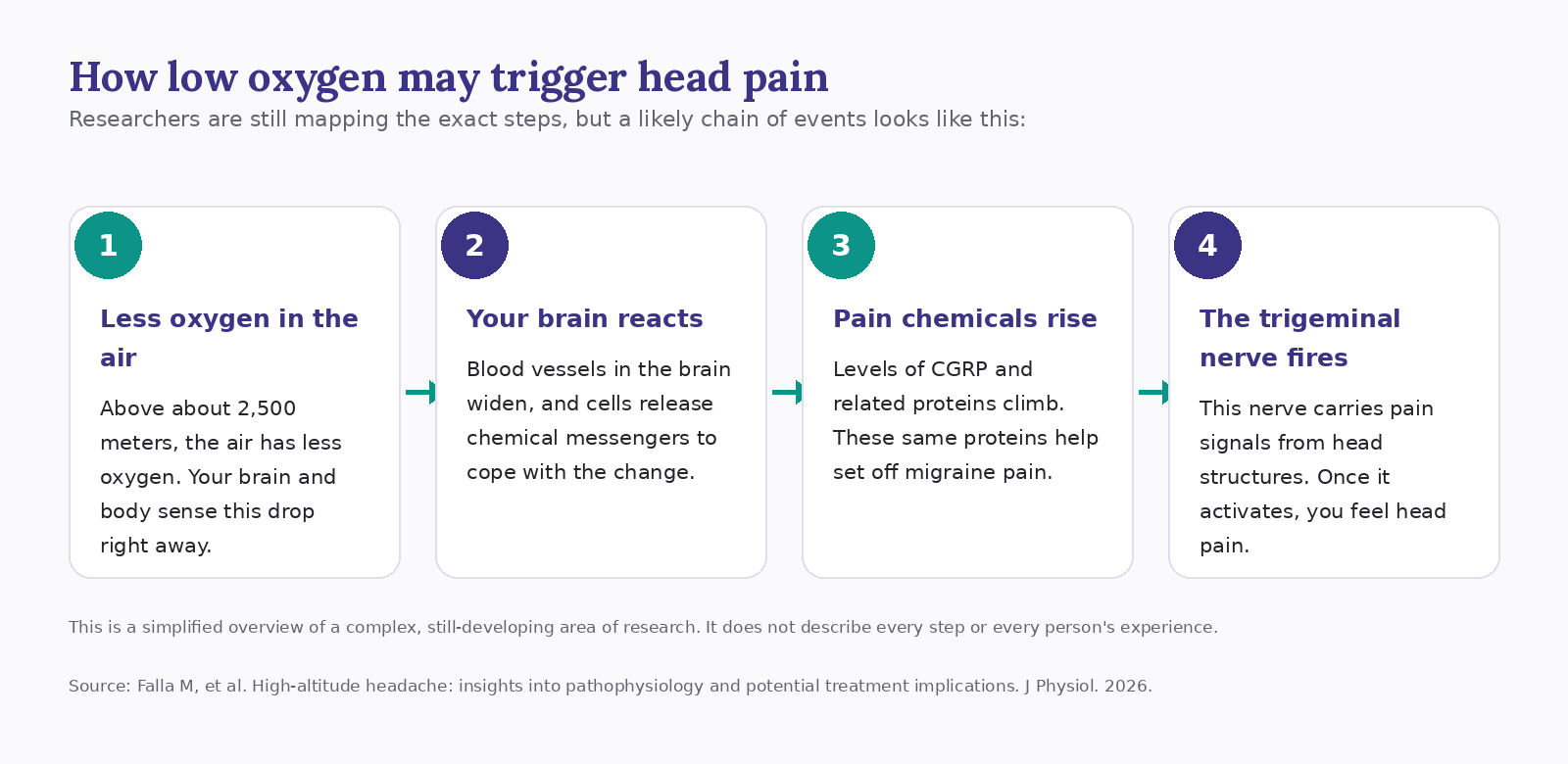
One research team tested this directly. They put volunteers in a lab and dropped the oxygen to levels that mimic high altitude, no mountain, no travel stress, just thinner air. A migraine-like headache followed in about 6 of every 10 participants. A handful even developed aura for the first time in their life.² That's strong evidence the low oxygen itself is doing the work, not the hassle of getting there.²
Does flying trigger migraine too?
Sometimes. The mechanism differs a little, and it happens less often than people assume. Cabins are pressurized, but usually only to the equivalent of 1,800 to 2,400 meters, roughly 6,000 to 8,000 feet. Not sea level. For some people, that gap is enough to feel.⁶
Airplane headache is one-sided, and centered around one eye, and it tends to build during takeoff or landing, easing within about 30 minutes once the plane levels off.⁶ Older estimates put it as high as 1 in 12 travelers. But the largest study on record, which surveyed 50,000 people as they walked off their flights, found headache during travel in fewer than 1 in 100, and true airplane headache, matching the full diagnostic criteria, in only about 1 in 500.⁷ Jet lag and flight dehydration are separate problems, though they can pile on.
How can you protect yourself before a high-altitude trip?
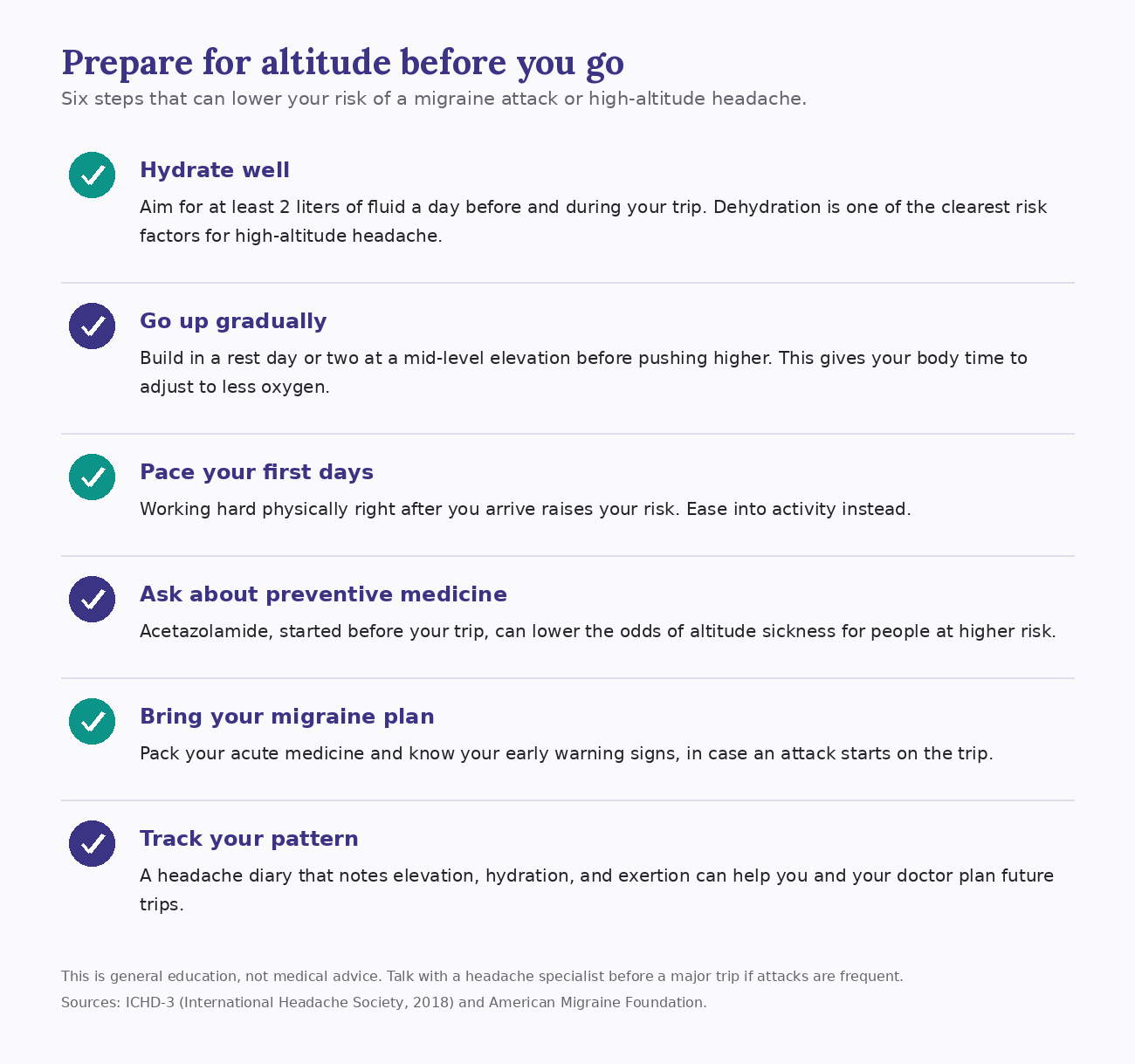
You can't remove all your risk, but you can lower it with some planning:
- Hydrate before and during your trip. Aim for at least 2 liters of fluid a day. Dehydration is one of the clearest risk factors for high-altitude headache.¹
- Go up gradually. Build in a rest day or two at mid-elevation before pushing higher, if your trip allows it. Your body needs time to adjust to thinner air.⁴
- Ease into exertion. Pushing hard physically right when you arrive raises your risk. Give yourself a day or two before you go all in.¹
- Ask your doctor about preventive medicine. Acetazolamide, started before your trip, can lower the odds of altitude sickness if you're at higher risk.⁴
- Pack your migraine plan. Bring your acute medicine and know your own early warning signs, in case an attack starts on the trip.
- Track your pattern. A headache diary that notes elevation, hydration, and exertion can help you and your doctor plan future trips.
If your attacks are frequent, or altitude has burned you before, talk with a headache specialist before a big trip. They can help you weigh preventive medicine against your own health history.
When does a headache at altitude need urgent care?
Most high-altitude headaches respond to rest, fluids, and simple pain relief, and they fade fast once you descend.³ Get help right away, though, if a headache at altitude shows up with confusion, trouble walking or keeping your balance, or severe shortness of breath at rest, or if the pain just keeps building despite rest and descent. Those signs can point to a rare but serious complication of altitude illness, and it needs care fast.
You can still enjoy the mountains
A history of migraine doesn't have to keep you off the trail or grounded. Altitude is a real trigger, the research backs that up, but it's also one of the more predictable ones. With the right prep, plenty of people get to elevation safely and enjoy it. If altitude keeps tripping you up, a Haven headache specialist can build a travel plan with you, preventive medicine included, for wherever you're headed next.
Frequently asked questions
Can altitude really trigger a migraine attack?
It really can. Studies show low oxygen at altitude triggers migraine-like attacks even in people with no personal history of migraine, and if you already have migraine, you're more likely to get a headache above about 2,500 meters.¹,²
How is a high-altitude headache different from a migraine attack?
High-altitude headache shows up within 24 hours of climbing above 2,500 meters and usually eases within 24 hours of coming back down. A migraine attack doesn't follow that clock. It can happen with or without a trip, and descending alone might not fully resolve it.³
Does flying cause the same kind of headache as mountain travel?
Not quite. Flying triggers a related but distinct headache tied to cabin pressure changes during takeoff and landing. And it's rarer than older estimates suggested: the largest study on record found it in only about 1 in 500 travelers.⁶,⁷
What can I do to prevent a migraine attack at altitude?
Stay well hydrated, climb gradually, pace your activity for the first day or two, and ask your doctor whether preventive medicine like acetazolamide makes sense for your trip.⁴
Is medication safe to take before a high-altitude trip?
Several options have evidence behind them for altitude headache, including acetazolamide, aspirin, and ibuprofen. Talk with your clinician about what fits your health history before you go.⁴
When should I worry about a headache at altitude?
Seek care right away if your headache comes with confusion, trouble walking, severe shortness of breath at rest, or symptoms that keep getting worse despite rest and descent.
Medically reviewed by: Karissa Secora, DMSc, PA-C, AQH, Haven Headache & Migraine Center and peer-reviewed by Alicia Chang, MSN, APRN, FNP-BC, FNP-C, CEN, PHN
References
- Falla M, Frank F, Strapazzon G, Lawley J. High-altitude headache: Insights into pathophysiology and potential treatment implications. The Journal of Physiology. 2026. https://doi.org/10.1113/JP289704
- Frank F, Kaltseis K, Filippi V, Broessner G. Hypoxia-related mechanisms inducing acute mountain sickness and migraine. Frontiers in Physiology. 2022;13:994469. https://pmc.ncbi.nlm.nih.gov/articles/PMC9485719/
- International Headache Society. 10.1.1 High-altitude headache. The International Classification of Headache Disorders, 3rd edition (ICHD-3). https://ichd-3.org/10-headache-attributed-to-disorder-of-homoeostasis/10-1-headache-attributed-to-hypoxia-andor-hypercapnia/10-1-1-high-altitude-headache/
- American Migraine Foundation. Altitude, Acute Mountain Sickness and Headache. https://americanmigrainefoundation.org/resource-library/altitude-acute-mountain-sickness-and-headache/
- Al-Karagholi MA, Arngrim N, Ashina M. Migraine headache and aura induced by hypoxia. The Journal of Physiology. 2024;602(21):5515-5522. https://doi.org/10.1113/JP284553
- International Headache Society. 10.1.2 Headache attributed to aeroplane travel. The International Classification of Headache Disorders, 3rd edition (ICHD-3). https://ichd-3.org/10-headache-attributed-to-disorder-of-homoeostasis/10-1-headache-attributed-to-hypoxia-andor-hypercapnia/10-1-2-headache-attributed-to-aeroplane-travel/
- Konrad F, Moritz A, Moritz M, Keunecke JG, Tischler F, Prottengeier J. The epidemiology of airplane headache: A cross-sectional study on point prevalence and characteristics in 50,000 travelers. Cephalalgia. 2022;42(10):1050-1057. https://pmc.ncbi.nlm.nih.gov/articles/PMC9442279/
This article is for general education and is not medical advice. It is not a substitute for care from a qualified health professional. Always talk with your clinician before starting, stopping, or changing any treatment. If you have a sudden, severe headache, the worst headache of your life, or a headache with new symptoms like weakness, trouble speaking, or vision loss, seek emergency care right away.